KYIV — March 17, 2026 : Ukrainian-Estonian defense startup Deftak has introduced a new family of AI-guided drone munitions designed for precision strike roles, presenting the system publicly during the Arsenal of Talents defense technology exhibition in Kyiv. Company representatives disclosed technical and development details to the Ukrainian defense outlet Militarnyi, outlining the system’s architecture, testing progress, and planned deployment pathway.
System Design and Guidance Technology
The newly presented munition is designed as a guided payload for unmanned aerial vehicles (UAVs), differing from conventional unguided bombs or projectiles that follow fixed ballistic trajectories after release. Deftak’s system incorporates an active guidance mechanism that enables continuous trajectory correction during flight.
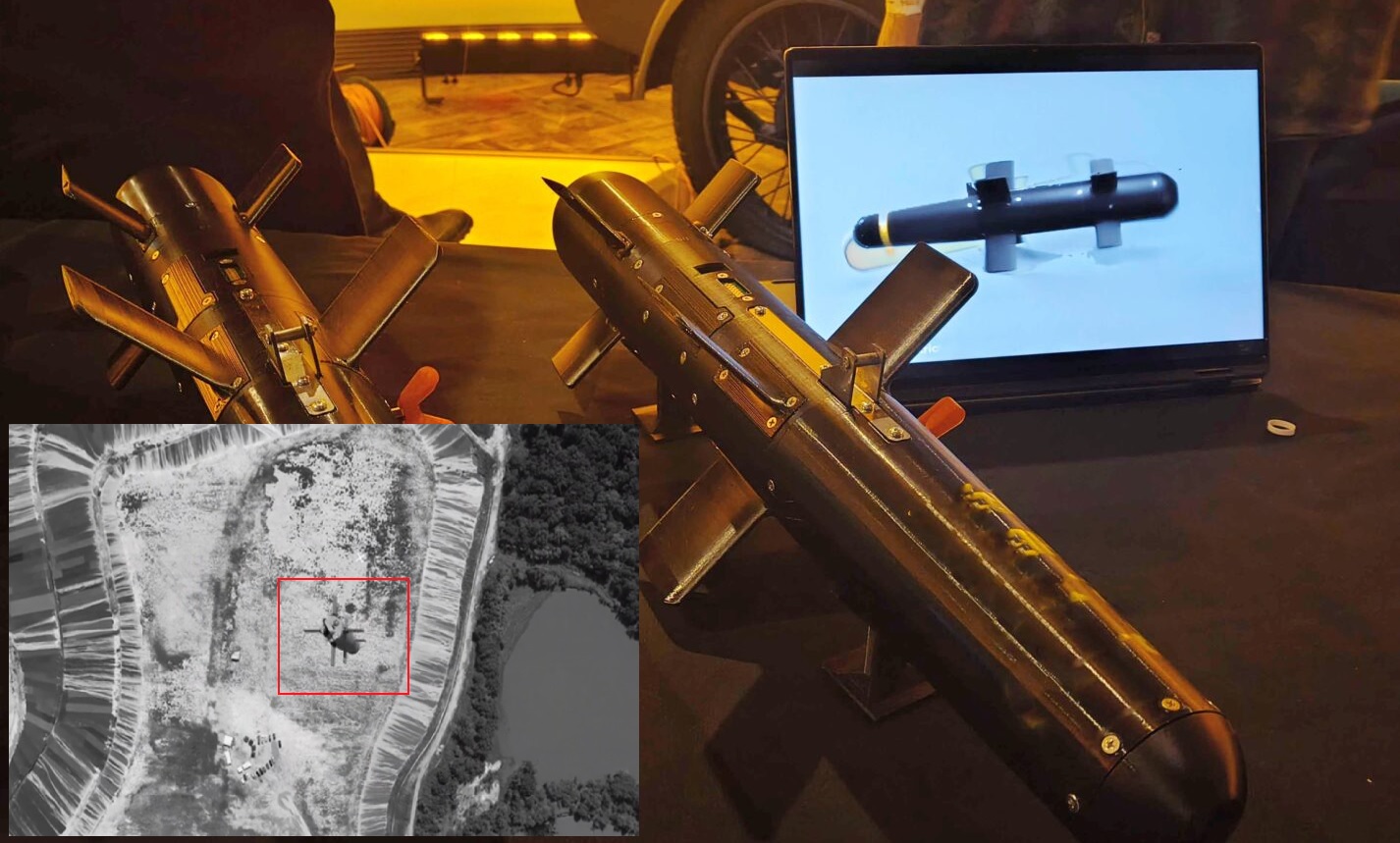
The munition is built around three primary onboard components: processing electronics, an optical targeting camera, and a high-explosive warhead. These elements are supported by proprietary software packages responsible for flight control and machine vision processing.
Using computer vision algorithms, the munition can identify, track, and navigate toward a designated target point autonomously. This approach allows the system to function without reliance on satellite-based navigation such as GPS. As a result, the munition is capable of maintaining targeting accuracy in environments affected by electronic warfare (EW), including GPS jamming.
According to the developers, the optical tracking system enables terminal-phase autonomy, meaning the munition does not require continuous external communication links once it has locked onto a target.
Testing and Operational Performance
Deftak confirmed that the guided munition has already undergone combat testing on multirotor drone platforms. During these trials, the system demonstrated the ability to operate effectively from higher-altitude release points while maintaining precision targeting capability.
The company stated that the munition achieved consistent performance in GPS-denied conditions, validating its design focus on resilience against electronic interference. However, no specific data regarding range, circular error probable (CEP), or warhead weight has been publicly disclosed.
Photographs released from the exhibition show a compact munition design featuring a visible forward-facing camera module, control surfaces for in-flight maneuvering, and an integrated warhead section.
Platform Integration and Development Roadmap
While initial deployment has focused on multirotor UAVs, Deftak is actively working to expand compatibility with additional aerial platforms. Integration efforts are currently underway to adapt the munition for use with fixed-wing unmanned systems, which would extend operational range and deployment flexibility.
In parallel, the company is developing a laser-guided variant of the munition. This version is intended to engage targets designated by external laser sources, including ground teams, forward observers, or other drones equipped with laser designators. The addition of laser guidance is expected to provide an alternative targeting method for coordinated operations.
The munition’s modular design is intended to support adaptation across different drone types and mission profiles, particularly for short- to medium-range strike roles.
Procurement and Industrial Plans
Deftak is in the process of preparing formal supply agreements with the Ministry of Defense of Ukraine, alongside completing the required codification procedures for official military adoption. Codification is a necessary step for integration into the Armed Forces’ inventory and procurement system.
The company indicated that serial production is expected to begin following the completion of government testing and approval processes.
Investment and Cost Structure
Development of the guided munition system has been supported by external funding. In 2025, Deftak secured approximately €600,000 investment from Darkstar, a European defense-focused investment fund.
According to the investor, the system’s primary advantage lies in its cost efficiency. The munition is estimated to be up to ten times less expensive than traditional guided weapon systems while delivering comparable precision performance. This cost profile is intended to enable scalable production and widespread deployment.
Deftak’s engineering team includes specialists with prior experience at major technology companies, including Google, Facebook, and EPAM. The company plans to use the available funding to expand manufacturing capacity and support large-scale supply to Ukrainian defense forces.
Operational Context
The development of Deftak’s guided drone munitions is part of a broader effort within Ukraine’s defense sector to produce domestically developed, cost-effective precision strike capabilities. The system is positioned for tactical UAV operations in contested environments where electronic warfare is prevalent.
Following completion of trials and formal adoption procedures, the munition is expected to enter service as a low-cost precision strike option integrated with existing and future Ukrainian drone platforms.
——— End of Article ———