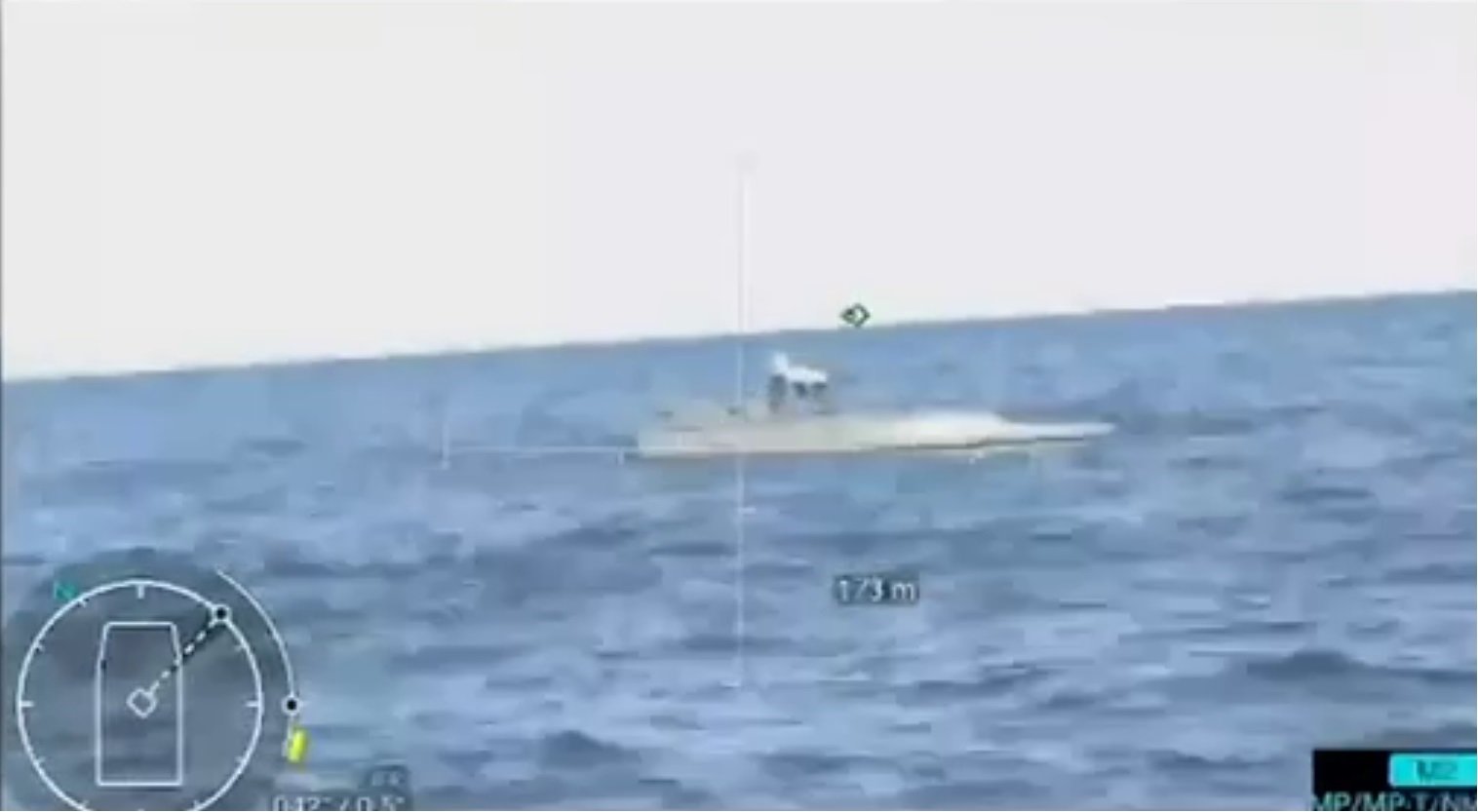
Black Sea — The Ukrainian Navy said on Saturday that one of its uncrewed surface vessels (USVs) destroyed a Russian uncrewed vessel in the Black Sea, describing the incident as the first naval battle in history between unmanned boats.
According to the Ukrainian Navy, units of the Main Intelligence Directorate (GUR/HUR) detected the Russian vessel at an undisclosed location. A Ukrainian Sargan 3000 USV equipped with a remotely operated Kongsberg Protector 12.7 mm weapon station was then used to engage the target.
The Navy released an 81-second video showing the encounter. The Sargan 3000’s onboard camera shows it acquiring and firing on the Russian USV. Around the 30-second mark, the footage switches to an aerial view from a nearby surveillance platform, although it is unclear whether that platform was crewed or unmanned. The Ukrainian vessel continues firing until parts of the Russian boat break away and it sinks.
Ukraine's Navy says a Sargan unmanned surface vessel destroyed a Russian unmanned boat with machine-gun fire in the Black Sea, the first-ever battle between unmanned surface vessels. Ukrainian Navy personnel operated in coordination with HUR. #Ukraine pic.twitter.com/Avg4ecz8m6
— NOELREPORTS 🇪🇺 🇺🇦 (@NOELreports) September 12, 2026
The Ukrainian Navy did not identify the Russian vessel in its initial statement. Some defense observers have identified it as an improved Orcan-type USV, also known as Zefir or Zephyr in some Russian sources. The identification and the Ukrainian claim have not been independently verified. The exact date and location were also not disclosed, although some reporting places the encounter in the northwestern Black Sea between Odesa and Crimea.
Sargan 3000
The Sargan 3000, meaning “needlefish” in Ukrainian, was introduced by Ukrainian President Volodymyr Zelensky in April 2026 as a multi-purpose platform that had undergone testing and entered service with the Ukrainian Navy. Some sources also refer to it as SeaWolf.
The vessel is associated with Nordex and uses Kongsberg’s Protector remote weapon station. It has a low-profile hull designed to reduce radar signature and uses waterjet propulsion, with available descriptions indicating a diesel or hybrid engine.
Reported specifications give it a length of 6.9 meters, width of 2.2 meters, an operational radius of up to 1,600 km, a payload capacity of 450 kg, and a speed of 40–55 knots.
The Sargan 3000 can connect to Ukraine’s Delta situational awareness system for real-time video, telemetry and targeting data. It is also described as having redundant satellite communications, autonomous inertial and optical navigation for GPS-jammed environments, and electronic countermeasures.
Its modular payloads can include machine guns, rockets, FPV drones, electronic warfare systems and mine-laying equipment.
Previous Combat Use
The latest engagement follows the Sargan 3000’s previously reported combat use. In July 2026, the Ukrainian Navy said a Sargan 3000 sank the Russian FSB border guard ship Izumrud near Novorossiysk, with some reports placing the incident near Gelendzhik.
Ukraine said there were dead and wounded among the ship’s crew and noted that Izumrud had participated in the November 25, 2018 Kerch Strait confrontation involving Ukrainian Navy vessels. It remains unclear from public statements whether the Sargan 3000 was used as a kamikaze vessel or weapons platform in that operation.
The latest incident demonstrates the expanding role of armed USVs in the Black Sea. Ukraine has extensively used maritime drones against Russian naval assets and facilities, while Russia has also developed and deployed its own USVs.
If confirmed, the engagement would represent a new use of maritime drones, with one armed uncrewed vessel being used to locate and destroy another. Both sides continue to develop USVs for attack, reconnaissance, patrol, electronic warfare and other missions.
——— End of Article ———