KYIV, — April 7, 2026 : Ukraine’s First Separate Medical Battalion conducted six successful casualty evacuation missions within a 24-hour period, using unmanned ground vehicles (UGVs) to extract wounded personnel from frontline positions under sustained threat from Russian first-person-view (FPV) drones, according to a statement reported by Ukrainian defense outlet Oboronka.
The operations took place between April 6 and April 7, following evacuation requests that began arriving on April 5. Two of the wounded soldiers had remained at forward positions since April 5, while additional cases were reported on April 6. All six evacuation sorties were completed within a single day despite continued drone surveillance and attack risks along key routes.
Robotic Systems Used for High-Risk Evacuation
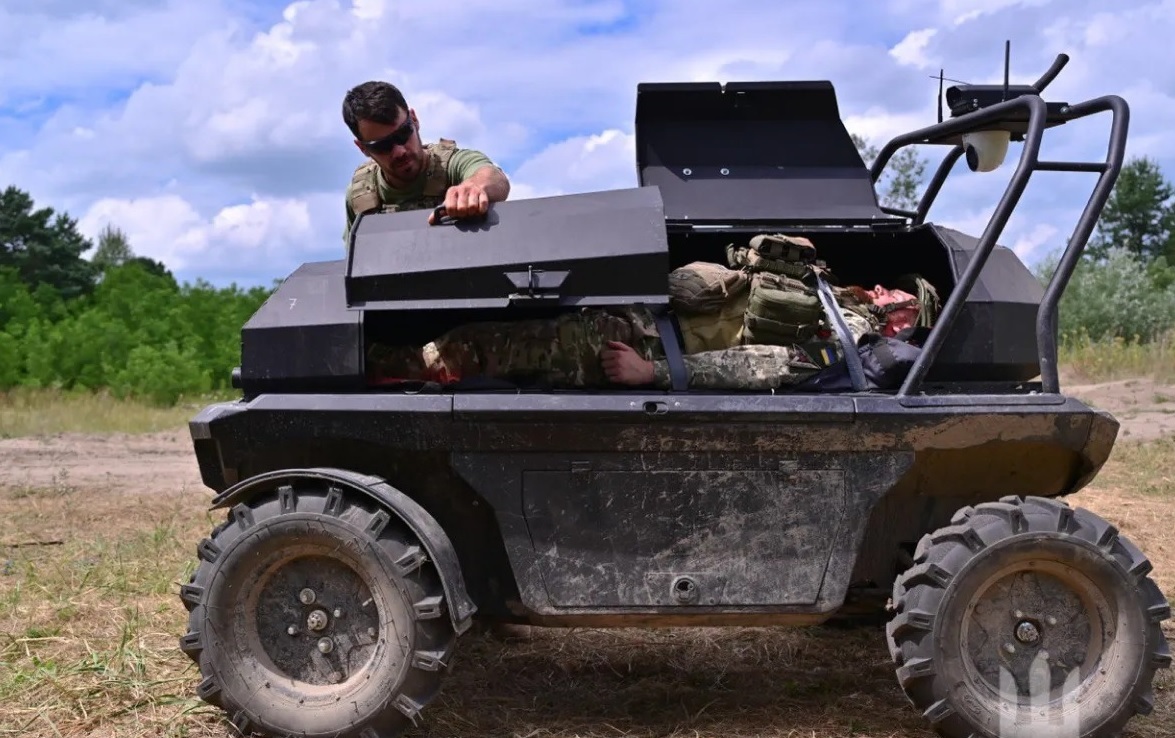
The battalion deployed two armored unmanned ground platforms identified as MAUL systems, designed specifically for casualty evacuation in contested environments. The vehicles are built on quadricycle chassis with full drive configurations and internal combustion engines, allowing them to operate across damaged roads, cratered terrain, and debris-strewn areas near the line of contact.
Across the six missions, the two robotic systems covered a combined distance of approximately 300 kilometers (186 miles). Each sortie involved navigating from rear positions to frontline locations, retrieving wounded personnel, and returning to designated transfer points. Every mission was completed successfully.
The MAUL platforms are equipped with armored steel capsules intended to protect casualties from shrapnel and drone-delivered explosives. The systems were operated by two parallel teams of remote operators, with each mission lasting between two and two-and-a-half hours.
Casualties and Medical Transfer Chain
The evacuated personnel sustained a range of injuries, including shrapnel wounds to limbs caused by FPV drone strikes. One soldier suffered a traumatic amputation of a foot due to a mine explosion and experienced significant blood loss prior to evacuation.
After extraction, the wounded were transferred at designated handover points to conventional medical evacuation crews. These teams transported the patients to surgical units within the First Separate Medical Battalion for further treatment.
Throughout the operations, the battalion maintained continuous remote monitoring of the wounded personnel’s condition. Coordination with adjacent military units was required to secure movement corridors and ensure timing aligned with tactical conditions on the ground.
Operational Constraints and Planning
According to the battalion, the missions required detailed route planning and constant communication between operators and frontline units. The unit described the operational cycle as involving “concentration, constant interaction with adjacent units, careful route planning, and constant remote monitoring,” while also noting the need to operate under persistent FPV drone threats.
Russian FPV drones have increasingly targeted both static defensive positions and moving vehicles, including ambulances and armored transports. This has reduced the viability of traditional casualty evacuation methods near active combat zones.
Ground robotic complexes (NRK systems) in Ukrainian terminology have been introduced to mitigate these risks. By removing onboard personnel, these systems allow evacuation operations to continue without exposing drivers and medics to direct attack.
Technical and Electronic Warfare Challenges
Despite their advantages, UGV operations face technical constraints. Control systems relying on analogue radio links remain vulnerable to electronic warfare (EW) jamming. Additionally, engine heat signatures can make the vehicles detectable by thermal imaging systems.
To address these challenges, operators employ multi-node control networks to maintain signal continuity and conduct pre-mission reconnaissance to identify gaps in enemy surveillance coverage. Route selection is adjusted to minimize exposure to known drone flight paths and observation zones.
Previous Robotic Evacuation Operations
The First Separate Medical Battalion has previously conducted similar missions using robotic systems. In an earlier operation in the Kostiantynivka area, the unit worked with the Libertas Battalion over two days to evacuate a critically wounded soldier under repeated FPV drone attacks. That mission resulted in the loss of one robotic unit and the destruction of an armored vehicle but was ultimately completed.
In another instance, the battalion used a UGV to evacuate a soldier suspected of suffering a stroke at a forward position, demonstrating the systems’ application beyond combat-related trauma.
During a separate operation referred to as “Skittles,” the battalion evacuated two severely wounded soldiers in consecutive missions. In the second extraction, the robotic platform sustained a direct hit from a drone-dropped explosive, but the armored capsule prevented further injury to the casualty.
Expanding Role of Unmanned Systems in Battlefield Medicine
The use of UGVs reflects a broader shift in Ukrainian military medical practices as drone warfare alters conditions along the front line. Traditional evacuation timelines, including the “golden hour” standard for trauma care, have been increasingly difficult to maintain due to the risk posed by aerial threats.
Unmanned systems are now being integrated not only for casualty evacuation but also for logistics support, including the delivery of ammunition, medical supplies, and equipment to forward units.
Ukraine has continued to expand the deployment and production of ground robotic systems for these roles. Ukrainian President Volodymyr Zelensky has previously awarded state honors to members of the First Separate Medical Battalion, recognizing their use of robotic platforms in high-risk evacuation missions and supporting broader efforts to scale such technologies across the armed forces.
——— End of Article ———