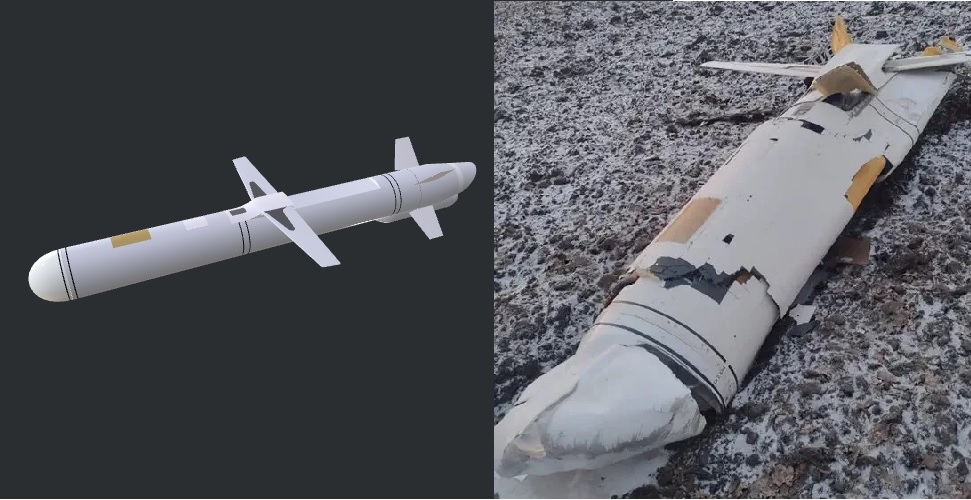
Kyiv, March 6, 2026 : The Defence Intelligence of Ukraine (GUR) has declassified detailed technical information about a newly identified Russian long-range air-launched cruise missile designated “Izdeliye 30” (Product 30). The disclosure, published on March 2, 2026 through Ukraine’s War & Sanctions portal, includes an interactive 3D model, photographs of internal components recovered from wreckage, and data outlining the production chain involving approximately 20 enterprises linked to the missile’s manufacturing program.
According to the Ukrainian intelligence briefing, Russian forces first employed the missile operationally against Ukraine in late 2025, marking the introduction of a previously undisclosed air-launched precision weapon within Russia’s aviation strike arsenal.
Missile Development and Design Origin
The Izdeliye 30 cruise missile was developed by the OKB Zvezda design bureau, which operates within Russia’s Tactical Missiles Corporation (KTRV). The bureau previously functioned as the Zvezda-Strela research and production centre.
Ukrainian intelligence states that the missile’s design architecture is derived from the Kh-35U anti-ship missile, which is deployed within the Bal coastal defence missile system. The new weapon reportedly incorporates enlarged dimensions and modified internal structures while retaining certain subsystems from earlier Russian missile programs.
Several mechanical and pneumatic elements are unified with existing Russian munitions. For example, the missile contains a pneumatic system pyrovalve identical to the component used in the Kh-35U, indicating reuse of established hardware across multiple weapons platforms.
Technical Characteristics
Based on analysis of recovered debris and documented components, the missile is described as a subsonic long-range cruise missile designed for air launch.
The known specifications released by Ukrainian intelligence include:
| Specification | Detail |
|---|---|
| Hull Diameter | 580 mm |
| Wingspan | Approximately 3 metres |
| Warhead Weight | 800 kg |
| Operational Range | At least 1,500 km |
| Cruising Speed | About 720 km/h |
| Flight Altitude | 200–2,000 metres |
| Engine | Izdeliye 64R compact turbojet |
| Engine Developer | ODK-Saturn |
The missile carries a warhead weighing approximately 800 kilograms, which is significantly heavier than the payload of several existing Russian air-launched cruise missiles. Ukrainian analysts state that the increased payload allows the weapon to strike large infrastructure targets and hardened facilities.
The propulsion system is a compact turbojet engine designated “Izdeliye 64R,” developed by the Russian engine manufacturer ODK-Saturn.
Structural Configuration
The missile features a folding wing mounted on the upper portion of the fuselage with an estimated wingspan of roughly three metres. This configuration differs from several earlier Russian cruise missiles.
When compared to the Kh-101 long-range cruise missile, the Izdeliye 30 shows several structural distinctions:
-
Wing placement: mounted above the fuselage rather than below
-
Tail configuration: four control surfaces on the empennage rather than three
-
Structural layout: enlarged fuselage relative to the Kh-35U base design
These modifications reflect adjustments intended to accommodate the larger payload and extended operational range.
Launch Platforms and Aviation Integration
Initial reporting by RIA Novosti in October 2023 described the Izdeliye 30 as a cruise missile intended primarily for tactical aircraft. However, the GUR assessment indicates broader compatibility across multiple Russian aviation platforms.
The missile can reportedly be deployed from:
-
Sukhoi Su-34 strike aircraft using external pylons
-
Sukhoi Su-57 fifth-generation fighter, carried within internal weapons bays
The weapon also uses an aviation ejection device similar to the AKU-5M launcher, which is already used with several Russian cruise missiles, including the Kh-101, Kh-55, and Kh-555.
Because of this compatibility, Ukrainian intelligence assesses that the missile could potentially be integrated into Russia’s strategic bomber fleet, including aircraft such as the Tu-95MS and Tu-160, without requiring major modifications to existing launch infrastructure.
Navigation System
The missile employs a hybrid satellite navigation system combining signals from both GPS and GLONASS constellations.
According to the GUR analysis, the navigation architecture integrates equipment from multiple Russian manufacturers to increase resistance to electronic warfare interference.
Key components include:
-
Kometa-M12 jam-resistant satellite receiver with a digital antenna array produced by VNIIR-Progress
-
NAVIS NR9-based receiving and computing unit developed by KB Navis
-
Integration interface module manufactured by ANPP Temp-Avia, a company known for producing flight control systems for guided aerial bombs
Electronics and Foreign-Sourced Components
Although the missile’s electronic systems are assembled domestically in Russia, Ukrainian intelligence reports that several microelectronic elements originate from foreign manufacturers.
The BUBS-30 electronic control unit, responsible for warhead control functions, incorporates a 32-bit ARM-based 1986VE1AT microcontroller produced by the Russian company PKK Milandr.
However, investigators documented 24 individual electronic components sourced from foreign suppliers, including manufacturers located in:
- United States
- Switzerland
- China
- Netherlands
Additional hardware includes an 8-bit register manufactured in Belarus.
These foreign components are primarily used within the missile’s navigation and control systems, including memory modules, GNSS receivers, and communications transceivers.
Documentation of Production Chain
The Ukrainian War & Sanctions portal release includes information identifying approximately twenty companies involved in the missile’s supply chain. The disclosure is part of an ongoing Ukrainian effort to document the industrial structure behind Russian weapons production and to trace the origin of imported electronic components found in recovered munitions.
The published material includes photographs of internal assemblies, subsystem descriptions, and a detailed digital reconstruction of the missile’s structure created from wreckage recovered following strikes inside Ukraine.
Distinction from the Su-57 Engine Program
Ukrainian officials also noted that the Izdeliye 30 cruise missile designation is unrelated to the “Izdeliye 30” afterburning turbofan engine under development for the Su-57 fighter aircraft. Despite sharing the same project name, the two programs represent separate developments within Russia’s aerospace industry.
Operational Context
The introduction of the Izdeliye 30 cruise missile indicates continued development of long-range air-launched precision weapons for Russian aviation forces.
With a range exceeding 1,500 kilometres, the missile allows launch aircraft to remain well outside Ukrainian air defence coverage while still striking targets across Ukrainian territory. The large warhead and extended range suggest the weapon is intended for attacks on major infrastructure and military facilities.
The system also reflects Russia’s effort to expand its inventory of cruise missiles during the ongoing conflict, particularly as existing stocks of earlier systems such as the Kh-101 have been used extensively since the start of large-scale hostilities.
——— End of Article ———