YEYSK, Russia / KYIV — May 15, 2026 : Ukraine’s Unmanned Systems Forces (USF) carried out a coordinated overnight drone operation on May 15 targeting Russian military infrastructure across multiple regions, including a strike on the Yeysk military airbase in Russia’s Krasnodar Krai that destroyed a rare Beriev Be-200 amphibious aircraft and damaged a Ka-27 naval helicopter.
According to Robert “Madyar” Brovdi, commander of the Ukrainian Unmanned Systems Forces, the attack on Yeysk was conducted by operators from the 1st Separate Center of the USF in coordination with the Deep Strike Centre of the Unmanned Systems Forces. The operation formed part of a wider campaign involving 55 fire strikes against 23 Russian military targets.
Strike on Yeysk Airbase
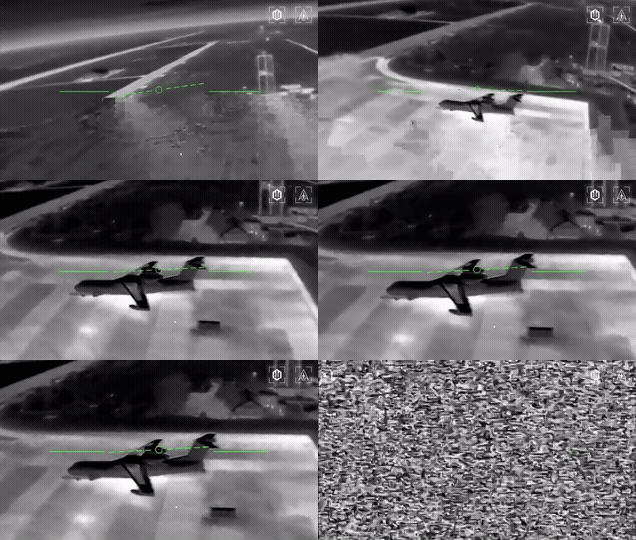
Footage released following the attack showed the complete destruction of the Be-200 aircraft on the airfield. Satellite imagery published on May 15 later confirmed the loss of the aircraft, identified as a Be-200PS amphibious platform.
The Be-200 “Altair” is a jet-powered amphibious aircraft capable of operating from both conventional runways and water surfaces. Russia has historically struggled to produce the aircraft in large numbers, making it a relatively rare asset within Russian aviation.
Powered by two D-436TP turbofan engines, the aircraft has a maximum speed of approximately 720 kilometers per hour and a range of up to 3,850 kilometers. In transport configuration, it can carry up to 72 passengers, while in firefighting missions it is capable of dropping up to 12 tons of water.
Although commonly associated with firefighting operations, the aircraft is also used for maritime patrol, cargo transport and search-and-rescue missions. The estimated value of the destroyed aircraft is between $30 million and $40 million.
Ka-27 Helicopter Hit
A Russian Ka-27 helicopter was also struck during the operation. Drone targeting footage released by Ukrainian forces showed the helicopter positioned beneath a netted protective structure apparently intended to reduce vulnerability to drone attacks.
The full extent of the damage to the helicopter remains under assessment. The Ka-27 is a ship-based multirole helicopter primarily designed for anti-submarine warfare, while also performing patrol, transport and search-and-rescue missions. The helicopter is estimated to have a value of approximately $15 million.
Strategic Role of the Airbase
Residents in Yeysk reported hearing multiple explosions shortly after 1:00 a.m. local time and posted images and videos on social media showing fires near the airfield area.
The Yeysk airbase is one of Russia’s key naval aviation facilities and has been used throughout the war to support combat operations against Ukraine. The base hosts the 859th Center for Combat Employment and Retraining of Naval Aviation Flight Personnel of the Russian Navy.
The facility also contains the NITKA ground-based aviation training complex, a specialized system designed to simulate the deck of an aircraft carrier. The installation allows Russian naval aviation pilots to practice carrier-style takeoff and landing procedures without deploying aboard an operational aircraft carrier.
Wider Overnight Operation
Ukrainian officials stated that the overnight operation targeted military and logistics infrastructure across several regions, including occupied Crimea, Donetsk, Zaporizhzhia and Luhansk oblasts, as well as locations in Taganrog and Berdyansk.
Additional reported targets included a Pantsir-S1 air defence system in occupied Crimea, a Tor-M2 air defence system in Luhansk Oblast, a Russian army training center and a dry cargo vessel carrying ammunition in the port of Berdyansk.
The strikes on Yeysk occurred simultaneously with a separate drone attack on the Ryazan Oil Refinery, located southeast of Moscow, reflecting Ukraine’s continued strategy of targeting both front-line military infrastructure and rear-echelon logistics facilities inside Russian-controlled territory.
——— End of Article ———