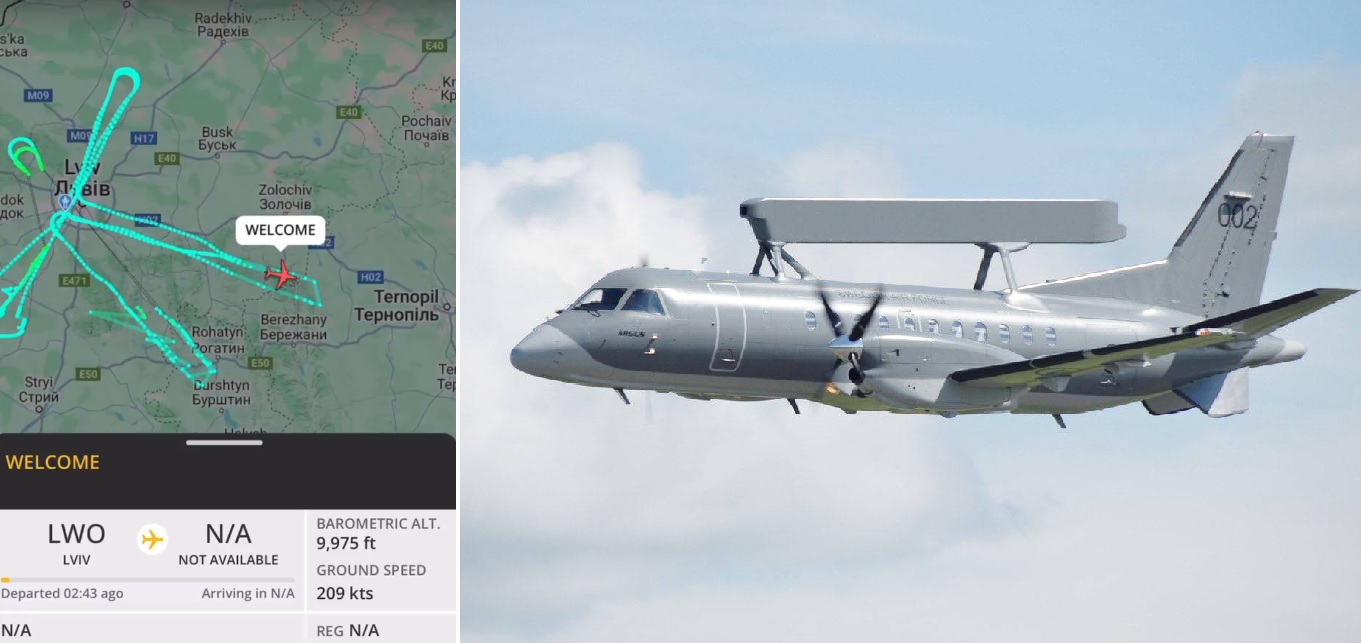
KYIV, — March 21, 2026 : Footage circulating online appears to show a Saab 340 Airborne Early Warning and Control (AEW&C) aircraft operating in Ukrainian airspace, marking the first visual indication that the platform has entered service with the Ukrainian Air Force. The video, first posted on a Russian Telegram channel and later shared across social media on March 20, has not been independently verified, and the exact date and location remain unconfirmed. However, no immediate signs of digital manipulation have been identified.
The aircraft in the footage is seen in level daytime flight and features the distinctive “balance beam” radar fairing mounted atop the fuselage, characteristic of the Saab 340 AEW&C configuration.
Early Indicators of Operational Activity
Prior to the emergence of the footage, there were indications that the aircraft had already begun limited operations. In April 2025, open-source flight-tracking platforms recorded an unidentified aircraft using the callsign “WELCOME” conducting flight patterns over the Lviv region in western Ukraine. The same callsign had previously been observed in airspace near Poland and Hungary.
At the time, analysts assessed that the aircraft was likely conducting post-delivery calibration and system checks, although some alternative assessments suggested it could have been an An-26RT platform, noting that transponder data can be manipulated.
Acquisition and Delivery Timeline
The Saab 340 AEW&C aircraft were provided to Ukraine by Sweden, which announced the transfer of two units in May 2024 as part of a military aid package valued at approximately $1.25 billion (SEK 13.3 billion).
The delivery package included training for aircrew and maintenance personnel, as well as the preparation of required ground infrastructure. The integration process was estimated to take around one year. By March 2025, Swedish officials indicated that deliveries were proceeding according to schedule, and in August 2025, Ukrainian officials confirmed that the aircraft had been transferred.
In Swedish service, the aircraft is designated ASC 890 or S 100D Argus. Other operators include Thailand, which operates two ex-Swedish units, and Poland, which has acquired aircraft previously operated by the United Arab Emirates.
Radar System and Technical Capabilities
The core capability of the aircraft is the Saab Erieye PS-890 radar, an active electronically scanned array (AESA) system mounted above the fuselage. Operating at altitudes of approximately 20,000 feet, the radar can detect airborne and surface targets at ranges of up to 280 miles (approximately 450 kilometers).
The system is capable of simultaneously tracking up to 1,000 airborne targets and 500 surface targets. Data is processed onboard by a three-person mission crew, consisting of a mission control officer, a combat control operator, and a surveillance operator.
The Erieye radar provides look-down capability, enabling detection of low-flying targets that may evade ground-based radar due to terrain limitations. This is particularly relevant for identifying Russian cruise missiles and one-way attack drones, including Shahed-136 (Geran-2) systems, which have been used extensively in recent strikes on Ukrainian infrastructure.
Later variants of the Erieye system include synthetic aperture radar (SAR) and ground moving target indication (GMTI) functions for detailed ground mapping and tracking of moving targets. It remains unconfirmed whether Ukraine’s aircraft include these enhanced capabilities.
Integration with Air Defense Network
The Saab 340 AEW&C introduces Ukraine’s first dedicated airborne early warning capability, significantly enhancing situational awareness across both air and surface domains.
Within Ukraine’s layered air defense network, the aircraft can function as an airborne command and control node, detecting, prioritizing, and assigning targets to fighter aircraft and ground-based air defense systems.
The platform is equipped with the NATO-standard Link 16 datalink, which is compatible with F-16 and Mirage 2000 fighter aircraft, as well as Western-supplied air defense systems. However, reports in late 2024 indicated that Link 16 systems were removed or disabled on some F-16s provided to Ukraine due to concerns over potential capture.
Despite this, reports from March 2025 indicated that the timing of the aircraft’s transfer was linked to modifications ensuring operational compatibility with Ukraine’s fighter fleet. Independent reporting in June 2025 suggested that a Saab 340 platform successfully detected a Russian Su-35 at a distance exceeding 200 kilometers near Kursk, enabling a Ukrainian F-16 to be vectored for interception.
Future integration with potential acquisitions such as Saab Gripen fighters could further enhance interoperability within a unified air defense framework.
Operational Considerations and Deployment
As a high-value asset, the Saab 340 AEW&C is expected to be a priority target for Russian forces. This is consistent with Ukraine’s own targeting of Russia’s A-50 Mainstay airborne early warning aircraft.
At the start of the conflict, Russia was estimated to operate nine A-50 aircraft. Since then, two have been confirmed destroyed, one damaged on the ground in Belarus, and another reportedly struck at a maintenance facility in the Novgorod region.
To reduce exposure, Ukraine is likely operating its Saab aircraft from airfields in the western part of the country, frequently relocating them between locations. With only two aircraft available, continuous round-the-clock coverage is not feasible. One aircraft is likely maintained on ground alert status, ready to deploy in response to large-scale missile or drone attacks.
Operational Impact
The introduction of the Saab 340 AEW&C provides Ukraine with a new layer of airborne surveillance and command capability, improving the detection and coordination of responses to aerial threats.
While the extent of its operational use remains limited by fleet size and security considerations, the system is expected to contribute to more efficient use of available air defense and fighter assets. Further operational data will determine the full impact of the platform on Ukraine’s air defense effectiveness.
——— End of Article ———