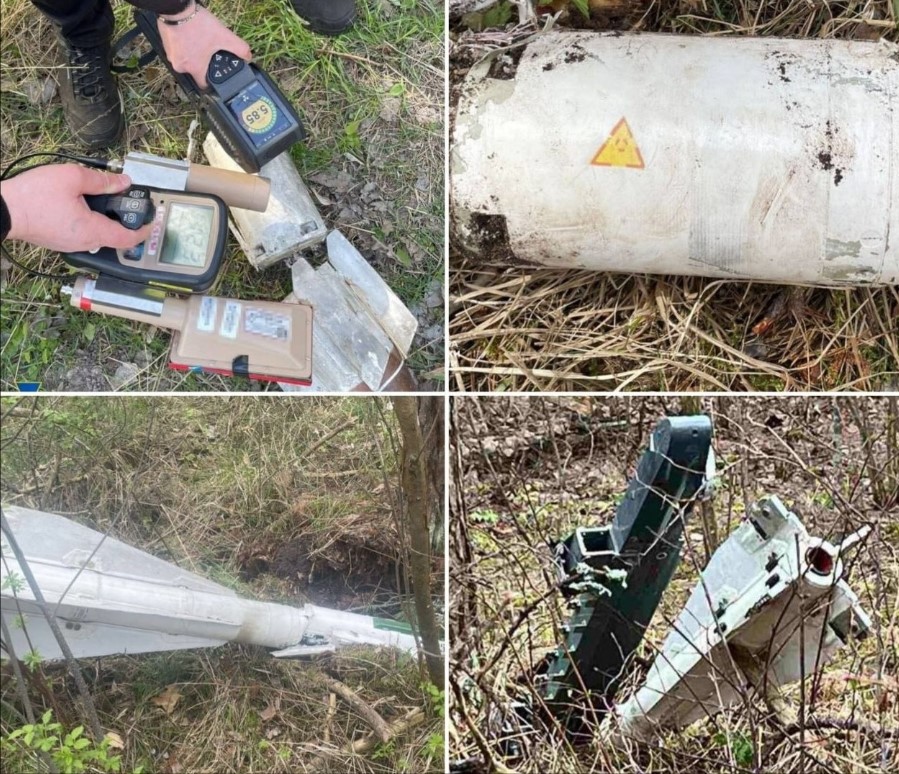
CHERNIHIV OBLAST, Ukraine, — May 20, 2026 : Ukraine’s Security Service (SBU) announced that laboratory testing conducted on missile fragments recovered from a modified Russian strike drone in the Chernihiv region detected depleted uranium components within the warhead assembly.
According to the SBU, the debris was recovered after a Russian aerial attack carried out during the night of April 6–7, 2026, near the village of Kamka in northern Ukraine’s Chernihiv Oblast. Counterintelligence officers and investigators examining the crash site identified parts of an R-60 air-to-air missile mounted on a modified Geran-2 (Shahed-type) unmanned aerial vehicle.
Radiation Detected at Crash Site
During radiation reconnaissance operations at the impact area, Ukrainian specialists recorded gamma radiation levels reaching 12 microsieverts per hour (μSv/h). The SBU stated that the detected level significantly exceeded natural background radiation and could present a health risk to individuals exposed to the debris at close range.
Subsequent laboratory analysis confirmed that striking elements inside the missile warhead contained depleted uranium materials, specifically identifying the presence of Uranium-235 and Uranium-238 isotopes.
The SBU stated that the findings were established through forensic and radiological examinations conducted after the recovery of the wreckage.
Modified R-60M Missile Identified
Military analysts involved in the investigation identified the recovered weapon as an R-60M, a modernized version of the Soviet-designed R-60 short-range infrared-guided air-to-air missile.
According to Ukrainian specialists, older variants of the missile traditionally used tungsten-based internal components, while the recovered R-60M configuration incorporated depleted uranium rods within parts of the warhead assembly.
The SBU stated that Russian forces have increasingly adapted air-to-air missiles for use on unmanned strike platforms during large-scale drone attacks. Ukrainian analysts believe the modification is intended to target Ukrainian fighter aircraft and helicopters attempting to intercept incoming drones.
Emergency Containment Operation
Following the discovery, a joint operation involving the SBU, the State Emergency Service of Ukraine (SESU), and units of the Ukrainian Armed Forces was conducted to secure the area and neutralize potential radiological hazards.
Officials stated that the missile warhead was isolated, rendered safe, and transported to a designated radioactive waste storage facility for controlled containment and storage.
The Chernihiv Oblast Prosecutor’s Office, working under procedural supervision with the SBU, has opened a pre-trial criminal investigation under Article 438 of the Criminal Code of Ukraine, which concerns alleged violations of the laws and customs of war.
Public Safety Advisory
Ukrainian authorities issued a public warning urging civilians not to approach or handle debris from drones, missiles, or other military ordnance discovered after attacks.
According to the SBU, the primary danger associated with depleted uranium arises when damaged or burned components release microscopic radioactive and chemically toxic particles into the surrounding environment.
Residents were instructed to immediately report suspicious debris to emergency services and avoid any direct contact with wreckage until specialist teams complete inspection and decontamination procedures.
The findings were publicly disclosed by the SBU on May 20, 2026. No independent international verification of the laboratory analysis had been publicly reported at the time of the announcement.
——— End of Article ———