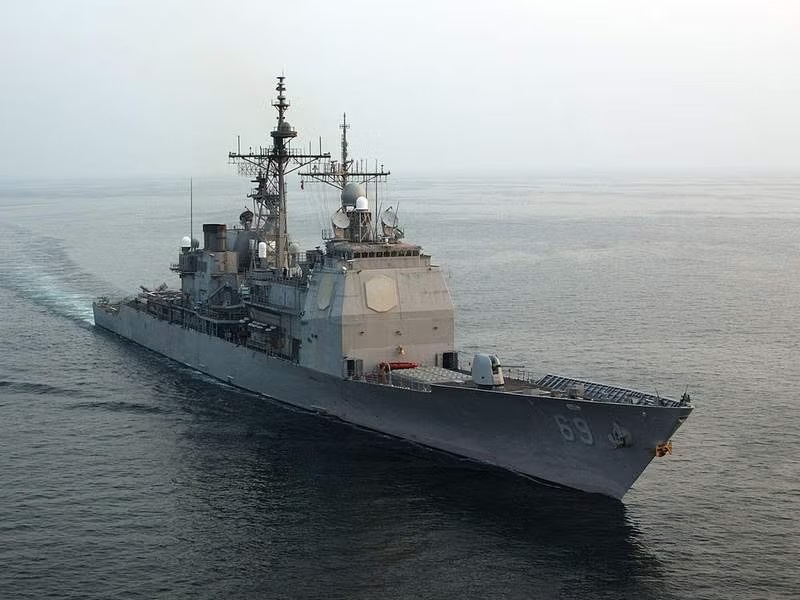
WASHINGTON — The U.S. Navy is moving ahead with the retirement of its remaining Ticonderoga-class guided-missile cruisers, ending the service of the Navy's only cruiser class after more than four decades. Built between 1980 and 1994, the ships have served as a key component of U.S. carrier strike groups, providing long-range air defence and precision strike capabilities.
The Navy originally commissioned 27 Ticonderoga-class cruisers, but 20 have already been retired. The remaining seven ships are scheduled to leave service by 2030, with USS Gettysburg, USS Chosin, and USS Cape St. George receiving service-life extensions through 2029 to support the transition.
The retirement marks a major change in the composition of the U.S. surface fleet, as the Navy shifts toward a force centred on Arleigh Burke-class destroyers while it continues development of future large surface combatants.
Key Role in Carrier Strike Groups
The Ticonderoga-class cruisers have long served as the primary air-defence ships for U.S. carrier strike groups. Each vessel is equipped with 122 Mk 41 Vertical Launch System (VLS) cells, allowing them to carry a large mix of missiles for different missions.
The launch cells can fire Tomahawk land-attack cruise missiles as well as SM-2, SM-3, and SM-6 surface-to-air missiles, enabling the ships to conduct long-range strike missions while also providing layered air and missile defence for the fleet.
With the retirement of the entire class, the Navy will lose more than 1,200 VLS cells from its surface fleet. Their primary replacement, the Arleigh Burke Flight III destroyer, carries 96 Mk 41 VLS cells, resulting in lower missile capacity per ship.
The reduction in missile capacity comes as the Navy continues to support high operational demands. Recent operations, including Red Sea missions against Houthi forces and the opening phase of Operation Epic Fury in early 2026, required the launch of hundreds of Tomahawk missiles, increasing pressure on available missile inventories.
The Navy is also preparing for the future retirement of its Ohio-class guided-missile submarines (SSGNs), each capable of carrying 154 Tomahawk missiles, which will further reduce overall long-range strike capacity.
Aging Fleet and Modernization Challenges
The decision to retire the cruisers follows years of growing maintenance challenges as the ships aged beyond three decades of service.
Many vessels have experienced corrosion, structural fatigue, hull cracks, mechanical wear, and increasing maintenance requirements. Navy officials have also identified aging radar systems approaching obsolescence against modern missile threats.
Another factor has been the ships' relatively low level of automation. Each cruiser typically requires a crew of 300 to 400 sailors, making them more expensive to operate than newer warships with comparable capabilities.
$3.7 Billion Modernization Program Fell Short
The future of the Ticonderoga-class was debated for more than a decade.
In 2010, the Navy proposed retiring several cruisers early, but Congress rejected the plan because of concerns that removing them would reduce air-defence protection for carrier strike groups.
Congress instead directed the Navy to implement the Cruiser Modernization Program, which aimed to extend the service lives of 11 selected cruisers through upgrades to structural components, electronics, and combat systems.
However, the program experienced major delays and cost overruns. According to the Government Accountability Office (GAO), modernization costs reached approximately $3.7 billion, around 200 percent above initial estimates.
The GAO also reported that about $1.84 billion was spent modernizing four cruisers, including USS Vicksburg and USS Cowpens, that were later decommissioned or scrapped before returning to operational deployment.
Former Chief of Naval Operations Admiral Michael Gilday said the aging cruisers were showing significant material deterioration, including structural cracks and increasing maintenance issues, while older radar systems were becoming less suitable against evolving missile threats.
Final Ships and Disposal Plans
As the remaining cruisers leave service, several retired ships are being used in fleet training.
During RIMPAC 2026, the former USS Mobile Bay is scheduled to participate in a SINKEX (sinking exercise), where it will be targeted by friendly forces to evaluate weapons systems and operational tactics.
Other retired cruisers, including the former USS Vella Gulf and USS Antietam, are also expected to be disposed of through similar exercises.
Future Surface Combatants
The retirement of the Ticonderoga class leaves the U.S. Navy without a dedicated cruiser class for the first time in decades.
Earlier plans to replace the cruisers through the CG(X) next-generation cruiser program were cancelled in 2010. The Navy has since shifted its focus to the DDG(X) program, which is intended to develop a future large surface combatant.
However, the program is expected to face development delays and high costs, with the first ships unlikely to enter service until the 2030s.
Until then, Arleigh Burke-class destroyers will continue to perform the Navy's primary air-defence and long-range strike missions. The transition also comes as other navies continue expanding their large surface combatant fleets, including China's Type 055 destroyers, while North Korea has indicated plans to develop heavily armed destroyers later this decade.
Source: militarywatchmagazine
——— End of Article ———