KYIV — April 3, 2026 : Ukraine’s 1st Separate Assault Regiment has begun systematically upgrading its fleet of M1A1 Abrams main battle tanks with additional protection measures designed to counter evolving battlefield threats, particularly first-person view (FPV) drones and shaped-charge munitions.
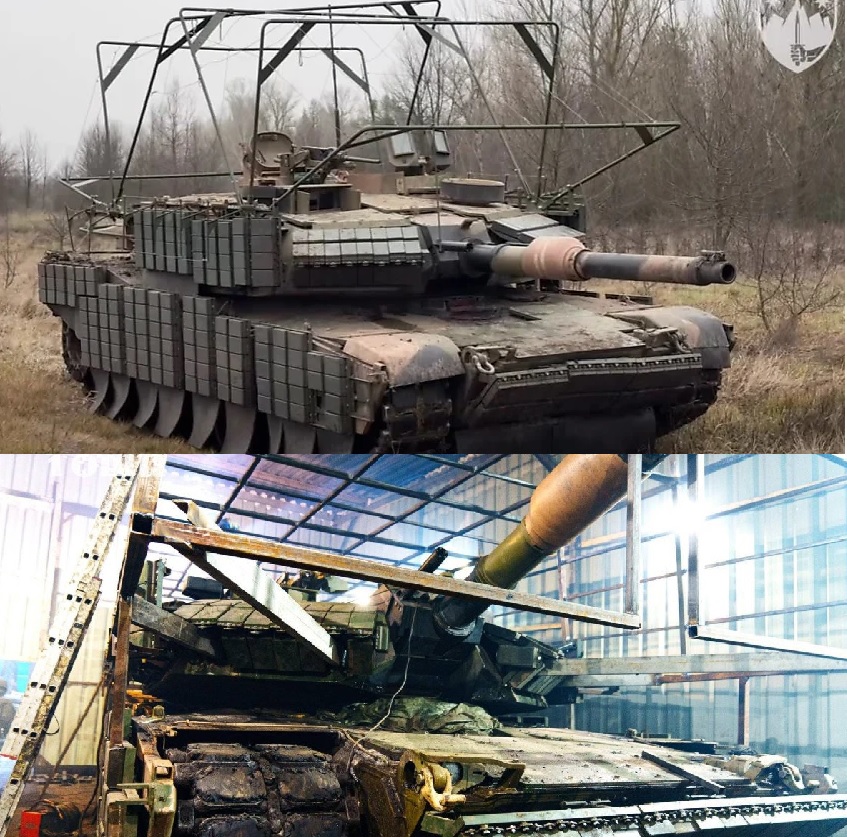
The regiment disclosed on April 1 that it is fitting the tanks with a combination of overhead protective grilles, anti-drone standoff structures, and Kontakt-1 explosive reactive armor (ERA). Footage released from a workshop shows installation work being carried out on both the hull and turret sections of the vehicles, indicating an organized and repeatable modification process rather than isolated field improvisations.
Physical Protection Measures Adapted to Drone Threats
The upgrades focus on mitigating vulnerabilities that have emerged in an operational environment dominated by persistent aerial surveillance and precision drone strikes. FPV drones frequently target exposed areas such as the turret roof and engine deck—zones not originally optimized for overhead protection in the Abrams design.
To address this, Ukrainian engineers have installed overhead grilles and metal standoff frameworks. These structures are designed to alter the attack geometry of incoming drones, forcing premature detonation of their warheads at a distance from the vehicle’s main armor. The spacing effect reduces the penetration capability of shaped-charge munitions before impact with the hull.
In parallel, Kontakt-1 ERA blocks have been mounted across the turret and hull. This Soviet-era system uses explosive-filled elements, identified as 4S20, which detonate outward upon impact. The resulting counter-explosion disrupts the focused jet of high-explosive anti-tank (HEAT) warheads, including those used in anti-tank guided missiles (ATGMs) and infantry-launched systems.
Integration of Mixed-Origin Systems
The application of Kontakt-1 on US-supplied Abrams tanks reflects a mixed-origin approach to survivability enhancements. The M1A1 platform, originally designed for high-intensity direct-fire engagements, relies on composite armor and advanced targeting systems. Export variants delivered to Ukraine are configured without depleted uranium armor and instead use alternative materials such as tungsten-based protection.
The addition of external ERA and anti-drone structures is intended to compensate for both evolving threats and differences in baseline protection levels. Ukrainian units are implementing these upgrades using available systems regardless of origin, indicating a flexible integration strategy at the unit level.
Fleet Growth Enables Standardization
The ability to scale these modifications is linked to the expansion of Ukraine’s Abrams inventory. The United States initially committed 31 M1A1 Abrams tanks in January 2023. This number increased following Australia’s October 17, 2024 decision to transfer 49 M1A1 SA (Situational Awareness) tanks from its retiring fleet.
By early 2026, Ukraine’s total Abrams inventory had reached approximately 80 vehicles from these two sources. The increased fleet size has allowed Ukrainian forces to transition from ad hoc modifications applied to individual tanks toward more standardized configurations implemented across units.
Crew Interface Localization and Training Efficiency
In addition to physical protection measures, some of the Australian-supplied Abrams tanks have been equipped with localized internal control panels. These modifications involve translating and adapting system interfaces from English to Ukrainian.
The localization effort is intended to reduce the cognitive burden on crews transitioning to a foreign platform. By improving usability and comprehension, the changes are expected to shorten training timelines and reduce the likelihood of operational errors during high-pressure combat situations.
Sustainment and Rear-Area Support Infrastructure
Sustaining the Abrams fleet under combat conditions requires an established maintenance and repair framework. Poland’s Wojskowe Zakłady Motoryzacyjne (WZM) facility in Poznań has expanded its capacity to support heavy armored vehicles, including those of US origin.
The facility has developed a 20,000-square-meter maintenance site and confirmed in early 2026 that it is preparing to begin servicing Abrams tanks. Initial capabilities include depot-level repairs, with engine maintenance for the Honeywell AGT1500 gas turbine planned for subsequent phases.
This rear-area infrastructure is intended to support rapid recovery, repair, and redeployment of damaged vehicles, ensuring continued operational availability despite high attrition rates.
Operational Context and Ongoing Adaptation
The 1st Separate Assault Regiment has previously deployed its Abrams tanks in combat operations, including engagements near Pokrovsk in December 2025. The current modifications reflect ongoing adaptation to battlefield conditions characterized by rapid target acquisition and persistent aerial threats.
Similar protective measures have been observed on Abrams tanks operated by other Ukrainian units, indicating a broader pattern of field-driven upgrades across armored formations.
No official figures have been released regarding the number of tanks modified under the current effort or the quantified impact of the added protection systems. The upgrades continue to be implemented as vehicles are integrated into active operations, with further adjustments expected as threat conditions evolve.
——— End of Article ———