RIYADH, Saudi Arabia : The National Association of Defense Industry of Ukraine (NAUDI) has unveiled a new multi-caliber surface-to-air missile (SAM) system named Shershen (Hornet) at the World Defense Show 2026 in Riyadh. The system is designed to integrate multiple missile types from different origins into a single, standardized air defense complex.
According to NAUDI, the Shershen has already been tested with five distinct missile types, including Soviet-era, Western-supplied, and newly developed Ukrainian munitions. Company representatives state that the five validated missiles represent the systems that have been fired so far, and that additional missile types can be integrated if required.
Development Background
The Shershen system is described as an evolution of Ukraine’s earlier “FrankenSAM” concept, under which engineers paired available missiles, launchers, and radars through hardware and software adaptations to create operational air defense units. While multiple FrankenSAM configurations remain in service, each required individual engineering solutions for specific missile-radar combinations.
Shershen is intended to serve as a standardized, modular platform capable of accommodating a broader range of components without requiring custom integration for every configuration. The system aims to address a persistent challenge within Ukraine’s air defense inventory: significant quantities of missiles, launchers, and radars that are incompatible with one another, resulting in unused stockpiles.
System Composition
The Shershen air defense complex consists of several modular elements:
-
A radar station and control point
-
Self-propelled launchers
-
Launch and reloading vehicles
-
Transport and reloading vehicles
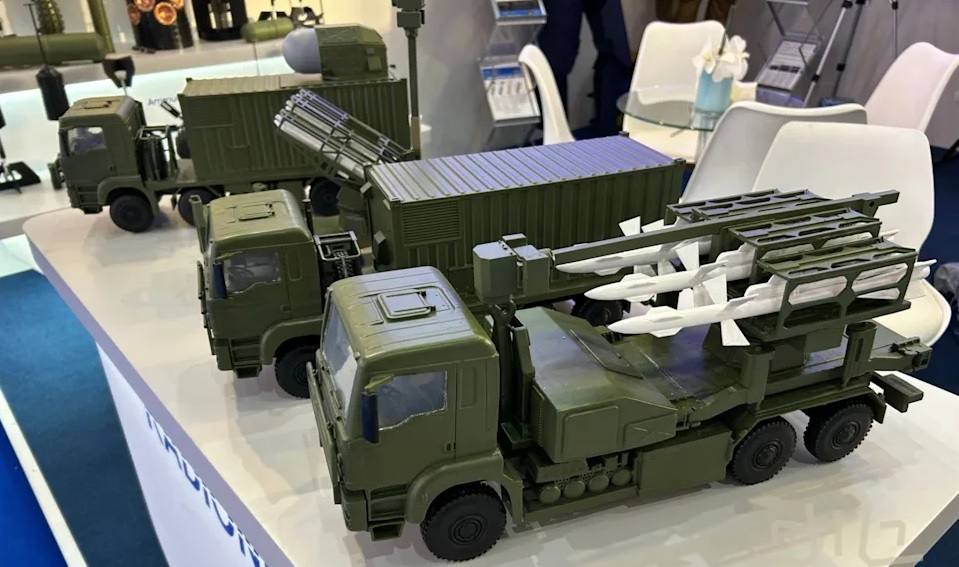
The launcher design incorporates a “multilift” mechanism similar to the Israeli Barak system concept, allowing the launch module to be removed from its transport vehicle and deployed on the ground as an autonomous firing unit. After deployment, the transport vehicle can relocate to reduce vulnerability to counter-battery fire.
The system is not tied to a specific radar model. NAUDI states that its open-architecture control system allows integration with various domestic and foreign radar platforms. During the exhibition, company officials noted compatibility with radar manufacturers including Thales, HENSOLDT, Teledyne, and Giraffe. The system can also integrate with Ukraine’s Krechet networked command system, which aggregates data from multiple radar and air-target detection sources.
Missile Integration
Shershen is designed to fire multiple categories of missiles:
-
Legacy Soviet missiles, including the R-27 (AA-10 Alamo) family
-
Western short-range infrared missiles, including IRIS-T and ASRAAM
-
Prospective Ukrainian-developed interceptors
The display model in Riyadh featured R-27 medium-range missiles mounted on the launcher. The R-27, originally an air-to-air missile with either radar or infrared guidance and a maximum range of up to approximately 100 kilometers in air-launched configuration, has been adapted for ground-based launch. The R-27ET1 infrared-guided variant is referenced in other systems such as India’s Samar-2, where the air target engagement range does not exceed 20 kilometers.
The exhibition model also appeared to incorporate the Ukrainian-produced Radionix Esmeralda radar, typically installed on Su-27 and MiG-29 fighter aircraft. Both aircraft types remain in Ukrainian service and routinely carry R-27 missiles. NAUDI states that pairing a domestically produced radar with a domestically producible medium-range missile supports greater supply autonomy.
The effective engagement range of the Shershen system depends on the specific missile that the system will use. NAUDI characterizes the platform as a short-to-medium-range system, comparable in role to IRIS-T SLM or NASAMS, and designed to intercept drones, cruise missiles, and manned aircraft. Heavy ballistic missile interception would continue to rely on longer-range systems such as Patriot or SAMP/T batteries operated by Ukraine.
Industrial and Cost Considerations
According to NAUDI Director Serhiy Honcharov, the system is designed to reduce dependence on a single supplier and mitigate delays in foreign deliveries. He stated that reliance on exclusive supply chains can lead to situations in which launchers are available but compatible missiles are not, and the volume of missile production is limited while costs increase over time.
Honcharov indicated that the Shershen control system is estimated to be approximately three times less expensive than comparable global systems, primarily due to its flexible software architecture and ability to integrate diverse hardware components.
Operational Implications
If deployed at scale, the Shershen system could enable Ukraine to convert previously incompatible missile, radar, and launcher inventories into operational air defense batteries. By creating a universal interface between disparate components, the system seeks to maximize the usability of existing stockpiles while preserving the ability to incorporate future missile types.
NAUDI states that the five validated missile types represent an initial integration baseline. Additional missile adaptations can be undertaken as operational requirements evolve.
——— End of Article ———