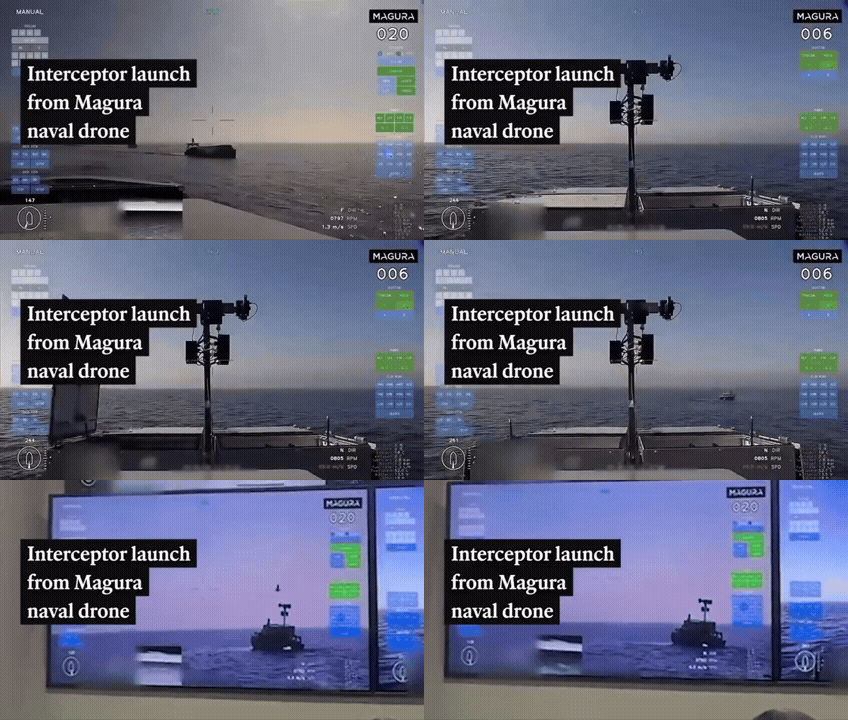
ODESA — March 7, 2026 : The Ukrainian Navy has introduced a new operational configuration for its Magura unmanned surface vessels (USVs), adapting the maritime drones to launch aerial interceptor drones designed to destroy incoming Russian Shahed-type loitering munitions approaching Ukraine’s Black Sea coast.
The system is intended to establish an offshore layer of drone defense for coastal cities, particularly Odesa, where Russian forces frequently direct long-range drone strikes.
Offshore Counter-Drone Concept
Under the concept presented by Ukrainian naval officials, Magura surface drones operate several miles offshore and serve as mobile launch platforms for interceptor drones. When incoming aerial threats are detected over the Black Sea, the vessel deploys small high-speed interceptors that pursue and collide with hostile drones before they reach Ukrainian coastal infrastructure.
Russian forces regularly program Shahed-type drones to approach targets at extremely low altitude across the sea. This “sea-skimming” flight profile allows the drones to remain below the effective detection range of many coastal radar systems, shortening the response time for ground-based air defense units.
By positioning unmanned vessels offshore, the Ukrainian Navy aims to move the interception zone further away from land, allowing threats to be engaged earlier in their flight path. Officials indicated that the system could act as the first defensive layer, intercepting drones before they reach land-based air defense networks protecting cities and ports.
Magura Surface Drone Platform
The interceptor drones are launched from variants of the Magura unmanned surface vessel family, including the Magura V5 and the larger Magura V7.
The Magura V5 measures approximately 5.5 meters in length, 1.5 meters in width, and about 0.5 meters in height above the waterline. It has a maximum speed of around 42 knots, an operational range of up to 800 kilometers, and a payload capacity of about 320 kilograms.
Navigation and control systems combine GNSS positioning, inertial navigation systems, and visual guidance technologies, supported by encrypted mesh radio communications or satellite links that allow remote control and coordination.
The larger Magura V7 variant is designed for extended offshore operations and prolonged loitering missions. It can remain deployed for long periods while monitoring airspace over the Black Sea and waiting to launch interceptors if threats are detected.
The Magura series was originally developed for maritime strike missions and has previously been used by Ukrainian defense intelligence units in operations against Russian naval targets in the Black Sea. Recent adaptations have expanded the platform’s role to include air-defense payloads such as drone launchers and missile-based systems.
Sting Interceptor Drone
The aerial interceptor integrated with the Magura platform is the Sting quadcopter, developed by the Ukrainian manufacturing group Wild Hornets and integrated into naval operations by the startup Uforce, which is involved in Magura production.
The Sting drone is designed specifically for drone-on-drone engagements and uses kinetic interception to destroy incoming targets through direct collision.
The interceptor is capable of reaching speeds of up to 250 kilometers per hour, with some operational configurations reportedly achieving up to 315 kilometers per hour, giving it a speed advantage over Shahed-type loitering munitions used by Russian forces. These attack drones typically cruise at around 185 kilometers per hour.
The Sting interceptor has an effective interception range of approximately 25 kilometers. If a target is not acquired or is destroyed by another system, the drone can return to base instead of being expended.
Production of the Sting system has expanded significantly during the war, with thousands of units delivered to Ukrainian forces for use in counter-drone operations.
Demonstration and Operational Status
The Ukrainian Navy presented the capability during demonstrations conducted on March 7. Officials stated that the system has been deployed on Magura boats operating off the coast of Odesa.
However, the concept of launching aerial interceptors from unmanned naval platforms has not yet been tested in large-scale combat operations. Ukrainian defense planners are evaluating its effectiveness as part of a broader layered defense strategy against mass drone attacks.
The system is intended to complement existing air defense networks by providing an additional engagement zone over the sea.
Economic Considerations
The drone-on-drone interception concept is also intended to address the economic imbalance involved in countering large drone swarms.
Shahed-type attack drones are estimated to cost between $30,000 and $50,000 per unit, allowing them to be deployed in large numbers.
Intercepting them using traditional surface-to-air missile systems can require the use of advanced interceptors costing several million dollars. For example, a PAC-3 interceptor used in the Patriot missile system can cost more than $13.5 million.
By contrast, the Sting interceptor drones cost only several thousand dollars per unit, allowing Ukrainian forces to engage lower-cost aerial threats without using strategic missile stockpiles.
Strategic Interest
Defense officials from the United States and several allied countries are monitoring the development of the offshore interceptor system as a potential model for countering large drone swarms.
If proven effective, the combination of maritime unmanned vessels and aerial interceptors could provide a scalable approach for defending coastal areas and naval bases against low-cost loitering munitions.
——— End of Article ———