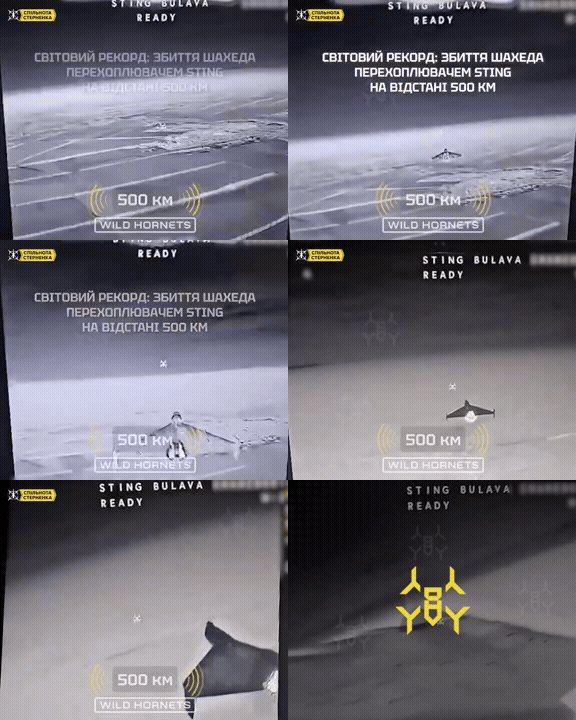
KYIV, — April 4, 2026 : A Ukrainian drone operator has successfully intercepted and destroyed two Russian Shahed-type loitering munitions from a distance of 500 kilometers, marking the first documented instance of such an engagement conducted at that range and against two targets simultaneously.
The operation was carried out on April 4 by an operator identified as Roman, callsign “Hulk,” who serves with Ukraine’s Bulava (“Mace”) unit. The engagement employed STING interceptor drones, which were remotely controlled using HORNET VISION Ctrl technology developed by the Ukrainian defence group Wild Hornets (Dyki Shershni).
According to Wild Hornets, the mission represents a new benchmark in remote drone warfare, demonstrating that interception can be conducted far beyond previously established control distances. Earlier operational ranges for such systems were typically limited to approximately 20–30 kilometers.
Extended-Range Control Capability
The success of the operation was enabled by HORNET VISION Ctrl, a drone control system introduced in March 2026 following several months of frontline testing. The system forms part of the broader HORNET VISION ecosystem and allows operators to control interceptor drones from hundreds of kilometers away from the launch site.
The technology provides high-definition video transmission with low latency, enabling operators to maintain situational awareness and precise control over long distances. It supports both digital and analog variants of the STING interceptor and integrates with proprietary ground control stations.
With this system, individual crews are now able to monitor operational areas exceeding 100 kilometers, while the April 4 mission demonstrated that engagement can be conducted at distances up to 500 kilometers from the operator’s position.
The separation between operator location and launch site is designed to improve personnel safety, allowing operators to conduct missions from protected rear areas while launch teams operate closer to the front line.
STING Interceptor System
The STING interceptor is a Ukrainian-designed drone developed specifically to counter Shahed-type loitering munitions, including the Shahed-131 and Shahed-136 variants. The system has been in operational use since 2025.
Technical specifications provided by Wild Hornets indicate that the interceptor has a top speed exceeding 340 kilometers per hour and can operate at altitudes of up to 3,000 meters. It is designed for rapid deployment from flat surfaces and emphasizes maneuverability for engaging fast-moving aerial targets.
The effectiveness rate of the STING system is reported to range between 60 percent and 90 percent, depending on operator experience and combat conditions. Wild Hornets stated that STING interceptors have collectively been responsible for more than 3,000 enemy unmanned aerial vehicle interceptions.
Operational Context and Unit Performance
The Bulava unit has been actively employing STING interceptors in counter-drone operations against Russian Shahed-type UAVs. Roman “Hulk” has previously been credited with a high number of interceptions, including a reported 20 Shahed drones downed in a single night during earlier mass attacks.
The April 4 engagement is part of a broader increase in Ukraine’s air defense efficiency. Ukrainian sources reported that in March 2026, interception rates for incoming drones and missiles reached approximately 90 percent.
Production of STING interceptors has expanded significantly, with output reported at over 10,000 units per month. The system is positioned as a cost-effective component of Ukraine’s layered air defense, with individual interceptor drones estimated to cost around $2,000, compared to $20,000 to $50,000 for Shahed-type munitions.
Deployment and Future Expansion
Wild Hornets confirmed that the HORNET VISION Ctrl system is entering wider serial deployment, with additional units expected to be delivered to frontline forces. The company continues to refine the STING platform, including improvements to video transmission systems and control links to support extended-range operations.
The development reflects a shift toward distributed and remotely operated air defense systems, enabling broader coverage of frontline areas while reducing risk to personnel.
No details were released regarding the precise location of the April 4 interception or the launch points of the Russian drones, citing operational security considerations.
The operation was first disclosed by Wild Hornets on social media and subsequently reported by Ukrainian media outlets, including Ukrainska Pravda and Censor.NET.
——— End of Article ———