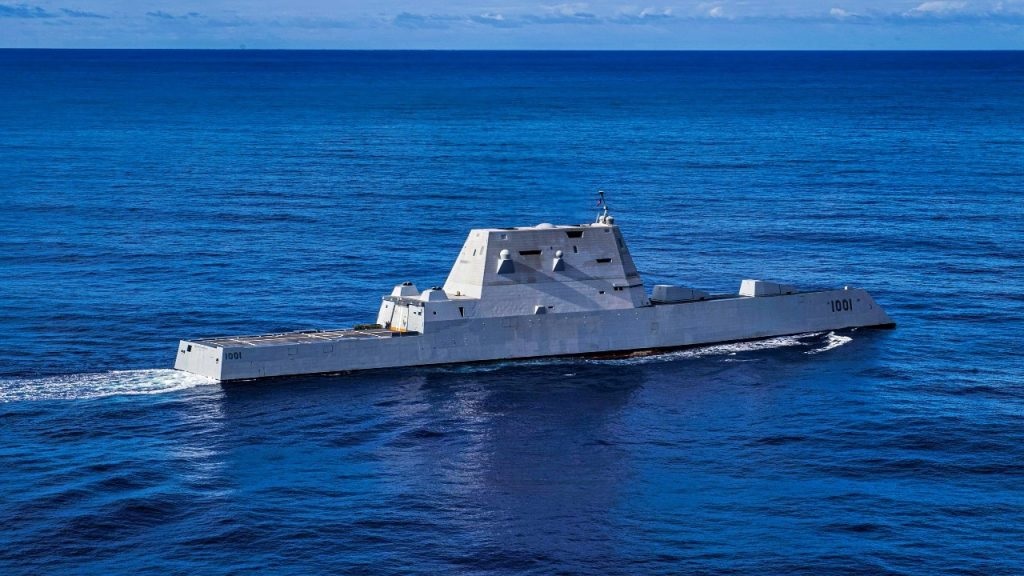
PASCAGOULA, Mississippi : The U.S. Navy has reached a significant milestone in its push toward next-generation naval warfare after the stealth destroyer USS Zumwalt (DDG-1000) successfully completed builder’s sea trials following an extensive and unprecedented modernization program. The trials were conducted by Huntington Ingalls Industries’ Ingalls Shipbuilding division in partnership with the U.S. Navy, confirming the ship’s readiness to transition into the world’s first hypersonic-armed surface combatant.
The completion of sea trials marks the first tangible operational step in transforming the Zumwalt from an experimental surface combatant into the Navy’s inaugural Conventional Prompt Strike (CPS) platform — a role that places the destroyer at the center of Washington’s emerging long-range deterrence strategy.
“This is a pivotal milestone for the Navy and industry,” Brian Blanchette, president of Ingalls Shipbuilding, said in a statement. “This modernization sets the precedent for the entire Zumwalt class and advances the U.S. Navy’s first warship with hypersonic strike capability.”
A Fundamental Transformation
USS Zumwalt, the lead ship of the three-vessel Zumwalt class, arrived at Ingalls Shipbuilding’s Pascagoula yard in August 2023 to undergo what Navy officials describe as a foundational redesign rather than a routine upgrade. Shortly after arrival, the 16,000-ton destroyer was moved onto land — a rare step for an active warship — to enable deep structural and systems modifications.
The centerpiece of the modernization was the integration of the Conventional Prompt Strike weapon system, the Navy’s sea-based hypersonic strike capability. This required the removal of the ship’s original twin 155-millimeter Advanced Gun Systems, which had become operationally obsolete after the cancellation of their specialized long-range ammunition. In their place, engineers installed large-diameter missile tubes designed to house hypersonic glide vehicles capable of traveling at speeds exceeding Mach 5.
The CPS system is designed to deliver conventional, non-nuclear strikes against high-value, time-sensitive targets anywhere in the world within minutes, significantly compressing an adversary’s decision-making timeline. For the Navy, deploying the weapon at sea adds mobility, survivability, and strategic ambiguity to U.S. deterrence planning.
Sea Trials Validate Combat Readiness
Following its undocking in December 2024, USS Zumwalt entered a rigorous series of builder’s sea trials aimed at validating the ship’s propulsion, navigation, combat systems integration, and overall seaworthiness after the extensive refit. The trials also assessed the performance of the ship’s unique all-electric integrated power system, which is critical for supporting energy-intensive weapons and sensors.
Navy and Ingalls engineers evaluated ship handling, power distribution, command-and-control systems, and the readiness of newly installed combat infrastructure. The successful completion of these trials clears the way for the ship’s delivery back to the Navy and eventual progression toward operational testing and deployment.
The Future of the Zumwalt Class
The Zumwalt modernization is only the first phase of a broader class-wide transformation. USS Lyndon B. Johnson (DDG-1002), the final ship in the class, is currently undergoing CPS weapon system integration at Ingalls Shipbuilding. USS Michael Monsoor (DDG-1001) is scheduled to receive the hypersonic system during a future availability period, completing the conversion of all three destroyers into dedicated long-range strike platforms.
Originally conceived as land-attack destroyers optimized for littoral warfare, the Zumwalt class struggled for years with unclear mission roles and escalating costs. The decision to repurpose the ships as hypersonic strike assets has effectively given the class a second life, aligning it with evolving U.S. military priorities focused on great-power competition.
A Stealthy Platform for a New Era
The Zumwalt class remains one of the most technologically advanced surface combatant designs ever fielded by the U.S. Navy. The destroyers feature a wave-piercing tumblehome hull, extensive radar-cross-section reduction measures, and a stealth profile more commonly associated with submarines than surface ships. Their electric propulsion architecture allows flexible power allocation between propulsion and advanced weapons, a key advantage as directed-energy and hypersonic systems enter service.
With hypersonic weapons onboard, the Zumwalt class is expected to perform missions ranging from strategic deterrence and power projection to sea control and command-and-control operations. Navy officials view the ships as a testbed for future surface combatants that must integrate high-energy weapons while remaining survivable in contested environments.
Strategic Implications
The successful sea trials of USS Zumwalt come amid intensifying global competition in hypersonic weapons, particularly as China and Russia rapidly expand their own arsenals. By deploying hypersonic strike capabilities at sea, the U.S. Navy gains a flexible, forward-deployable option that complicates adversary defenses and strengthens conventional deterrence without relying on nuclear escalation.
As USS Zumwalt moves closer to operational deployment, the ship’s transformation signals not only the revival of a once-controversial class but also the emergence of a new era in surface warfare — one defined by speed, stealth, and long-range precision strike.
——— End of Article ———