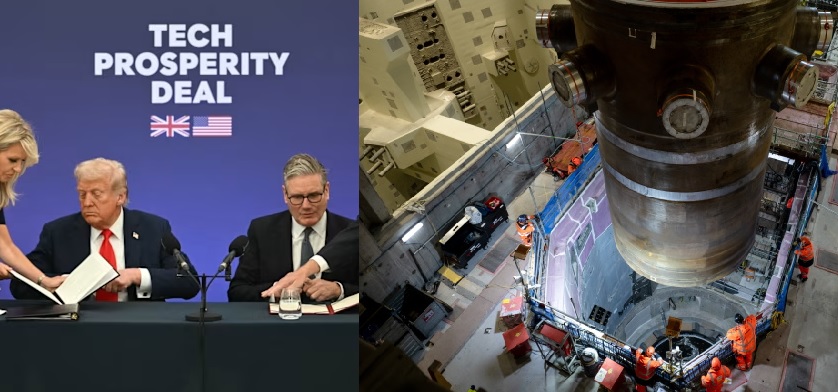
LONDON / WASHINGTON, Feb. 25, 2026 : The United Kingdom and the United States have tentatively resumed work on their multibillion-pound Tech Prosperity Deal, restarting discussions with a narrowed focus on civil nuclear energy cooperation after the broader agreement was paused in December 2025 amid wider trade disagreements.
The renewed engagement is limited to nuclear and fusion-related components of the pact, while other sectors originally covered under the agreement — including artificial intelligence and quantum computing — remain on hold.
Civil Nuclear and Fusion Talks Restart
Senior officials from both governments have begun fresh discussions aimed at advancing joint nuclear infrastructure initiatives and coordinating regulatory processes for advanced reactor technologies. As part of the restart, London and Washington are preparing to host a joint summit dedicated to commercial fusion technologies, reflecting continued bilateral interest in long-term clean energy development.
The operational focus centers on streamlining regulatory pathways, accelerating licensing timelines for advanced nuclear systems, strengthening supply chains for advanced nuclear fuels, and reducing reliance on Russian nuclear fuel supplies by the end of 2028.
The civil nuclear cooperation framework forms part of the Tech Prosperity Deal memorandum of understanding signed on September 18, 2025, during U.S. President Donald Trump’s state visit to the United Kingdom. The agreement originally covered collaboration across strategic science and technology sectors, including artificial intelligence, civil nuclear energy, fusion, quantum technologies, and telecommunications.
Hartlepool Advanced Modular Reactor Deployment
A key project under the resumed dialogue is the partnership between UK utility Centrica and U.S.-based nuclear engineering company X-energy to deploy advanced modular reactors at the existing Hartlepool nuclear site in North East England.
Centrica and X-energy signed a joint development agreement on September 15, 2025, to deploy X-energy’s Xe-100 advanced modular reactors in the United Kingdom. The Hartlepool site, jointly owned by EDF and Centrica, was identified as the preferred first location. The existing Hartlepool nuclear power station is scheduled to cease operations in 2028.
The proposed deployment involves up to 12 Xe-100 units, delivering a combined capacity of approximately 960 megawatts. Each Xe-100 reactor produces 80 megawatts of electricity or 200 megawatts of thermal heat. At full deployment, the Hartlepool project is expected to generate enough electricity to power approximately 1.5 million homes.
The initiative forms part of a broader plan to establish a UK fleet of up to 6 gigawatts of advanced modular reactor capacity. The Hartlepool development is projected to create up to 2,500 skilled jobs and generate more than £12 billion in lifetime economic value. The site has been designated for new nuclear development under the UK government’s National Policy Statement.
In addition to electricity generation, the reactors are expected to provide high-temperature heat for heavy industries in Teesside. Initial full-scale project activities are targeted to begin in 2026, with first electricity generation anticipated in the mid-2030s, subject to regulatory approvals.
Rolls-Royce SMR U.S. Regulatory Entry
Another central element of the resumed cooperation is coordinated support for Rolls-Royce as it progresses through the United States regulatory and licensing process for its small modular reactor (SMR) technology.
Rolls-Royce announced in September 2025 that it had formally entered the U.S. regulatory process for its SMR design. Earlier in 2025, Rolls-Royce SMR Ltd was selected as the preferred bidder to develop the United Kingdom’s first commercial small modular reactors.
Under the Tech Prosperity Deal’s nuclear provisions, both governments committed to supporting streamlined regulatory alignment and cooperation to accelerate deployment of advanced nuclear technologies in each other’s markets.
AI and Quantum Pillars Remain Paused
While the civil nuclear components have resumed, other major pillars of the Tech Prosperity Deal remain inactive. When signed in September 2025, the agreement included frameworks for shared artificial intelligence computing infrastructure, quantum benchmarking task forces, and telecommunications development.
Discussions in these areas have not advanced during the current restart phase. Officials have described the resumed cooperation as phased and sector-specific, indicating that broader implementation remains contingent on progress in separate trade negotiations.
Background to the Suspension
The Tech Prosperity Deal was suspended in December 2025 following tensions linked to wider macroeconomic trade negotiations between the two countries. The pause reportedly followed frustration within the U.S. administration regarding the United Kingdom’s resistance to addressing specific non-tariff barriers during parallel trade discussions.
The current restart signals a sector-by-sector approach, allowing both governments to proceed with areas of strategic alignment while continuing negotiations on broader trade matters.
No official joint statement has yet been issued by the UK government or the U.S. administration regarding the resumed discussions. The Financial Times first reported the restart on February 25, 2026, citing multiple individuals briefed on the talks.
——— End of Article ———