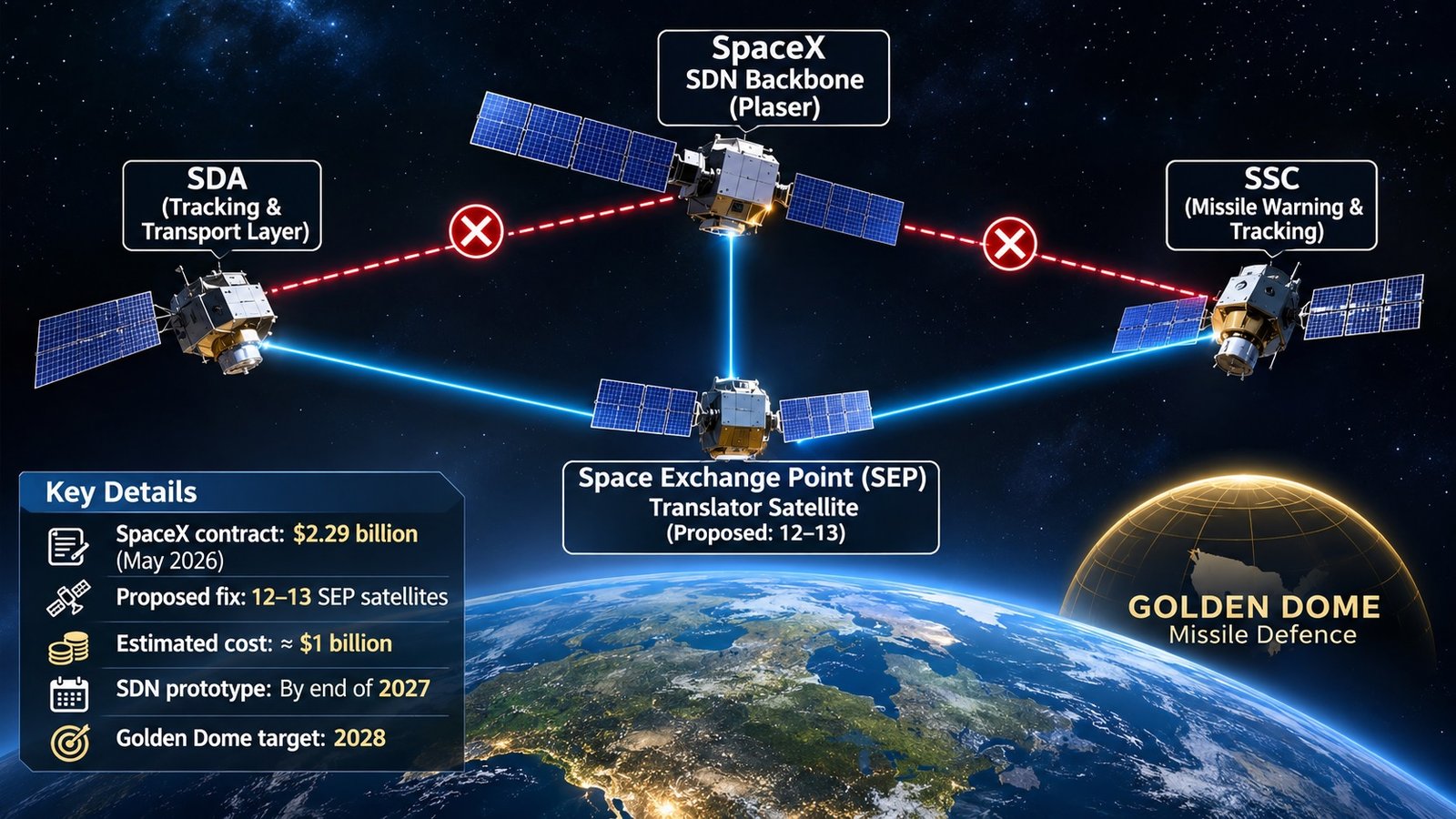
Washington, – The U.S. Space Force is facing a major technical challenge in its planned military satellite network. Satellites operated by different defence agencies cannot directly exchange data through their laser communication systems. Resolving the problem could require 12–13 additional satellites and approximately $1 billion in extra funding, according to Breaking Defense.
The issue affects the Space Data Network (SDN) Backbone, a $2.29 billion contract awarded to SpaceX in May 2026 by Space Systems Command. The network is designed to provide high-speed, secure data transmission between military satellites, sensors and command systems using optical communications terminals (OCTs).
SpaceX uses its proprietary laser terminals, known as Plasers, which are incompatible with the optical communication systems used by the Space Development Agency (SDA) and Space Systems Command (SSC). The SDA and SSC terminals are also incompatible with each other because they were developed using different technical standards for different orbital requirements.
Space Force Considers Additional Satellites
To overcome the problem, the Space Force is considering 12 to 13 Space Exchange Point (SEP) satellites, also called translator satellites. These spacecraft would carry compatible terminals and software to receive, convert and relay data between otherwise incompatible satellite networks.
Industry and former government sources estimate each satellite could cost $12 million to $14 million, with the wider solution potentially requiring around $1 billion. The Space Force has not confirmed this estimate.
In August 2026, Space Systems Command awarded $12 million each to five companies: Amazon LEO for Government, Lockheed Martin, Northrop Grumman, Rocket Lab and York Space Systems. The contracts support multi-vendor connectivity demonstrations and development of orbital router satellite prototypes. General Atomics and CACI are also developing related Enterprise Space Terminal hardware.
Impact on Golden Dome Missile Defence
The compatibility issue is important for Golden Dome, the planned U.S. missile defence architecture. It requires rapid data transmission between space-based sensors, command centres and interceptors to support missile detection, tracking and interception.
The SDN Backbone is intended to connect government and commercial satellites across different orbital layers. SpaceX must deliver an operational prototype by the end of 2027, supporting the wider Golden Dome timeline of 2028.
The mismatch partly reflects different development approaches. SDA developed its optical communication standard for low Earth orbit (LEO) operations, while SSC developed Enterprise Space Terminals for beyond-low-Earth-orbit missions. A 2025 decision to shift the SDN Backbone role towards SpaceX's constellation also contributed to the integration challenge.
The Space Force is examining a possible future version of the SDA optical standard that could support communication between low Earth orbit and medium Earth orbit (MEO) satellites. However, this standard has not yet been contracted for current satellite batches. Demonstrations of the SEP prototypes are planned for 2027.
The challenge highlights the difficulty of integrating commercial and military satellite networks into a single system. Resolving the issue is essential to establishing the SDN as a reliable communications backbone for U.S. missile warning, tracking and defence operations.
——— End of Article ———