Paris Nord Villepinte, France – French defence technology company HGH has secured an order for three SPYNEL-F panoramic infrared cameras from the French Navy, marking the second phase of an ongoing programme to evaluate advanced thermal surveillance technology for maritime operations.
Announced on November 5, 2026, the procurement was facilitated through the innovation office of the Navy General Staff. HGH will work with the French Maritime Gendarmerie to test the systems across different vessels and operational conditions before any potential wider deployment.
The order follows successful trials conducted in January 2026 aboard a French Maritime Gendarmerie patrol vessel. Following the evaluation, SPYNEL-F received the PERSEUS label, a recognition awarded through a joint initiative of the French Navy and the Directorate General of Armaments (DGA). The award ceremony took place on November 4 during Euronaval 2026.
SPYNEL-F Thermal Camera Capabilities
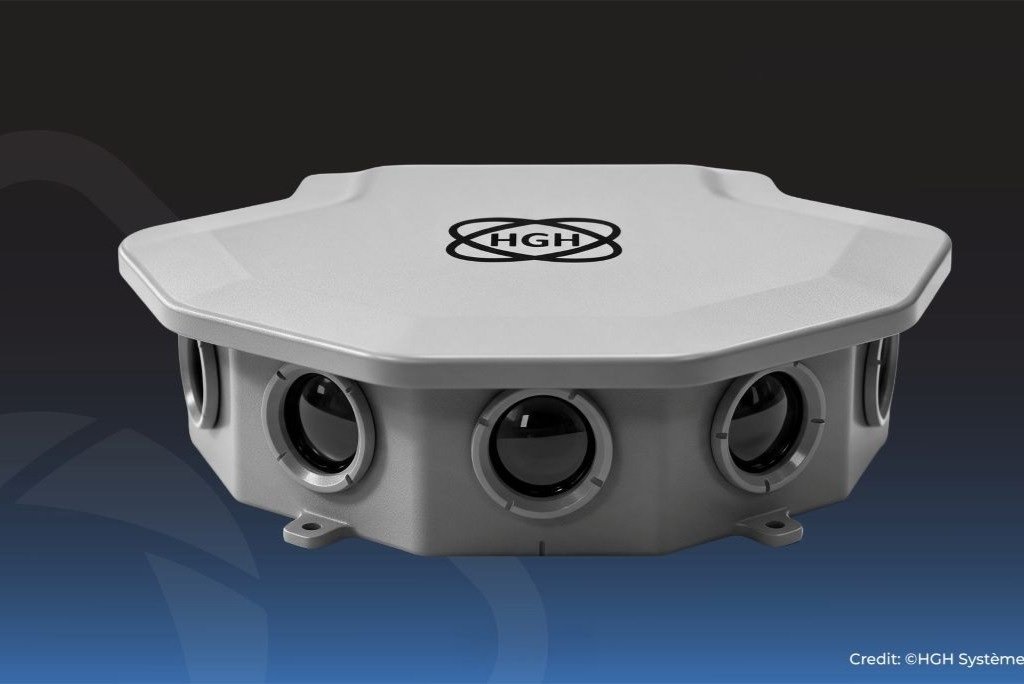
The SPYNEL-F belongs to HGH's family of panoramic infrared surveillance systems. It is designed for continuous maritime monitoring and weighs approximately 3 kg, making it suitable for installation on both large warships and smaller vessels, including unmanned surface vehicles (USVs).
The system uses an uncooled Long-Wave Infrared (LWIR) sensor to produce 1.5-megapixel thermal images at a 30 Hz frame rate. It provides a 180-degree horizontal field of view and a 45-degree vertical field of view, supported by integrated digital image stabilization.
The camera is fully passive and emits no electromagnetic radiation, making it difficult to detect through electronic emissions. Its design also eliminates the need for a mechanical gyrostabilization platform.
Combined with HGH's CYCLOPE software and GAIA artificial intelligence, SPYNEL-F can automatically detect, track and classify air and surface targets. According to HGH's specifications, detection ranges reach 400 metres for humans and 900 metres for vehicles and rigid-hulled inflatable boats (RHIBs).
French Navy to Conduct Further Operational Trials
The three newly ordered cameras will be evaluated across different operational profiles, including search and rescue (SAR) missions. Their ability to detect objects and people in complete darkness and challenging weather conditions, including rain, heat and cold, will be assessed.
Following the initial patrol vessel trial, HGH also plans to test SPYNEL-F on four different vessel types to examine its interoperability across maritime platforms. The system is intended to support navigation, improve situational awareness and help detect people who have fallen overboard.
HGH CEO Vincent Leboucher said the second phase of experimentation reflects the company's commitment to developing compact infrared surveillance systems that meet the operational requirements of security and defence forces.
The announcement coincides with Euronaval 2026, taking place from November 3 to 6 at Paris Nord Villepinte. HGH is displaying its SPYNEL-F and other infrared surveillance technologies at Booth C87, Hall 6.
——— End of Article ———