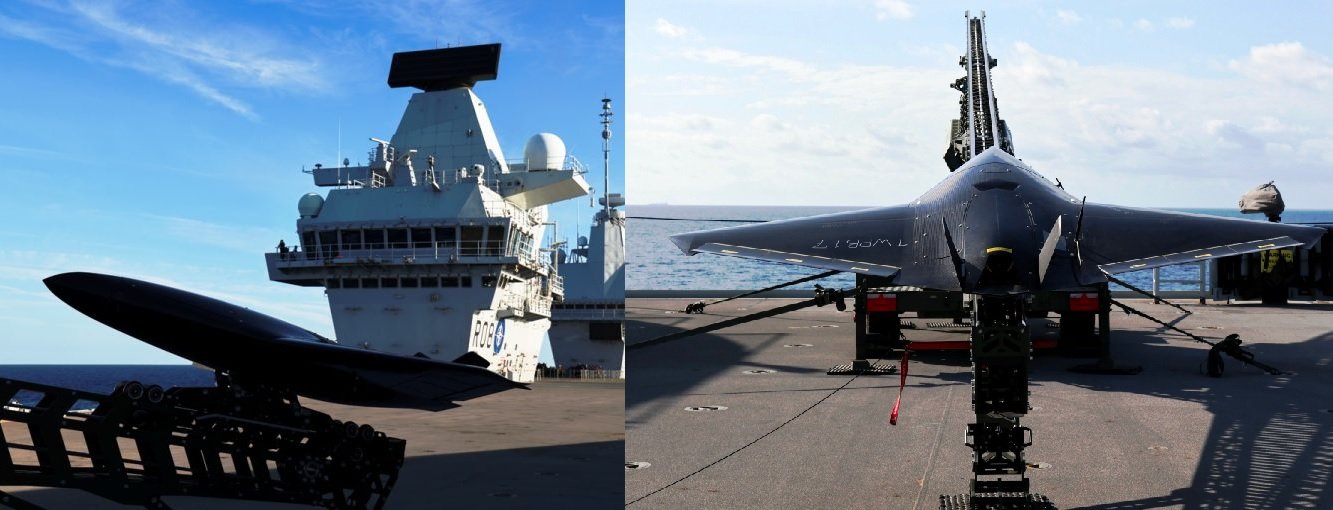
North Atlantic, United Kingdom – The Royal Navy has successfully launched Nyan One-Way Effector (OWE) strike drones from HMS Queen Elizabeth for the first time, marking progress towards its planned hybrid fleet of crewed and uncrewed aircraft.
The trials took place in mid-October during Exercise Neptune Reach B. Four Nyan drones, developed and manufactured in Wiltshire by BAE Systems’ Callen-Lenz, were rail-launched from the aircraft carrier. All four successfully reached their designated strike points.
The exercise tested how autonomous strike drones could operate safely from a large carrier and potentially work alongside F-35B stealth fighters and other uncrewed systems during future carrier strike operations.
Nyan Drone Capabilities
The Nyan is a compact, jet-powered uncrewed aircraft with a 2.9-metre wingspan and a reported cruise speed of 220 km/h. It uses a gas-turbine engine and is designed for precision strikes. Its features include a low radar cross-section and the ability to operate in environments where GPS and other navigation signals are denied. It can be launched using a rail or pneumatic catapult.
Previous Trials and Project Vantage
The latest trials follow Nyan's first seaborne launch from the Royal Navy's experimental vessel XV Patrick Blackett during Exercise Neptune Reach A in June 2026. The British Army has also tested the drone in Estonia during Exercise Spring Storm in May. In February, the UK Ministry of Defence awarded Callen-Lenz a £5 million contract to supply Nyan systems for British forces deployed on Operation Cabrit.
The trials are part of Project Vantage, a joint initiative involving the Royal Navy, British Army and Royal Air Force to accelerate the testing and introduction of maritime strike drones.
Royal Navy Capability Sponsor Lieutenant Commander David Burton said the exercise would provide operational experience and help determine how maritime one-way effectors could support future carrier strike operations. He added that the findings would contribute to Maritime Aviation Transformation and the Navy's hybrid fleet plans.
Matt Foster, CEO of BAE Systems' Callen-Lenz, said the successful carrier launches demonstrated Nyan's potential to support future force development through affordable and scalable combat capabilities.
BAE Systems is continuing to develop autonomous systems through its FalconWorks advanced research and technology hub, drawing on more than 25 years of experience in uncrewed and autonomous technologies.
The trials provide practical experience in operating strike drones from an aircraft carrier and will help the Royal Navy assess their future integration into carrier strike groups.
——— End of Article ———