WASHINGTON — March 8, 2026 : The United States has formally requested Ukraine’s assistance in countering Iranian-designed Shahed loitering munitions as Washington faces increasing drone threats against U.S. and allied assets in the Middle East. The request reflects Ukraine’s extensive operational experience defending against thousands of Shahed-type drones used by Russia during the ongoing war.
The discussions, reported by Politico and confirmed by Ukrainian officials, form part of broader bilateral consultations between Washington and Kyiv that have continued for approximately a year. The talks include continued U.S. financial and military support for Ukraine alongside the sharing of practical counter-drone tactics, operational knowledge, and technology developed during Ukraine’s defense against Russian drone attacks.
Expanding U.S.–Ukraine Military Cooperation
Ukrainian President Volodymyr Zelenskyy stated that Kyiv had received a specific request from the United States for assistance in countering Shahed drones threatening U.S. interests and partner infrastructure in the Middle East. According to Zelenskyy, Ukrainian authorities have been instructed to provide the necessary expertise and specialists while ensuring Ukraine’s own defensive requirements remain protected.
Ukraine has accumulated extensive experience in intercepting Shahed drones over more than four years of conflict with Russia, which has deployed large numbers of Iranian-origin loitering munitions against Ukrainian cities, energy facilities, and military infrastructure. Ukrainian forces have developed a layered defense approach that includes mobile anti-aircraft guns, truck-mounted heavy machine guns, electronic warfare systems, interceptor drones, and short-range air defense missiles.
The experience gained in detecting, tracking, and destroying slow-moving propeller-driven drones has become increasingly relevant for the United States and its regional partners, particularly as Iran and its allied groups continue to employ low-cost unmanned aerial systems across the Middle East.
Cost Challenges in Countering Shahed Drones
One of the primary concerns facing the United States and allied militaries is the cost imbalance between the drones and the interceptors typically used to defeat them. Shahed-type drones are estimated to cost between $30,000 and $50,000, while many air defense interceptors currently used against them—such as Patriot PAC-2 or PAC-3 missiles—can cost several million dollars per shot.
This disparity has driven efforts to develop alternative interception methods that rely on lower-cost systems capable of engaging large numbers of drones simultaneously. Ukrainian forces have experimented with several such approaches, including low-cost interceptor drones.
Examples include the Ukrainian-developed Octopus interceptor drone, which costs approximately $3,000 per unit and has been licensed for production in the United Kingdom, and the Sting quadcopter, designed to collide with or detonate near incoming Shahed drones.
Deployment of the Merops Counter-Drone System
As part of its response to growing drone threats, the U.S. Army is deploying the Merops counter-unmanned aerial system (C-UAS) to the Middle East. The system is designed to intercept incoming drones using dedicated interceptor drones rather than traditional missile systems.
The Merops platform has been tested in operational environments in Ukraine and during live-fire exercises at NATO ranges in Europe, including facilities in Poland and Romania. According to reports from The Wall Street Journal, the system has already intercepted more than 1,000 Shahed-type drones during testing and operational trials.
The platform is associated with Project Eagle, an initiative linked to former Google CEO Eric Schmidt, which focuses on developing low-cost drone interception technologies suitable for modern battlefield conditions.
Merops System Architecture and Components
The Merops system is designed as a highly mobile, modular counter-drone platform capable of rapid deployment in field conditions. Its architecture typically includes several integrated components:
Radar Detection Unit
The system relies on a compact ground-based radar array for early detection and tracking of incoming aerial targets. The radar identifies drones based on flight signatures and provides real-time tracking data to the command module.
Command and Control Module
Operators manage the system through a command interface that integrates radar inputs, threat analysis software, and interceptor drone control systems. The system allows both manual operator control and semi-autonomous engagement modes.
AS3 Surveyor Interceptor Drones
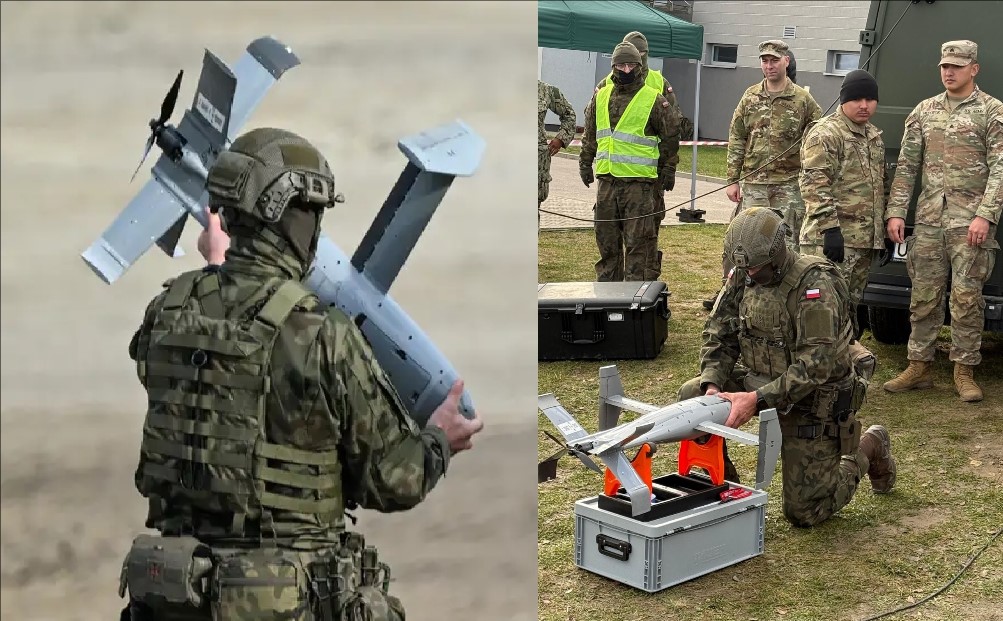
The primary interception mechanism of the Merops platform is the AS3 Surveyor interceptor drone, a propeller-driven unmanned aerial vehicle designed to pursue and destroy hostile drones.
Key specifications of the AS3 Surveyor interceptor include:
-
Maximum speed: approximately 280 km/h (about 180 mph)
-
Operational altitude: up to around 16,000 feet
-
Propulsion: propeller-driven electric propulsion system
-
Guidance: artificial intelligence-assisted targeting combined with operator control
-
Target acquisition: infrared heat signatures, radar reflections, and radio-frequency emissions
-
Navigation capability: able to continue tracking targets even when satellite signals are disrupted or electronic communications are jammed
The interceptor drone physically neutralizes hostile drones through collision or explosive proximity engagement, allowing the system to defeat targets without relying on expensive missile interceptors.
Mobility and Deployment Configuration
The Merops system is designed to operate from a compact mobile platform. The entire system—including radar equipment, command systems, and interceptor drone launch units—can be mounted in the bed of a standard midsize pickup truck.
This configuration allows rapid repositioning and deployment across dispersed locations such as military bases, ports, energy infrastructure, or temporary forward operating sites.
The system’s mobility is intended to support distributed defense against drone swarms, which often approach targets from multiple directions simultaneously.
Ukrainian Operational Experience
Ukrainian forces have reportedly operated and evaluated the Merops platform in environments characterized by heavy electronic warfare activity, including GPS jamming and communications disruption. These conditions have allowed developers to refine the system’s autonomous navigation and targeting capabilities.
Because of this operational experience, Ukrainian personnel are expected to assist in training U.S. and allied operators on the system. Sources familiar with the program indicate that Ukrainian instructors may participate in training programs associated with Merops deployments in the Middle East.
Strategic Implications
The U.S. request for Ukrainian expertise reflects a shift in the traditional flow of military assistance, where operational knowledge gained on the Ukrainian battlefield is now informing defensive strategies in other regions.
By integrating interceptor drone systems such as Merops with existing radar and air defense networks, the United States aims to create a scalable and cost-efficient defense against mass drone attacks.
The cooperation also highlights the growing role of drone-on-drone interception technologies as militaries adapt to the widespread use of inexpensive unmanned aerial systems in modern conflicts.
While discussions between Washington and Kyiv continue, officials from both countries have not announced final details of any formal agreement governing the transfer of technology or personnel associated with the counter-drone cooperation.
——— End of Article ———