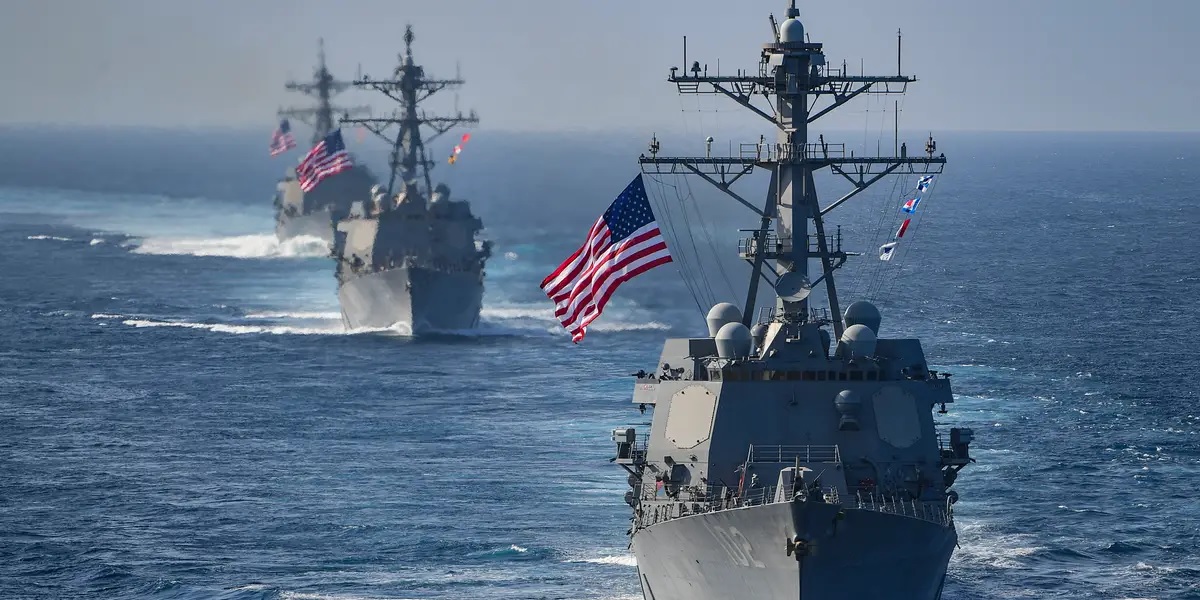
WASHINGTON, — April 5, 2026 : The United States administration has submitted its fiscal year 2027 budget request, proposing $65.8 billion in funding for naval shipbuilding within a broader $1.5 trillion national security budget presented by President Donald Trump.
According to budget documents, the Department of Defense is seeking $60.2 billion for shipbuilding through the base budget, alongside an additional $5.6 billion allocated via reconciliation funding. When adjusted for inflation, the proposal represents the second-largest U.S. naval shipbuilding request since 1955. The only higher level of spending in real terms occurred in 1962 during the Navy’s “41 for Freedom” ballistic missile submarine program.
Fleet Expansion and Procurement Plan
The fiscal 2027 proposal outlines a significant increase in planned ship procurement. The Navy intends to acquire a total of 34 vessels, including 18 battle force ships and 16 non-battle force ships. This represents a substantial increase compared to the previous fiscal year’s request.
Planned acquisitions include continued procurement of Virginia-class attack submarines and funding for the Columbia-class ballistic missile submarine program, which alone is allocated approximately $15.2 billion. The request also includes new guided-missile destroyers, amphibious warfare ships, and a range of logistics and support vessels.
Additional platforms funded under the proposal include submarine tenders, fleet oilers, surveillance ships, and sealift vessels intended to strengthen operational reach and sustainment capabilities. Budget documents specify that funding also supports strategic sealift vessels, hospital ships, Consolidated Cargo Replenishment at Sea tankers, and a special mission ship.
Golden Fleet Initiative and New Battleship Program
The shipbuilding request is aligned with the administration’s broader “Golden Fleet” initiative, which focuses on expanding naval capacity and modernizing maritime capabilities.
A central component of this initiative is the development of a new class of large surface combatants referred to as the Trump-class battleship, designated in Navy planning documents as BBG(X). This program replaces the previously planned DDG(X) next-generation destroyer effort.
The lead vessel, expected to be named USS Defiant, is currently in the design phase, with construction projected to begin in the early 2030s. Officials indicate that the conventionally powered ships are expected to displace between 30,000 and 40,000 tons. Planned capabilities include integration of Conventional Prompt Strike hypersonic missiles, directed-energy laser systems, a 32-megajoule electromagnetic railgun, and the potential deployment of a nuclear-armed sea-launched cruise missile (SLCM-N).
Frigate Program Restructuring
The Navy has also revised its approach to the future frigate program. The Constellation-class frigate program has been canceled. In its place, the Navy will pursue a new frigate design under the FF(X) program, based on a variant of the U.S. Coast Guard’s Legend-class National Security Cutter.
Secretary of the Navy John Phelan stated that the change is intended to streamline construction and reduce integration complexity that affected earlier programs.
Industrial Base and Funding Strategy
The fiscal 2027 proposal continues the administration’s use of reconciliation funding to support defense spending priorities, following a similar approach adopted in the fiscal 2026 budget. This mechanism enables funding to be distributed over multiple years.
Defense leadership, including Secretary of Defense Pete Hegseth, has indicated that the scale of the shipbuilding request is intended to support expansion of the U.S. maritime industrial base. This includes increasing capacity at public shipyards and strengthening supply chains through a broader network of domestic suppliers.
Legislative Outlook
Lawmakers are expected to review and debate the $1.5 trillion national security budget, including the $65.8 billion shipbuilding request, in the coming weeks. Officials have stated that additional detailed budget documentation, including line-by-line allocations for individual ship programs, is expected to be released later in April 2026.
The fiscal 2027 submission reflects a continued emphasis on naval expansion, fleet modernization, and logistics capability development in response to evolving strategic requirements.
——— End of Article ———