WASHINGTON — March 8, 2026 : The United States Department of Defense announced on March 6 that it has approved a $53.1 million contract modification for Lockheed Martin to expand production capacity for the AGM-158C Long Range Anti-Ship Missile. The funding will support the acquisition of manufacturing tooling and testing equipment required to increase output of the advanced maritime strike missile rather than directly purchasing additional completed missiles.
The contract modification was awarded to Lockheed Martin’s Missiles and Fire Control division located in Orlando, Florida. According to the Department of Defense announcement, the award represents modification P00028 to an existing contract identified as FA8682-19-C-0008.
Contract Modification Details
The modification provides $53,115,962 in additional funding to support Phase IV B activities associated with expanding production infrastructure for the LRASM program. Following the modification, the total cumulative value of the contract increased from $409,832,456 to $462,948,418.
All work funded under this modification will be conducted at Lockheed Martin’s Orlando facility. The Department of Defense stated that the activities funded by the contract modification are expected to be completed by November 29, 2028.
Funding for the modification was obligated from Fiscal Year 2025 U.S. Navy production funds at the time the award was issued. The contracting authority overseeing the agreement is the Air Force Life Cycle Management Center, which operates from Eglin Air Force Base.
Focus on Manufacturing Capacity
The contract modification is aimed specifically at strengthening industrial capacity required to support future LRASM production increases. Rather than financing procurement of additional missiles in the short term, the investment will be used to acquire specialized tooling and test equipment necessary for higher production throughput.
Pentagon procurement strategies in recent budget cycles have increasingly emphasized strengthening defense manufacturing infrastructure. This approach allows the U.S. military to expand output more rapidly when demand for precision weapons increases.
Department of Defense budget documents indicate that procurement quantities for the LRASM are projected to rise significantly in the near term. The Fiscal Year 2025 defense budget outlines plans for LRASM purchases that are more than 70 percent higher than Fiscal Year 2024 procurement levels.
In addition, the Department of Defense has established a multiyear procurement framework covering Fiscal Years 2024 through 2028, which authorizes the acquisition of 477 LRASM missiles.
LRASM System Overview
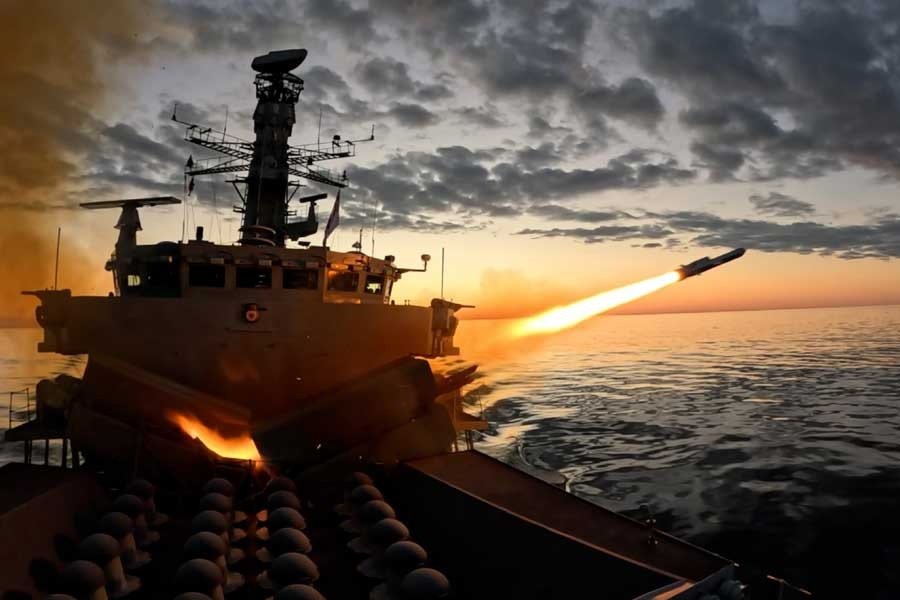
The AGM-158C Long Range Anti-Ship Missile is a precision-guided cruise missile designed to engage high-value naval targets in contested maritime environments. The missile was developed as part of a joint program between the United States Navy and the United States Air Force to improve offensive anti-surface warfare capabilities.
LRASM is derived from the AGM-158B Joint Air-to-Surface Standoff Missile-Extended Range platform and incorporates additional systems intended for maritime targeting in heavily defended environments.
The missile features a semi-autonomous guidance architecture that combines multiple navigation and targeting technologies. These include GPS guidance, inertial navigation, an imaging infrared seeker, and passive radio-frequency sensors designed to identify and discriminate targets while operating in contested electronic warfare conditions.
The missile has an estimated operational range of more than 200 nautical miles and carries a 1,000-pound blast-fragmentation warhead. LRASM measures approximately 14 feet in length and weighs about 2,760 pounds.
Operational Platforms
LRASM is currently deployed on several U.S. strike platforms used for long-range maritime attack missions.
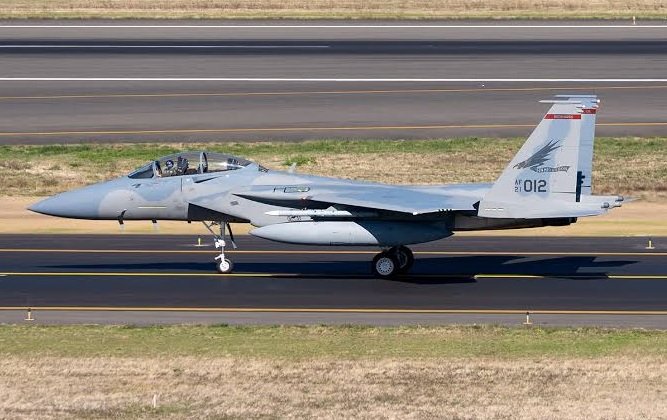
Operational integration has been completed on the B-1B Lancer, which is capable of carrying up to 16 LRASM missiles internally. The missile is also integrated on the F/A-18E/F Super Hornet, where aircraft can carry up to four missiles.
Additional integration efforts continue for other platforms, including the F-35 Lightning II, as part of ongoing modernization efforts for U.S. maritime strike forces.
Program Context
The LRASM program was originally developed to address capability gaps in the United States’ ability to conduct long-range anti-ship operations against advanced adversaries operating within heavily defended naval environments.
The latest contract modification reflects broader U.S. defense planning efforts aimed at ensuring that the industrial base supporting long-range precision weapons can sustain increased production levels over extended periods. By expanding tooling and test equipment capacity, the Department of Defense aims to ensure that manufacturing infrastructure is capable of supporting future procurement requirements for advanced maritime strike systems.
——— End of Article ———