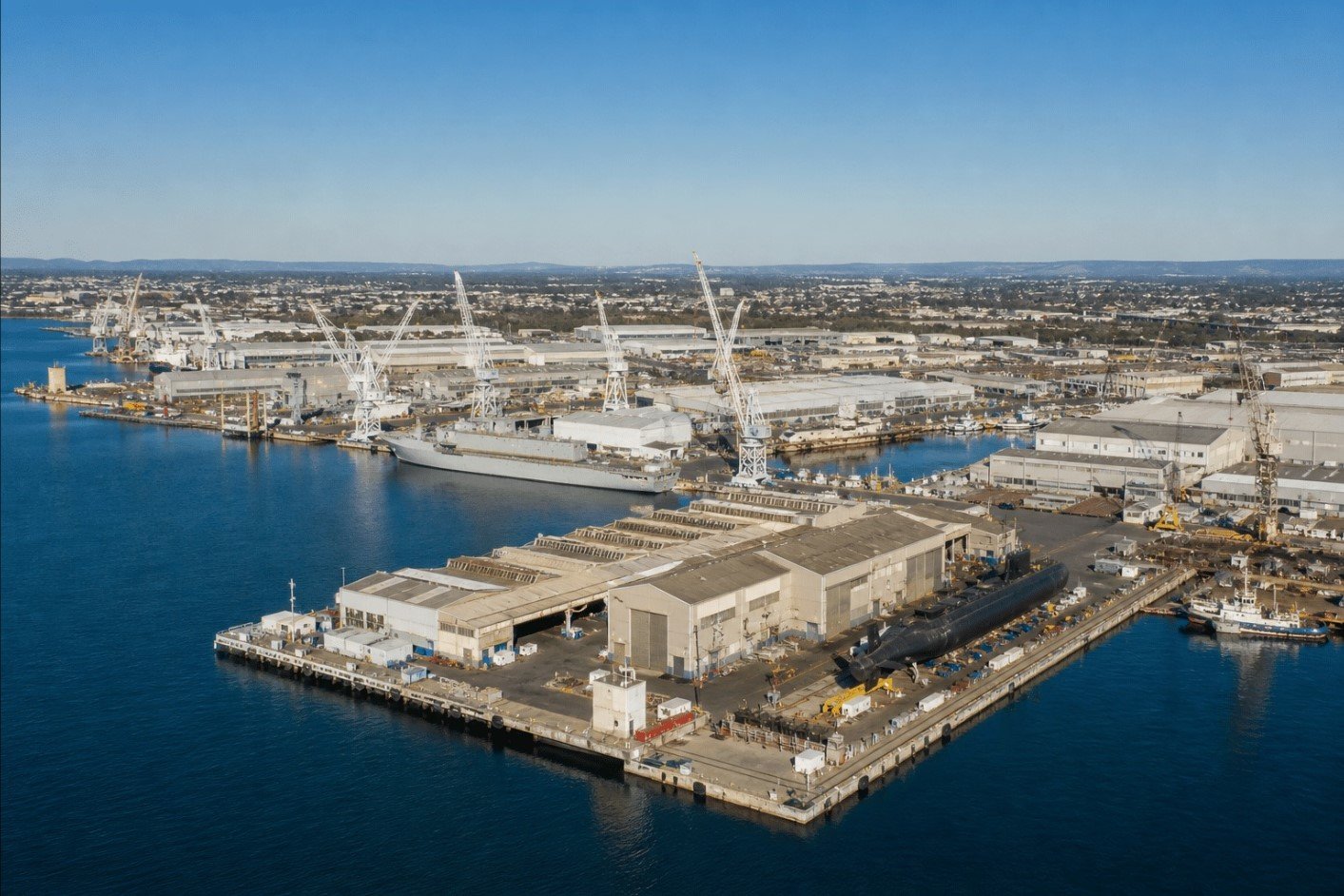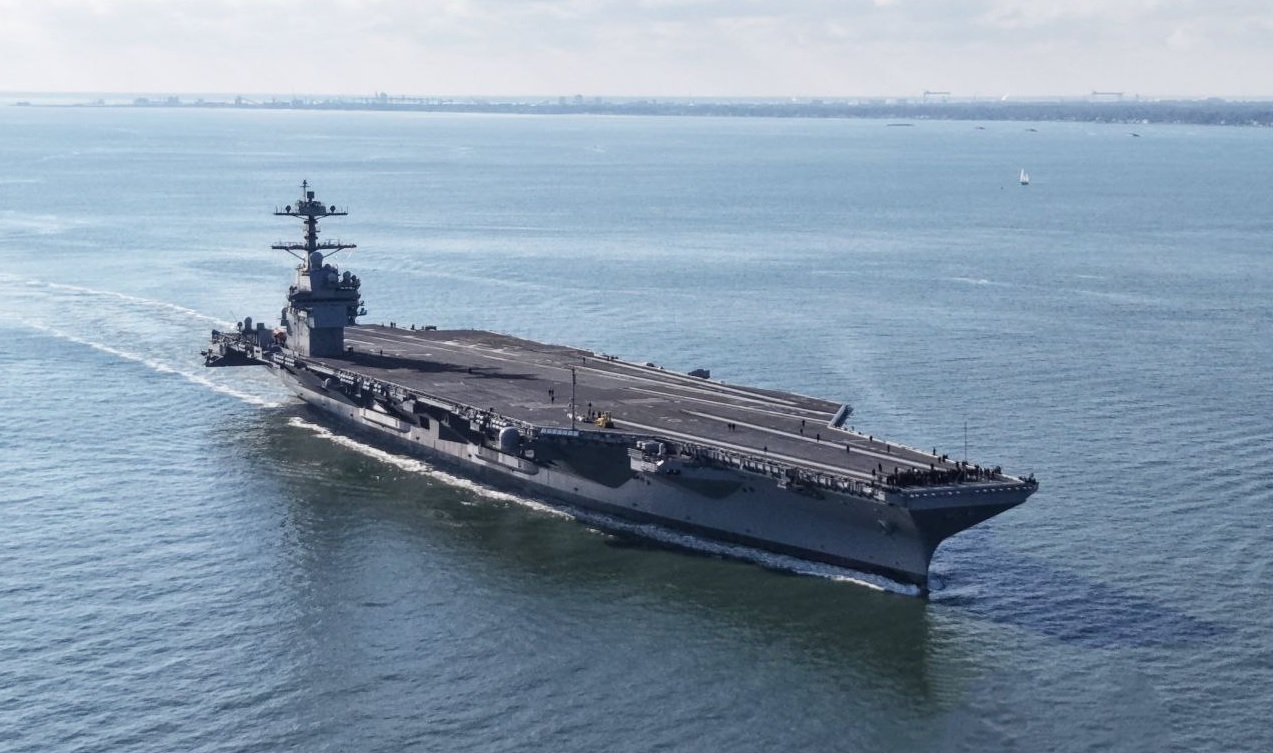
NEWPORT NEWS, Va., : The future USS John F. Kennedy (CVN-79), the U.S. Navy’s second Gerald R. Ford-class nuclear-powered aircraft carrier, departed Huntington Ingalls Industries’ Newport News Shipbuilding yard on January 28 to begin her first set of at-sea trials. The movement, initially tracked by open-source ship-spotter accounts and later confirmed by HII, marks a major transition from construction to operational testing for the carrier.
The departure signals the start of builder’s sea trials, during which shipyard and Navy personnel will evaluate propulsion, navigation, electrical generation, and a range of core ship systems under real operating conditions. These trials represent a critical prerequisite for follow-on acceptance testing and eventual delivery to the U.S. Navy.
Sea Trials and Delivery Schedule
According to U.S. Navy Fiscal Year 2025 budget documentation, the John F. Kennedy is scheduled for delivery to the Navy in March 2027, with final fitting-out work expected to conclude by July 2027. The ship had originally been planned for delivery in 2025, but the schedule was revised to allow additional time for system certification and completion of outstanding integration work.
Budget documents attribute the delay primarily to the certification process for the Advanced Arresting Gear (AAG) system, as well as continued work on the Advanced Weapons Elevators (AWE). Both systems represent significant technological departures from legacy carrier designs and require extensive testing to meet operational and safety standards.
The revised timeline will temporarily reduce the Navy’s deployable aircraft carrier force. With the USS Nimitz (CVN-68) scheduled to retire following her final operational deployment in 2025, the U.S. Navy is expected to operate a force of 10 nuclear-powered aircraft carriers until the John F. Kennedy is formally delivered and commissioned.
Role Within the Ford-Class Program
The John F. Kennedy is the second ship in the Gerald R. Ford class, following USS Gerald R. Ford (CVN-78), which was delivered in 2017. The class was designed to replace the aging Nimitz-class carriers, introducing a new power generation architecture, reduced manpower requirements, and increased sortie generation capacity.
The extended construction timeline for CVN-79 has resulted in a roughly 10-year gap between the delivery of the first and second ships of the class. Navy planning documents indicate that subsequent carriers are expected to be delivered at shorter intervals as production processes stabilize and lessons learned are applied.
Two additional Ford-class carriers are currently under contract as part of a two-ship block buy: USS Enterprise (CVN-80) and USS Doris Miller (CVN-81). The Enterprise, laid down in 2022, is projected to enter service approximately three and a half years after the delivery of CVN-79, reflecting improved construction pacing.
Technological Features and System Differences
While sharing the same basic hull form and propulsion architecture as USS Gerald R. Ford, the John F. Kennedy incorporates several notable design and systems updates. Most significantly, CVN-79 is the first aircraft carrier equipped with RTX’s AN/SPY-6(V)3 Enterprise Air Surveillance Radar (EASR).
The AN/SPY-6(V)3 replaces the Dual Band Radar installed on CVN-78 and is part of the broader SPY-6 radar family currently being fielded across the U.S. Navy, including on Flight III Arleigh Burke-class destroyers. The system uses Radar Modular Assemblies (RMAs), allowing the radar’s power and configuration to be scaled to match the requirements of different platforms. This common architecture is intended to improve maintainability, upgrade potential, and fleet-wide interoperability.
Like other Ford-class carriers, the John F. Kennedy is equipped with the Electromagnetic Aircraft Launching System (EMALS) and the Advanced Arresting Gear (AAG), both developed by General Atomics. These systems replace the steam catapults and hydraulic arresting wires used on Nimitz-class carriers. EMALS and AAG are designed to support a wider range of aircraft weights, reduce stress on airframes, and improve launch and recovery efficiency. The ship also features electromagnetic weapons elevators, intended to move munitions more rapidly from magazines to the flight deck.
Although these systems encountered reliability and integration challenges during the early operational period of USS Gerald R. Ford, they remain central to the Navy’s long-term carrier modernization strategy and are expected to reach higher maturity levels aboard CVN-79.
Historical Background
CVN-79 is the second U.S. Navy aircraft carrier named in honor of President John F. Kennedy. The first, USS John F. Kennedy (CV-67), was a conventionally powered Kitty Hawk-class carrier commissioned in 1968 and retired from service in 2007.
After years in reserve, the hull of CV-67 was transported to Brownsville, Texas, in early 2025 for dismantling. The ship was sold for scrapping alongside her sister ship, USS Kitty Hawk, to International Shipbreaking Limited, marking the final chapter of the earlier carrier bearing the Kennedy name.
Specifications and Capabilities
The USS John F. Kennedy is designed to function as both a forward-deployed strike platform and a sovereign diplomatic asset. The ship has a full-load displacement of approximately 100,000 tons and measures 1,092 feet (332.9 meters) in length, with a beam of 134 feet (40.8 meters) and a flight deck width of 256 feet (78 meters).
Propulsion is provided by two Bechtel A1B nuclear reactors, which generate significantly more electrical power than the reactors used on Nimitz-class carriers and are intended to support current and future high-energy systems. The ship is capable of sustained speeds in excess of 30 knots.
The carrier is designed to embark an air wing of more than 75 aircraft. Planned aircraft types include F/A-18E/F Super Hornet Block III strike fighters, E-2D Advanced Hawkeye airborne early warning aircraft, EA-18G Growler electronic attack aircraft, MH-60S and MH-60R helicopters, and C-2A Greyhound carrier onboard delivery aircraft.
Defensive systems aboard CVN-79 include Rolling Airframe Missile launchers, Evolved Sea Sparrow Missile launchers, and multiple Phalanx Close-In Weapon System mounts, providing layered protection against airborne and missile threats.
The ship’s total complement, including ship’s company and air wing personnel, is expected to be approximately 4,550 sailors.
Program Outlook
With the commencement of sea trials, the John F. Kennedy enters a decisive phase of testing that will shape the remaining years of the Ford-class carrier program. Navy officials view CVN-79 as a transitional ship, incorporating lessons from the lead vessel while setting the technical and operational baseline for follow-on carriers.
If the current schedule holds, the delivery of the John F. Kennedy in 2027 will restore the U.S. Navy’s carrier force to 11 ships and mark a significant step toward stabilizing production of its next generation of aircraft carriers.
——— End of Article ———