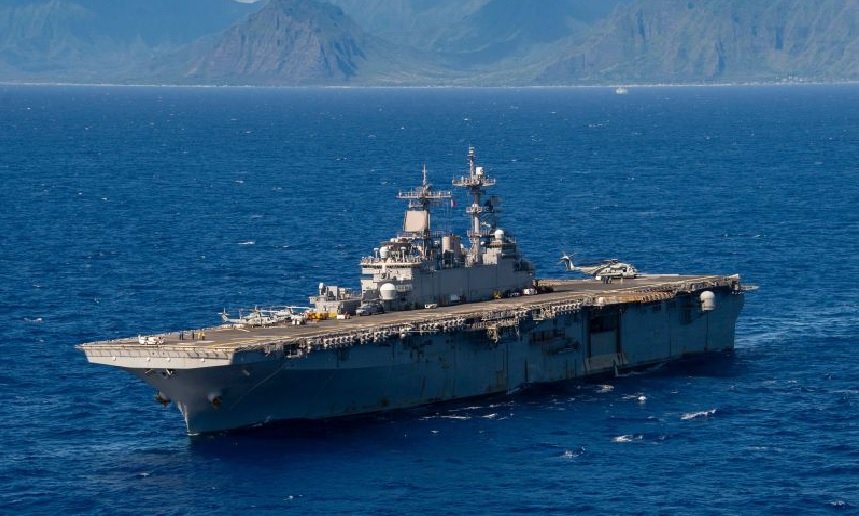
HONOLULU, Hawaii — Firestorm Labs has successfully demonstrated at-sea manufacturing by producing 3D-printed drones and hundreds of spare parts aboard the U.S. Navy's Wasp-class amphibious assault ship USS Essex while the vessel was sailing to Hawaii for the Rim of the Pacific (RIMPAC) 2026 exercise.
The demonstration showed how a containerized manufacturing system can support naval operations by allowing drones and repair parts to be produced directly aboard a warship instead of relying on shore-based supply chains.
Containerized Microfactory Produces Drones at Sea
The production was carried out using Firestorm Labs' xCell system, a transportable microfactory housed inside standard shipping containers. The platform combines additive manufacturing (3D printing), digital preparation tools, automation, and assembly stations to manufacture unmanned aerial systems (UAS) and replacement parts in operational environments.
During approximately two weeks at sea, the xCell system produced more than 1,000 components and manufactured 12 Squall first-person view (FPV) drones aboard USS Essex.
The Squall is a light electric FPV quadcopter with a largely printable airframe. According to Firestorm Labs, it can reach speeds of up to about 80 mph, has a range of up to 20 miles, provides around 42 minutes of flight time, and can carry a payload of roughly 5.5 pounds. Components that cannot be printed, including batteries, motors, flight controllers, cameras, and radio systems, are supplied as kits and integrated during assembly.
Manufacturing Continued in Challenging Sea Conditions
The production and assembly process continued while USS Essex operated in sea conditions with waves reaching 12 feet, equivalent to Sea State 5.
Service members from the U.S. Navy, Marine Corps, and other participating units took part in printing, assembling, and supporting the manufacturing process aboard the ship.
The demonstration formed part of the Naval Postgraduate School's Consortium for Advanced Manufacturing Research and Education (CAMRE) distributed advanced manufacturing network and was facilitated by FLEETWERX.
Drones Used During RIMPAC 2026 Exercise
After USS Essex arrived in Hawaii, the newly produced Squall drones were used during training activities at Makua Military Reservation on Oahu.
Marines from the 3rd Light Armored Reconnaissance Battalion operated the drones after receiving training from Firestorm Labs personnel on additive manufacturing, drone assembly, and flight operations.
During the exercise, the drones served as "red cell" adversary aircraft in a counter-unmanned aircraft systems (C-UAS) training scenario, supporting experimentation under the Naval Postgraduate School's CAMRE program during RIMPAC 2026.
On-Demand Production of Repair Parts
In addition to manufacturing drones, the xCell microfactory produced a variety of repair and maintenance items requested by the USS Essex crew.
According to Firestorm Labs, printed items included:
- Gauges for deck tie-down inspections
- Reverse-engineered valve handwheels
- A non-conductive digging knife
- A deployment mount for Starlink internet hardware
- Mechanical test articles used to evaluate printer performance during operations at sea
- An Apache Rotor Guard droop stop designed to protect helicopter rotor systems
- Multiple versions of a Life Preserving Unit vacuum adapter, developed from a sailor's concept for testing inflatable safety equipment
- More than 20 additional crew-requested parts
The company said these parts were manufactured directly aboard the ship without waiting for delivery from shore or resupply vessels.
Reducing Logistics Requirements
Firestorm Labs said manufacturing equipment onboard reduces the need to transport replacement parts through long supply chains.
According to the company:
"Every part xCell printed on deck is one that doesn't need to be flown or shipped across contested waters — cutting the fuel, aircraft hours, and personnel it takes to keep a ship operational."
The company added that repairs which previously could require days or weeks while waiting for replacement parts can instead be completed within hours while the ship remains deployed.
Supporting the Navy's Containerized Capability Strategy
The demonstration aligns with the U.S. Navy's broader effort to expand the use of modular and containerized systems that can be deployed across different ships.
In March 2026, Chief of Naval Operations Adm. Daryl Caudle announced the Navy's "containerized capability campaign plan" during the McAleese Defense Programs conference.
Speaking about the initiative, Caudle said:
"I want to containerize everything."
He described a concept in which standardized shipping containers carrying capabilities such as drones, weapons, and sensors could be installed on different vessels and moved between operational regions as needed. The approach is intended to provide greater flexibility while using standardized engineering, interfaces, and integration with combat and communications systems.
Pentagon Expanding Containerized Weapons Programs
The Department of Defense is also expanding containerized military capabilities beyond manufacturing.
In May 2026, the Pentagon announced the Low-Cost Containerized Munitions (LCCM) program, signing framework agreements with Anduril, CoAspire, Leidos, and Zone 5.
Under the program, the Department of Defense plans to acquire more than 10,000 containerized missiles over a three-year period beginning in 2027.
The initiative reflects the Pentagon's broader focus on modular, transportable systems that can rapidly increase military capability while complementing existing platforms.
Demonstration of At-Sea Manufacturing
The USS Essex trial demonstrated that containerized manufacturing can operate under real maritime conditions while supporting both unmanned aircraft production and ship maintenance.
By producing drones and repair parts directly aboard the ship, the demonstration provided a practical example of how distributed manufacturing could reduce dependence on traditional logistics and improve operational support during deployed naval missions.
——— End of Article ———