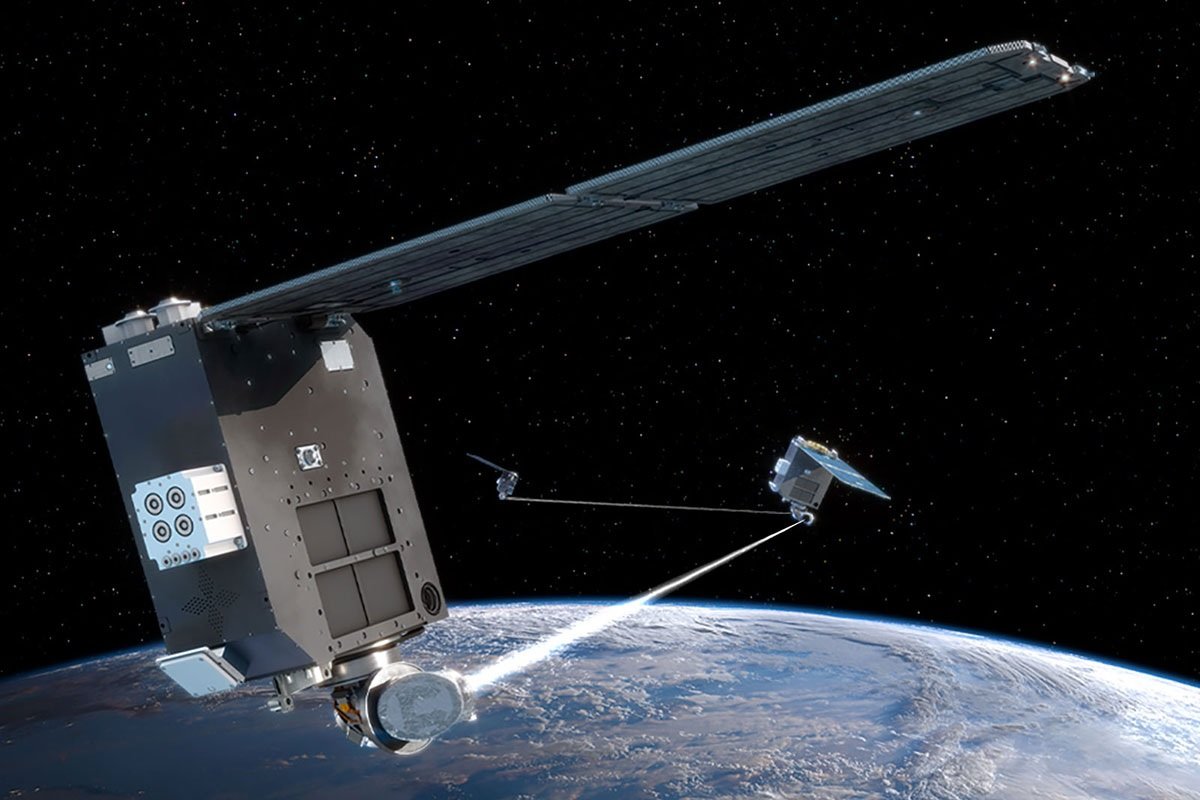
WASHINGTON — The U.S. Space Force is seeking industry designs for highly maneuverable satellites that can be rapidly launched and used to approach, inspect and interact with objects in orbit.
Space Systems Command (SSC) issued a Request for Information (RFI) on September 18 under the VICTUS program, which focuses on rapidly deploying satellites into orbit. The current effort is for market research and does not establish a budget or guarantee a follow-on contract. The Space Force is targeting the first satellites for launch in fiscal year 2029, subject to a broader acquisition strategy.
Rapid-launch capability
Under the baseline requirement, a mission-ready satellite would remain in storage at a contractor facility for up to two years and launch within 14 days of receiving a call-up order.
The Space Force is also examining faster response options, including 36-hour and 12-hour launch windows for more demanding scenarios. These are currently stretch goals rather than firm requirements.
Close-range orbital operations
Once deployed, the spacecraft would need to approach a target to zero meters of separation for inspection or interaction. Potential targets include orbital debris and cooperative satellites.
After completing an operation, the spacecraft must be able to move to another orbit and repeat the process. It would need enough fuel for more than a dozen major maneuvers across low Earth orbit (LEO), medium Earth orbit (MEO), and highly elliptical transfer paths toward geostationary orbit.
Open architecture
The Space Force wants the spacecraft to support sensors and payloads from different suppliers rather than being tied to one company's hardware.
The RFI identifies Handle 2.0 as the open architecture standard for this purpose. The framework builds on earlier work by The Aerospace Corporation and is being matured under a contract awarded to Falcon ExoDynamics.
RFI follows space-control weapons disclosure
The RFI was issued three days after Air Force Secretary Troy Meink said at the Air, Space & Cyber Conference on September 15 that the United States has "on-orbit space-control weapons" capable of defending the Joint Force against hostile adversaries.
Meink did not provide details about the weapons' design, number or launch dates. The September 18 RFI does not establish a connection between those weapons and the proposed rendezvous satellite program.
Meink also said a prototype satellite designed to track moving targets was scheduled to launch in September and that space-based interceptors associated with the Golden Dome missile-defense effort were flight-ready.
Builds on VICTUS HAZE
The new effort follows the earlier VICTUS HAZE demonstration, which involved Rocket Lab's Puma satellite and True Anomaly's Jackal spacecraft.
Rocket Lab launched its spacecraft after receiving about 17 hours' notice. The spacecraft then conducted rendezvous and proximity operations, including approaching and imaging the target. Lawrence Livermore National Laboratory provided an optical payload for tracking and imaging.
Industry requirements
Companies responding to the RFI do not need to submit formal proposals. SSC is seeking information about their security clearances, manufacturing facilities and flight heritage.
Companies must demonstrate that they have had at least two satellites operating in LEO or one satellite operating in geostationary orbit since January 2021, with the required experience deadline extending to January 2027.
Responses are due October 19 and must be limited to either a 15-page white paper or a 20-slide presentation. Submissions must also include a rough cost estimate covering engineering, hardware, software, testing and support.
The Space Force said incomplete submissions will not be reviewed. The RFI is for market research only and does not represent a commitment to award a contract.
Main Source : defence-blog
——— End of Article ———