WASHINGTON — March 13, 2026 : The Defense Innovation Unit (DIU) and the United States Navy have selected Anduril Industries to participate in the Combat Autonomous Maritime Platform (CAMP) project, a Department of Defense initiative focused on rapidly prototyping and fielding extra-large autonomous underwater vehicles (XL-AUVs) capable of transporting heavy payloads across long distances beneath the ocean surface.
The program seeks to accelerate development of autonomous maritime systems that can operate for extended durations in contested undersea environments and support distributed maritime operations. The CAMP initiative builds on a solicitation issued in April 2025, which requested commercially available or demonstration-ready systems capable of traveling more than 1,000 nautical miles, operating in GPS-denied environments, and diving to depths exceeding 200 meters.
Selection Through Competitive Process
Anduril was selected through DIU’s Commercial Solutions Opening (CSO) acquisition process, a procurement method designed to allow the Department of Defense to rapidly evaluate and integrate commercially developed technologies.
The selection followed the completion of what the company described as the longest demonstration of an extra-large autonomous underwater vehicle conducted to date. According to Anduril, the test validated the endurance, range, and operational performance of the system under conditions intended to replicate real mission environments.
Under the CAMP project, Anduril will conduct a long-duration, operationally representative demonstration of its Dive-XL autonomous submarine platform within four months of contract award. The demonstration will allow the Navy and DIU to evaluate the system’s performance as part of broader experimentation with large autonomous undersea vehicles.
No financial details of the contract were disclosed.
Dive-XL Autonomous Submarine Platform
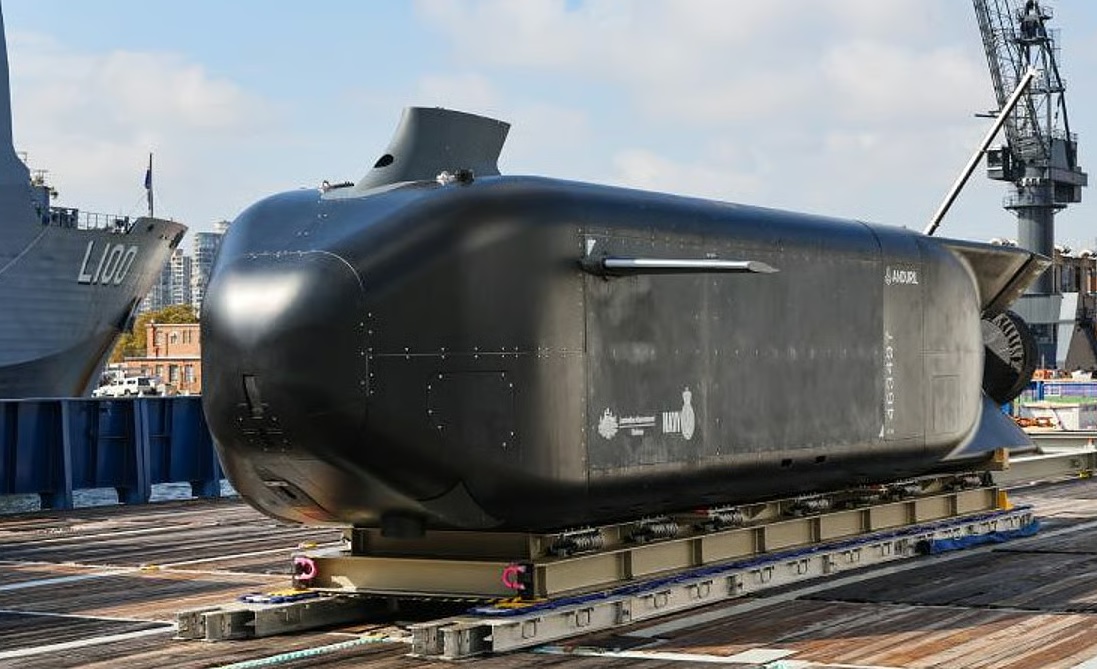
The system proposed for the CAMP program is Anduril’s Dive-XL, an extra-large autonomous underwater vehicle designed for extended missions at long ranges and varying depths.
The vehicle uses an all-electric propulsion system and is capable of traveling more than 2,000 nautical miles without surfacing. The platform is engineered to operate autonomously in GPS-denied environments and at depths greater than 200 meters, allowing it to function in areas where satellite navigation is unavailable.
The Dive-XL platform is designed with a modular architecture capable of carrying up to three payload modules simultaneously, with a total payload volume of approximately 11.4 cubic meters. The modular configuration allows the vehicle to be adapted for different mission requirements, including sensor packages or payload delivery.
The submarine incorporates a two-point lift interface that allows launch and recovery from ships, piers, or other maritime infrastructure. The design also allows the vehicle to fit inside standard commercial freight containers, enabling transportation by commercial trucks, rail systems, or cargo logistics networks for rapid deployment.
Operational Testing and Performance Data
Operational data released by Anduril indicates that the company’s autonomous undersea vehicles have collectively accumulated more than 42,355 kilometers of operational travel and 6,752 hours of mission time.
The company states that these operational metrics demonstrate the maturity, reliability, and endurance required for long-duration undersea missions and distributed maritime operations.
Anduril currently operates multiple Dive-XL vehicles within the United States, which have been used for testing and operational demonstrations.
Manufacturing and Production Infrastructure
Production of the Dive-XL platform is supported by manufacturing facilities in both the United States and Australia.
The company operates a purpose-built production facility in Quonset Point, Rhode Island, designed to manufacture dozens of Dive-XL vehicles annually along with hundreds of the smaller Dive-LD autonomous underwater vehicles.
Additional production activities take place in Sydney, Australia, where Dive-XL systems are also manufactured.
Previous Program Experience
Anduril’s work on the Dive-XL platform draws in part from its earlier defense programs, including a contract awarded in 2025 by the Royal Australian Navy for the Ghost Shark project.
The Ghost Shark program involved delivery of an extra-large autonomous underwater vehicle derived from the Dive-XL design and the establishment of a dedicated production facility. The project was intended to accelerate development timelines and demonstrate an alternative approach to defense procurement focused on rapid prototyping and delivery.
Strategic Role of Autonomous Undersea Systems
The CAMP project is part of a broader effort by the United States Department of Defense to expand the use of autonomous and robotic maritime systems alongside traditional crewed naval platforms.
Military planners expect extra-large autonomous underwater vehicles to play a growing role in future naval operations by extending operational reach, maintaining persistent presence in contested maritime areas, and supporting a range of missions such as intelligence collection and payload deployment.
For the U.S. Navy, the CAMP program provides a platform for large-scale experimentation with autonomous undersea systems, helping evaluate how such vehicles can be integrated into existing naval command structures and operational concepts.
Officials involved in the program have indicated that autonomous platforms are expected to complement rather than replace crewed submarine fleets, providing additional capabilities for sustained operations in the undersea domain.
——— End of Article ———