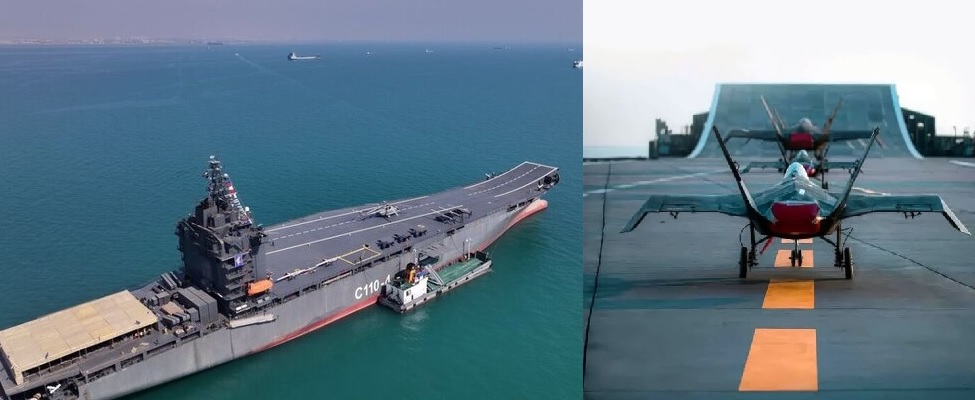
TEHRAN / WASHINGTON : Iran’s Islamic Revolutionary Guard Corps Navy (IRGCN) has formally inducted the IRIS Shahid Bagheri into operational service, marking the country’s first attempt to field a carrier-like platform dedicated primarily to unmanned aerial systems and asymmetric naval warfare.
The vessel, converted from a civilian container ship, is intended to serve as a mobile base for drones, helicopters, cruise missiles and fast-attack craft. Iranian officials portray the ship as a means of extending naval reach beyond the Persian Gulf, while U.S. and allied defense analysts view it as a strategically significant but structurally vulnerable asset.
Origin and Conversion Program
The Shahid Bagheri began its service life as a commercial container ship named Perarin. Conversion work reportedly commenced in 2022 and was conducted by Iranian shipyards under the supervision of the IRGC. Rather than attempting to build a conventional aircraft carrier, Iran opted to modify an existing hull to support unmanned aviation and light naval aviation operations.
Open-source assessments estimate the vessel’s displacement at approximately 42,000 tons. It measures about 240 meters (787 feet) in length, with its beam expanded to roughly 32 meters to accommodate flight operations. Iranian sources claim an operational range of up to 22,000 nautical miles without refueling, allowing sustained deployments into the Indian Ocean, Red Sea and surrounding maritime corridors.
Flight Deck and Aviation Infrastructure
The most prominent structural modification is an angled flight deck fitted with a ski-jump ramp. This configuration enables the launch of fixed-wing drones with heavier payloads without the use of catapult systems. The ship is also equipped with arresting gear designed to recover reusable drones, a capability not previously available to Iran’s naval forces.
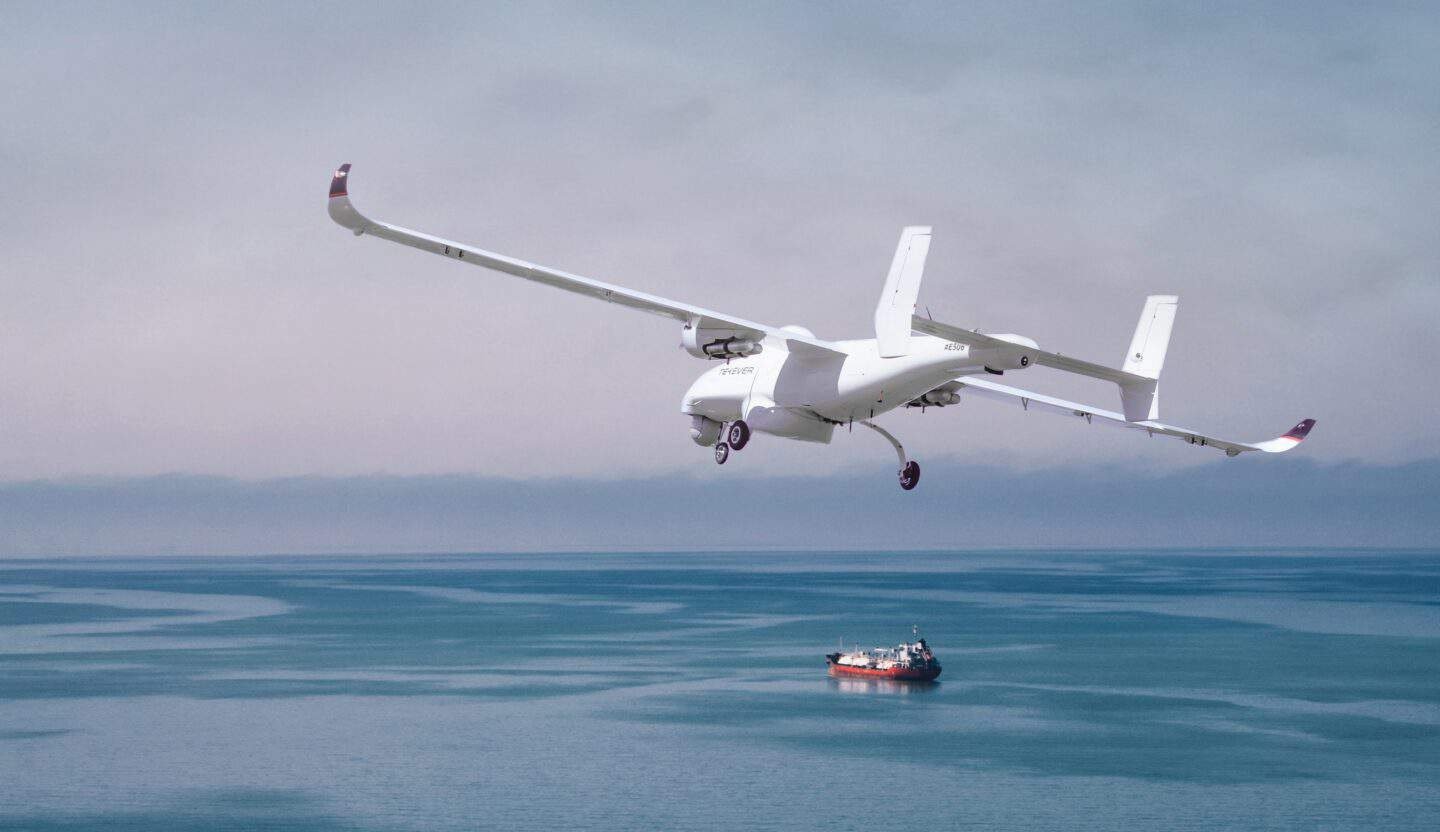
The reported air wing consists of more than 60 unmanned aerial vehicles. Platforms associated with the ship include Ababil-series drones, the Mohajer-6 intelligence and strike UAV, and Shahed-136 loitering munitions. The flight deck also supports rotary-wing operations, including medium transport and utility helicopters such as the Bell 412 and Mil Mi-17.
Weapons, Boats and Defensive Systems
In addition to aviation functions, the Shahid Bagheri is configured as a multi-role combat platform. It is assessed to carry launchers for Noor and Qader anti-ship cruise missiles, both of which are key components of Iran’s coastal and maritime strike capability.
The vessel’s hull has been modified to house and deploy fast-attack craft directly from internal bays near the waterline. These boats, typically armed with rockets or missiles, are central to IRGC naval doctrine emphasizing swarm tactics and rapid, short-range engagements.
For self-protection, the ship is believed to be equipped with indigenous air-defense systems, including elements of the “3rd Khordad” surface-to-air missile family, along with close-in weapon systems designed to counter incoming missiles and drones.
Strategic Role and Vulnerability
Iranian military statements describe the Shahid Bagheri as a force multiplier designed to offset conventional naval disadvantages through unmanned systems and dispersed attacks. By operating drones, missiles and fast boats from a single mobile platform, the IRGCN aims to complicate adversary detection and response timelines.
Western naval analysts note that the vessel retains the structural characteristics of a commercial ship. It lacks the armor protection, compartmentalization and redundancy typical of purpose-built warships. As a result, it is assessed to be significantly more vulnerable to modern anti-ship weapons than conventional naval combatants.
U.S. Military Assessment in a Conflict Scenario
According to U.S. and allied defense assessments, if a direct military conflict were to erupt between Iran and the United States, the Shahid Baggeri would likely be treated as a high-priority target. Analysts assess that early neutralization of the vessel would be aimed at disrupting Iran’s ability to conduct coordinated drone, missile and swarm-boat operations at distance from its coastline.
By removing the platform early in a conflict, U.S. naval planners assess that Iran’s capacity to project unmanned air power and conduct sustained asymmetric operations at sea would be significantly reduced. For this reason, the ship is viewed as both an operational asset and a strategic vulnerability within Iran’s naval posture.
Current Status
The IRIS Shahid Baggeri is expected to participate in future IRGCN exercises and patrol missions, serving as a test platform for Iran’s evolving unmanned maritime doctrine. Its deployment underscores Tehran’s continued focus on unconventional naval systems rather than direct competition with U.S. carrier strike groups.
While the vessel represents a notable expansion of Iran’s unmanned naval capabilities, defense analysts broadly agree that its survivability in a high-intensity conflict would depend on remaining outside the reach of advanced naval and air strike forces.
——— End of Article ———