The United States Navy and Marine Corps have selected Dutch shipbuilder Damen’s LST 100 design as the basis for their future Medium Landing Ship (LSM) program, marking a major milestone in Washington’s effort to rebuild affordable, survivable amphibious lift for operations in contested littoral waters.
The decision was formally announced on 5 December by Secretary of the Navy John C. Phelan, who confirmed that the Damen Landing Ship Transport 100 has been designated the official design basis for the new class of LSMs.
From Concept to Concrete Design
The LSM program, previously known as the Light Amphibious Warship (LAW), aims to procure 18 to 35 medium-sized landing ships to support the Marine Corps’ evolving Expeditionary Advanced Base Operations (EABO) concept. These ships are intended to move Marine Littoral Regiments, weapons, fuel and supplies between island outposts across the Indo-Pacific and other contested regions, operating closer to shore than traditional large amphibious assault ships.
For several years, the Navy examined clean-sheet designs before shifting to an “off-the-shelf” approach when cost estimates exceeded budget expectations. In 2025, the service acquired full technical data packages for two foreign-derived designs – Israel’s Logistics Support Vessel (ILSV) and Damen’s LST 100 – and began assessing them as potential baselines for the program.
According to a recent contracting notice, the Navy has now designated the Damen LST 100 as the official design basis for the LSM, enabling planners to adapt the proven hull and layout to U.S. survivability, communications and combat systems requirements while compressing design risk and schedule.
LST 100: A Modern Beaching Ship
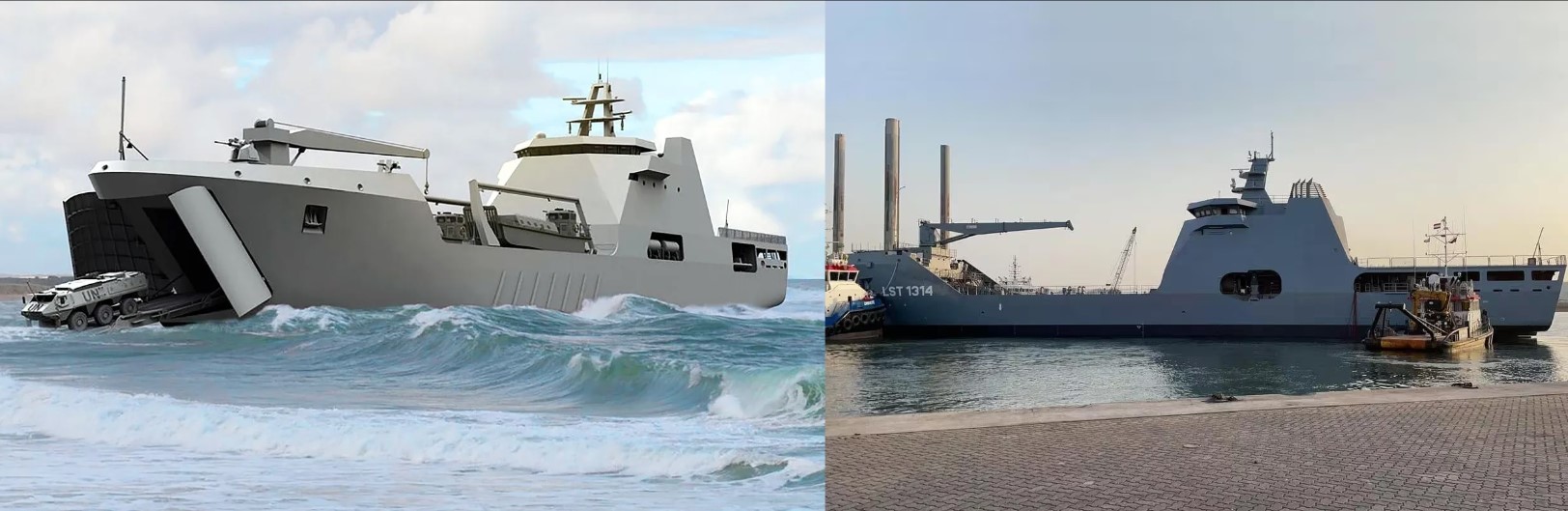
Damen’s LST 100 is a modern take on the classic landing ship, combining a beaching bow ramp with roll-on/roll-off cargo spaces and a full-length vehicle deck. According to company data, the design has a displacement of about 3,900–4,000 tonnes, a length of 100 meters, a beam of 16 meters, and is optimised for operations in shallow waters and small harbours.
Key characteristics of the baseline LST 100 design include:
-
Cargo capacity: around 500 tonnes of vehicles and supplies, with roughly 1,020 m² of roll-on/roll-off deck area.
-
Range and endurance: more than 3,400 nautical miles, suited for intra-theater movements rather than trans-oceanic crossings.
-
Well-developed logistics layout with internal ramps, a large stern working deck, and a crane for loading boats, containers and vehicles.
-
Secondary roles such as maritime security, humanitarian assistance, disaster relief, and search and rescue, supported by accommodation and command spaces for embarked forces.
The LST 100 has already been built for export customers, including Nigeria, which commissioned the landing ship Kada (LST 1314) in 2022, and has been selected by Australia as the preferred design for its Landing Craft Heavy replacement program.
For the U.S. Navy, the Damen design will be adapted into an American-built variant with U.S. combat systems, communications, and survivability features, but the underlying hull form, cargo layout and beaching capability are expected to remain broadly consistent with the proven template.
Enabling Marine Corps island-hopping
The Marine Corps has repeatedly argued that smaller, more numerous amphibious ships like the LSM are essential to its Force Design transformation. Rather than relying exclusively on large, expensive amphibious assault ships, Marine Littoral Regiments are expected to disperse across island chains, operating anti-ship missiles, air defenses and surveillance systems from austere bases.
To sustain those forces, the LSM is being designed as a “coastal logistics ship”—able to beach on rough, unimproved shores, offload vehicles and missile launchers rapidly, and then reposition before adversary sensors and weapons can target it.
Analysts see the choice of the LST 100 as a logical step in that direction. The design’s shallow-water optimisation, bow ramp, and relatively modest propulsion demands make it well suited to shuttle runs between islands and coastal sites, while being cheaper and easier to build in numbers than traditional big-deck amphibs.
Industrial Strategy And Next Steps
While Damen provides the design, the ships themselves will be constructed in the United States, in line with U.S. law for major naval combatants. The Navy has already signalled that it will competitively award a Vessel Construction Manager (VCM) to oversee the program, manage the “build-to-print” design, and coordinate multiple shipyards that may participate in serial production.
Earlier this year, U.S. shipbuilder Bollinger was identified as the preferred builder for the lead LSM hull, leveraging its experience constructing Israel’s ILSV design in American yards. With Damen’s LST 100 now formally selected as the design basis, Bollinger and other yards are expected to compete to build follow-on ships once the detailed U.S. variant is finalised.
Current planning calls for the Navy to field the first operational LSM before the end of the decade, with a long-term objective of a fleet of around 35 ships if budgets permit.
A signal of Urgency in the Pacific
By choosing a mature foreign design rather than a bespoke American concept, the Navy and Marine Corps are signalling that speed and affordability now outweigh the desire for a custom solution.
The LST 100 decision compresses development time, builds on real experience from existing operators, and moves the LSM program closer to the “shovel-ready” status that Congress has demanded as lawmakers scrutinise the Navy’s broader shipbuilding record.
If schedules hold, the new LSM class based on Damen’s design will give U.S. forces a flexible, hard-working workhorse for island-hopping, logistics and crisis response—and a critical tool for sustaining dispersed Marines in any future confrontation in the Indo-Pacific.
——— End of Article ———