WASHINGTON — The U.S. Navy is seeking a field-deployable cleaning system to address a recurring maintenance issue affecting the U.S. Marine Corps' F-35B Lightning II fighter jets. On July 9, the U.S. Naval Air Warfare Center Aircraft Division (NAWCAD) issued a sources sought notice requesting information from industry on commercial off-the-shelf (COTS) cleaning equipment that can be adapted to remove hardened deposits known as "clutch sludge" from the aircraft's lift fan clutch cooling system.
The notice, identified as N6833526RFI0521, requests responses by July 16, 2026, giving industry seven business days to submit information. The short response period indicates the priority the F-35 Joint Program Office (JPO) is placing on finding a practical maintenance solution.
Clutch Sludge in the F-35B Lift System
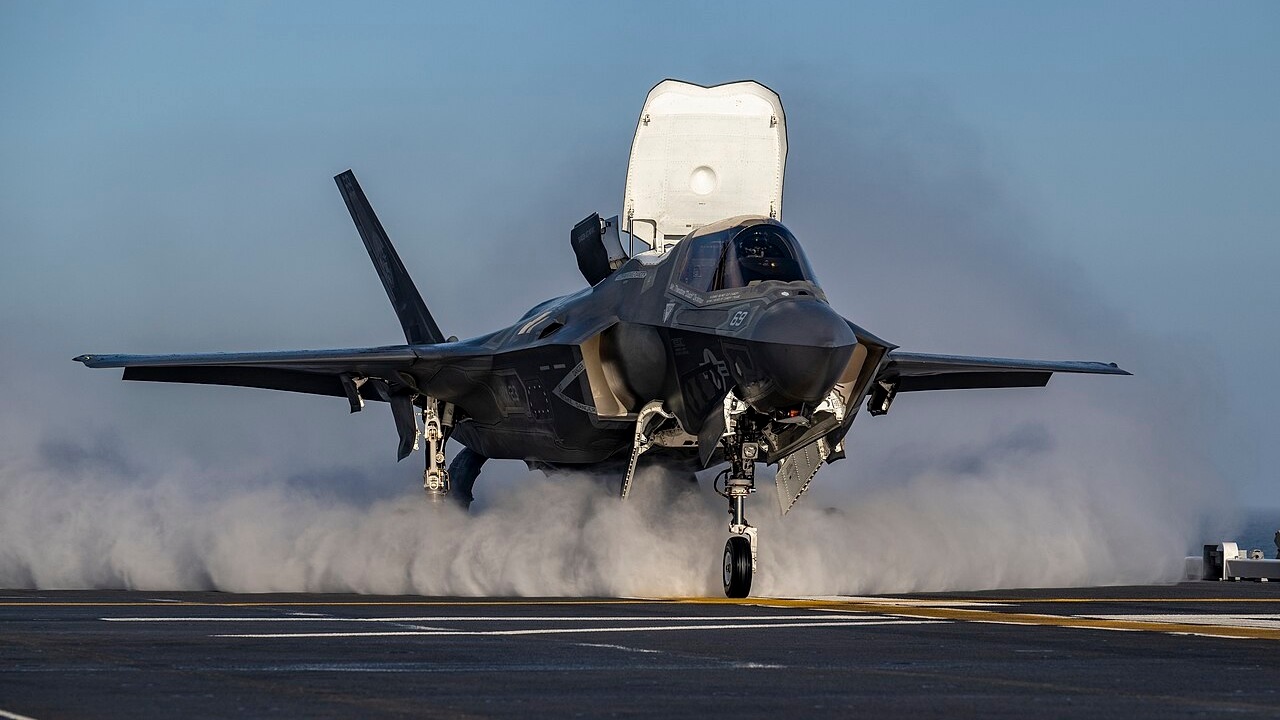
The F-35B is the short takeoff and vertical landing (STOVL) version of the F-35 Lightning II, designed to operate from short runways and amphibious assault ships. Its vertical landing capability is provided by the Rolls-Royce LiftSystem, which works with the Pratt & Whitney F135 engine.
The LiftSystem includes a vertically mounted LiftFan positioned behind the cockpit that produces approximately 20,000 pounds of upward thrust. During vertical landings and short takeoffs, a mechanical clutch connects the LiftFan to the engine's driveshaft, allowing the fan to operate alongside the engine's downward-vectoring exhaust nozzle.
According to the Navy's notice, a mixture of carbon fiber dust from the clutch system and synthetic oil gradually builds up inside the clutch cooling exhaust ductwork and vent panel screens. Over time, this material hardens into what is referred to as clutch sludge, creating a maintenance challenge that requires periodic removal.
Issue Dates Back to Early Development
The clutch system has been monitored since the F-35B's early testing phase.
In 2011, Pratt & Whitney identified that clutch plates within the LiftFan system were making unexpected contact during normal forward flight. The additional contact generated more heat than the clutch had originally been designed to handle.
To manage the issue, Lockheed Martin introduced additional temperature sensors and operating procedures requiring pilots to descend below 10,000 feet if clutch temperatures exceeded specified limits, allowing cooler air to reduce temperatures. These operational measures have remained in use, while maintenance personnel continue dealing with sludge accumulation inside the cooling system.
Navy Looking for Existing Commercial Technology
Rather than developing an entirely new cleaning system, the F-35 Joint Program Office's Propulsion Support Equipment Sustainment Manager is looking for existing commercial equipment that can be modified for the F-35B.
According to the notice, the requested system must:
- Precisely control water temperature, pressure, and water quality to remove hardened sludge without damaging nearby aircraft components.
- Safely collect and recover wastewater and removed contaminants to meet environmental requirements.
- Include a custom connection that fits the F-35B clutch cooling hardware.
- Be portable enough for maintenance crews to transport and operate at Marine Corps air stations and other operating locations.
Technical evaluation of proposed systems will be conducted by the F-35 JPO Propulsion LST In-Service Engineering Team.
Focus on Field-Level Maintenance
The Navy's requirement for a deployable cleaning system is intended to improve maintenance efficiency and aircraft availability.
Currently, extensive maintenance on propulsion components often requires aircraft or major assemblies to be sent to depot-level maintenance facilities. A portable cleaning system would allow maintainers to remove clutch sludge directly at the squadron level, reducing maintenance time and minimizing the period aircraft remain unavailable for training or operational missions.
The notice emphasizes finding a solution that can be used wherever Marine Corps F-35Bs are deployed, supporting expeditionary operations as well as routine maintenance.
Previous Sustainment Improvements
The F-35B sustainment network has continued to expand in recent years.
In 2023, Fleet Readiness Center East (FRCE) became the first U.S. Department of Defense facility outside Rolls-Royce's LiftWorks facility in Indianapolis to assemble an F-35B LiftFan clutch. The additional repair capability increased in-house maintenance capacity as the Marine Corps' F-35B fleet continued to grow.
Information Request Only
The July 9 notice is a sources sought request, not a formal procurement solicitation. Companies responding are asked to provide information on their existing products, cleaning methods, system specifications, and whether their solutions are commercial, modified-commercial, or another type of capability.
The Navy has limited submissions to five pages, and the information will be used to evaluate available technologies that could support future maintenance requirements for the F-35B fleet.
As the Marine Corps continues expanding its fleet of F-35B aircraft, maintaining the reliability of the LiftSystem and its clutch assembly remains an important part of sustaining aircraft readiness for training, shipboard operations, and expeditionary missions.
——— End of Article ———