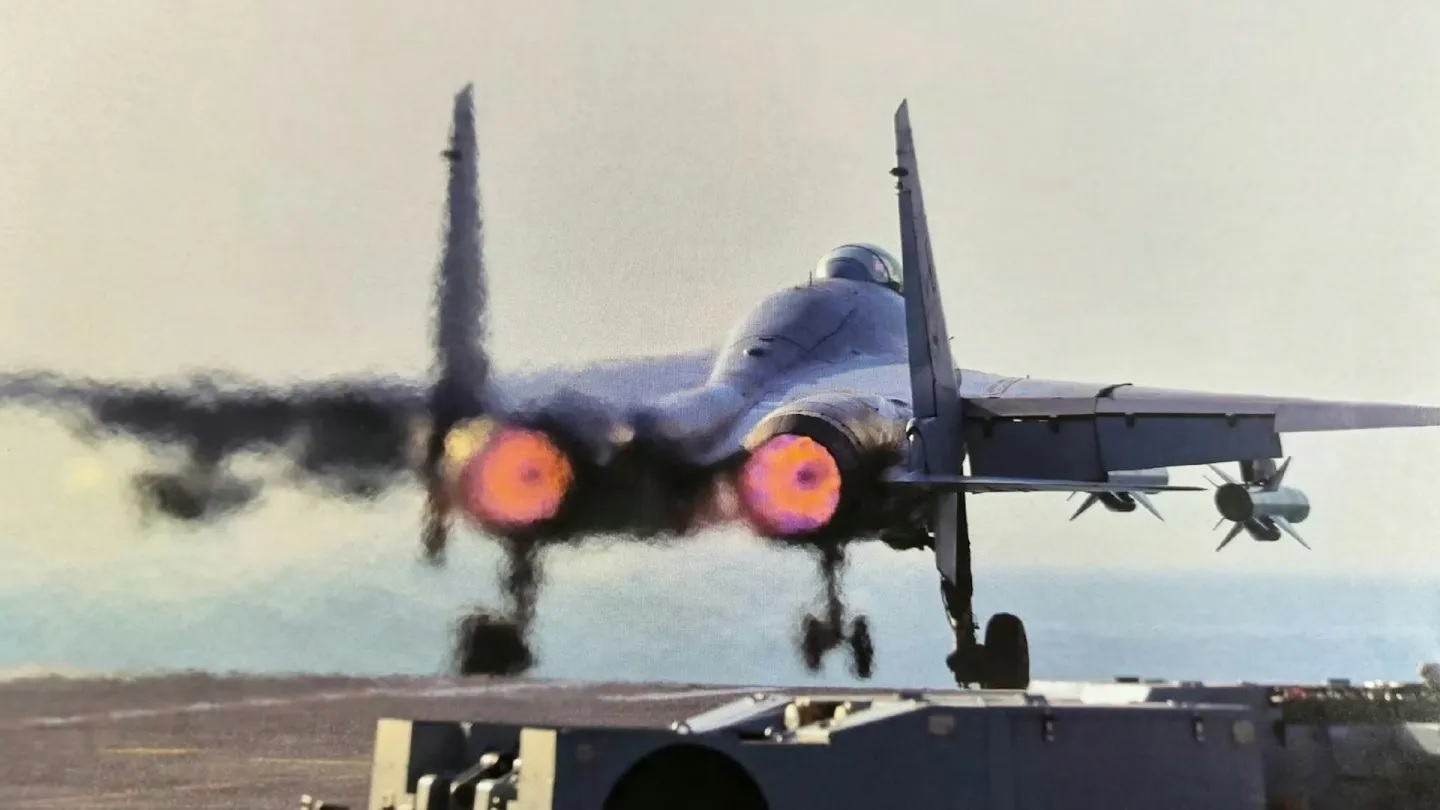
SHANGHAI, China — A newly released image has provided the clearest evidence so far of a Chinese J-15T carrier-based fighter launching from the aircraft carrier Fujian while carrying four YJ-83K anti-ship missiles. The photograph shows the aircraft in full afterburner moments before leaving the flight deck, highlighting the increased payload capability made possible by China's first aircraft carrier equipped with an electromagnetic aircraft launch system (EMALS).
The image marks the first known visual confirmation of a J-15T taking off with four heavy anti-ship missiles. The four YJ-83K missiles together weigh approximately 6,400 pounds (around 2,900 kilograms), excluding any additional stores that may not be visible in the image. Earlier images of the J-15T prototype had shown the aircraft carrying only a single YJ-83K training round.
Heavier Payload Made Possible by EMALS
The J-15T was developed to operate from the Fujian, the People's Liberation Army Navy (PLAN) first aircraft carrier equipped with catapult-assisted takeoff but arrested recovery (CATOBAR) operations using an electromagnetic aircraft launch system (EMALS).
China's previous aircraft carriers, Liaoning and Shandong, use short takeoff but arrested recovery (STOBAR) operations with ski-jump ramps. While effective, the ski-jump launch method limits the maximum takeoff weight of carrier-based aircraft, restricting the amount of fuel and weapons they can carry.
With EMALS, the J-15T can launch with significantly heavier payloads, allowing the aircraft to make better use of its full carrying capacity. Besides carrying more weapons, the additional launch weight could also be used for extra fuel, increasing operational range, or for different mission-specific weapon configurations.
Previously, the heaviest strike load publicly observed on STOBAR-operated J-15 fighters consisted of two YJ-83K anti-ship missiles along with four air-to-air missiles. Air-defense configurations typically included four PL-12 medium-range and two PL-8B short-range air-to-air missiles.
The newly observed four-missile configuration represents a notable increase in strike payload compared with previous J-15 operations from ski-jump carriers.
空母福建のカタパルト発進するJ-15Tと空母山東のスキージャンプ発進するJ-15の比較 pic.twitter.com/2SrUkIZdU8
— OedoSoldier (@OedoSoldier) September 22, 2025
Comparison of a STOBAR J-15 carrier launch and a CATOBAR J-15T launch from Fujian
YJ-83K Anti-Ship Missile
The YJ-83K is a radar-guided, turbojet-powered, subsonic anti-ship missile widely used by China. It is broadly comparable in role to the U.S. AGM-84 Harpoon.
According to available specifications, the missile has:
- An estimated range of about 112 miles (180 kilometers)
- A 360-pound (163-kilogram) semi-armor-piercing high-explosive warhead
- A sea-skimming flight profile, cruising at approximately 65 to 100 feet before descending to around 16 to 24 feet during the terminal attack phase
- A launch weight of roughly 1,600 pounds (725 kilograms) per missile
With four YJ-83K missiles onboard, the J-15T carries a substantial anti-ship strike load during catapult-assisted launches.
Upgraded J-15T Variant
The J-15T is an upgraded version of China's carrier-based J-15 fighter, designed specifically for CATOBAR operations while retaining compatibility with STOBAR operations when required.
One of the major changes in production aircraft is the introduction of domestically produced WS-10H turbofan engines, replacing the Russian-built AL-31F engines used on earlier J-15 variants.
The aircraft is also capable of carrying other weapons, including PL-10 short-range and PL-15 medium-range air-to-air missiles, depending on mission requirements. Reports have also shown the J-15T carrying a buddy refueling pod and, in some images, larger anti-ship missile configurations during testing.
Benefits for Other Carrier Aircraft
The increased launch capability provided by Fujian's electromagnetic catapults is expected to benefit more than just the standard J-15T strike fighter.
The J-15DT, a two-seat electronic warfare variant designed for a mission similar to the U.S. Navy's EA-18G Growler, requires higher takeoff weights because it carries multiple external electronic warfare and jamming pods. CATOBAR operations allow the aircraft to launch with heavier mission equipment and fuel loads.
Reports have also suggested that a CATOBAR version of the two-seat J-15S may be developed as either a carrier trainer or a multirole strike aircraft. If introduced, it would also benefit from the increased launch performance provided by the Fujian's EMALS.
Expanding China's Carrier Aviation Capabilities
The newly released image highlights how the combination of the J-15T and the Fujian's electromagnetic catapult system is expanding the operational capabilities of China's carrier aviation.
By allowing carrier-based fighters to launch with heavier fuel and weapon loads than was possible from ski-jump carriers, the CATOBAR system provides greater flexibility for strike, air-defense, and electronic warfare missions. The image offers the strongest visual evidence to date that the J-15T is beginning to operate with substantially heavier combat payloads from China's newest aircraft carrier.
——— End of Article ———