WHITE SANDS MISSILE RANGE, New Mexico — March 12, 2026 : The United States Navy has resumed live-fire testing of its long-studied electromagnetic railgun weapon system after several years of limited activity. According to the Naval Sea Systems Command (NAVSEA) Warfare Centers Year in Review 2025, a dedicated testing campaign was conducted in February 2025 at the White Sands Missile Range (WSMR), a major U.S. military testing facility located in New Mexico.
The trials marked the first structured series of railgun firing tests after the program was largely paused around 2021 due to funding adjustments and shifting modernization priorities within the U.S. Department of Defense. The February campaign focused on collecting detailed technical data on high-velocity projectile launches and evaluating system performance during repeated electromagnetic firings under controlled conditions.
February 2025 Testing Campaign
The three-day testing effort was conducted by the Naval Surface Warfare Center Port Hueneme Division (NSWC PHD) through its White Sands Detachment (WSD), working in cooperation with the Naval Surface Warfare Center Dahlgren Division in Virginia. The activity was performed on behalf of NAVSEA’s Joint Hypersonics Transition Office, which coordinates U.S. defense research related to high-speed weapons technologies.
Engineers involved in the campaign focused on gathering telemetry and instrumentation data associated with electromagnetic launches. Measurements included projectile acceleration, launch dynamics, rail and barrel structural stresses, power delivery behavior, and the overall operational performance of the system during high-energy firing sequences.
Testing at White Sands Missile Range provides several operational advantages. The range encompasses approximately 3,200 square miles of restricted airspace and land area, allowing engineers to safely conduct high-velocity projectile launches while tracking them using long-range radar, optical sensors, and telemetry systems. Conducting trials at a land-based facility also enables the recovery of fired projectiles and components for detailed forensic examination, which is significantly more difficult during naval tests conducted at sea.
Principles of Electromagnetic Railgun Technology
Electromagnetic railguns differ fundamentally from conventional naval artillery systems. Traditional naval guns rely on chemical propellants to launch explosive projectiles. In contrast, railguns use electromagnetic forces generated by high electrical currents to accelerate solid metal projectiles.
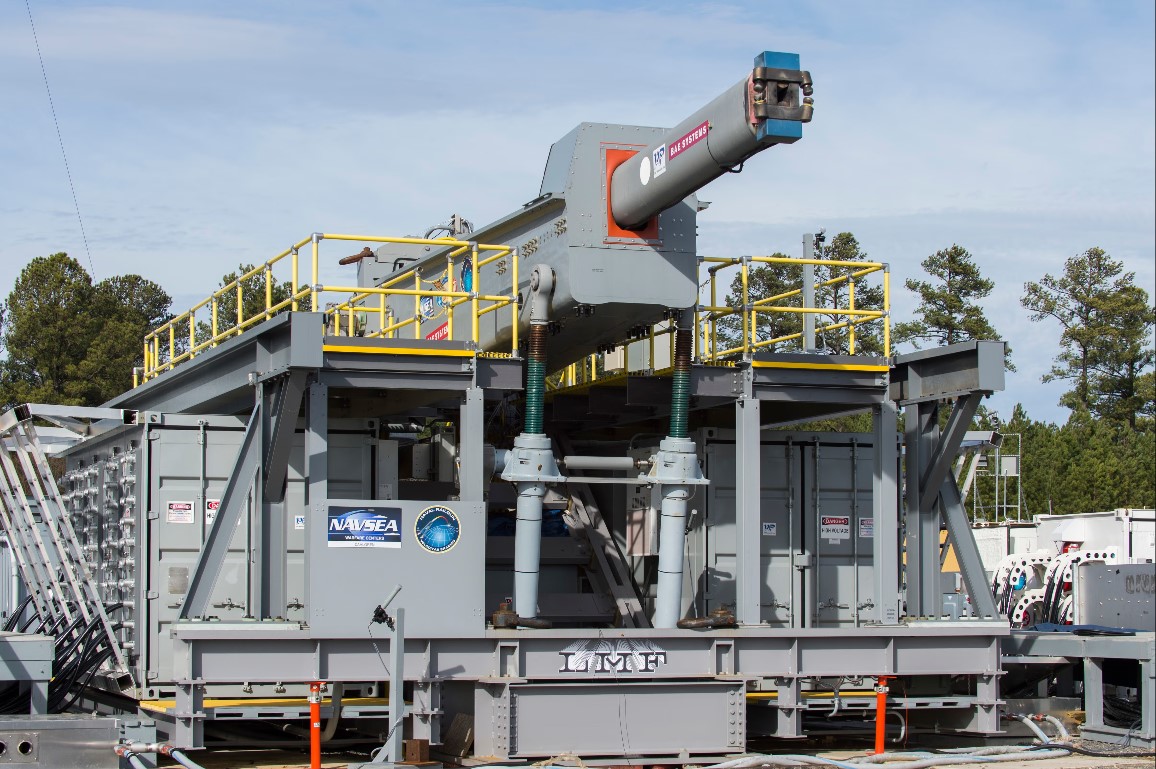
The system stores large amounts of electrical energy in capacitor banks. During firing, the stored energy is rapidly discharged through two parallel conductive rails. As electrical current flows through the rails and the projectile’s armature, a powerful electromagnetic field is generated that propels the projectile forward along the rails.
Earlier U.S. Navy experiments demonstrated projectile velocities reaching approximately Mach 6, placing the weapon within the hypervelocity regime. Because the projectile itself contains no explosive payload, the destructive effect is generated entirely through kinetic energy. At such velocities, the impact energy alone can disable or destroy targets.
The concept offers potential advantages such as reduced reliance on explosive munitions, extended engagement ranges compared with conventional naval guns, and the possibility of lower per-shot costs once operational systems are fully developed.
Development History of the U.S. Railgun Program
Formal research into naval electromagnetic railgun technology began in 2005 under the Office of Naval Research (ONR). Over the course of the program, the U.S. government invested more than $500 million in research and prototype development.
Two primary industry partners were involved in building prototype systems:
BAE Systems, which developed a railgun prototype used extensively for early performance testing.
General Atomics, which constructed an alternative system based on the same electromagnetic launch principles.
Testing during the program’s earlier phases was conducted primarily at facilities such as the Naval Surface Warfare Center Dahlgren Division in Virginia. Engineers evaluated factors including projectile velocity, accuracy, system energy requirements, launch dynamics, and durability of the gun components.
During this period, the Navy also examined the use of hypervelocity projectiles (HVP) that could potentially be fired from both railguns and modified conventional artillery systems.
Technical Challenges and Program Suspension
Despite promising early demonstrations, the railgun program encountered several engineering and operational challenges that slowed its development.
One major issue involved component degradation. Each firing generates extremely high electrical currents and temperatures, placing heavy stress on the conductive rails and barrel structures. These forces cause significant wear and erosion of the launch components, reducing their operational lifespan and requiring frequent replacement.
Another challenge relates to power generation and management. A single railgun shot can require energy levels exceeding 32 megajoules, delivered in a very short time interval. Supplying and managing this amount of power demands specialized electrical systems that exceed the capabilities of most existing naval ship designs.
These technical obstacles, combined with shifting defense priorities toward hypersonic missiles, directed-energy weapons, and other advanced technologies, resulted in the railgun program entering a reduced-activity phase around 2021. Although full development slowed, research on related technologies such as hypervelocity projectiles continued.
Role of White Sands Missile Range
The White Sands Missile Range has supported U.S. military weapons testing for decades. The facility’s instrumentation infrastructure enables tracking of high-speed objects using radar, telemetry receivers, optical sensors, and long-range measurement systems.
The environment allows engineers to observe projectile flight behavior across large distances and collect data on factors such as trajectory stability, aerodynamic performance, and terminal effects. Recovery of fired components also provides opportunities for materials analysis, allowing researchers to evaluate rail wear, projectile deformation, and other structural effects caused by electromagnetic launch forces.
The February 2025 tests therefore represent a renewed effort to gather baseline data on system durability and launch performance during repeated high-velocity firings.
International Development of Railgun Systems
Interest in electromagnetic railgun technology continues internationally, with several countries conducting their own research and prototype testing programs.
In Japan, the Japan Maritime Self-Defense Force has conducted live-fire trials of a ship-mounted railgun prototype developed by the Acquisition, Technology and Logistics Agency (ATLA). In 2025, the prototype was reportedly tested from the experimental vessel JS Asuka, marking a milestone in at-sea railgun experimentation.
Meanwhile, China has also explored electromagnetic launch technology. Defense analysts have reported modifications to certain People's Liberation Army Navy vessels to support experimental railgun installations for sea-based trials.
These developments have sustained international interest in electromagnetic launch systems as potential future naval weapons.
Future Evaluation and Program Outlook
The resumption of railgun testing at White Sands Missile Range indicates that the United States Navy continues to examine the feasibility of electromagnetic launch systems as part of its long-term weapons research portfolio.
Data gathered during the February 2025 campaign will help engineers analyze projectile acceleration behavior, structural durability, power system performance, and component wear under repeated firing conditions. The information will support ongoing assessments by NAVSEA and the Joint Hypersonics Transition Office regarding the future role of electromagnetic launch technology in next-generation naval platforms.
The Navy has not announced any immediate plans to deploy the railgun system aboard operational vessels. However, the renewed testing program suggests continued technical evaluation of high-velocity kinetic weapon systems within the broader framework of U.S. defense research and hypersonic weapons development.
——— End of Article ———