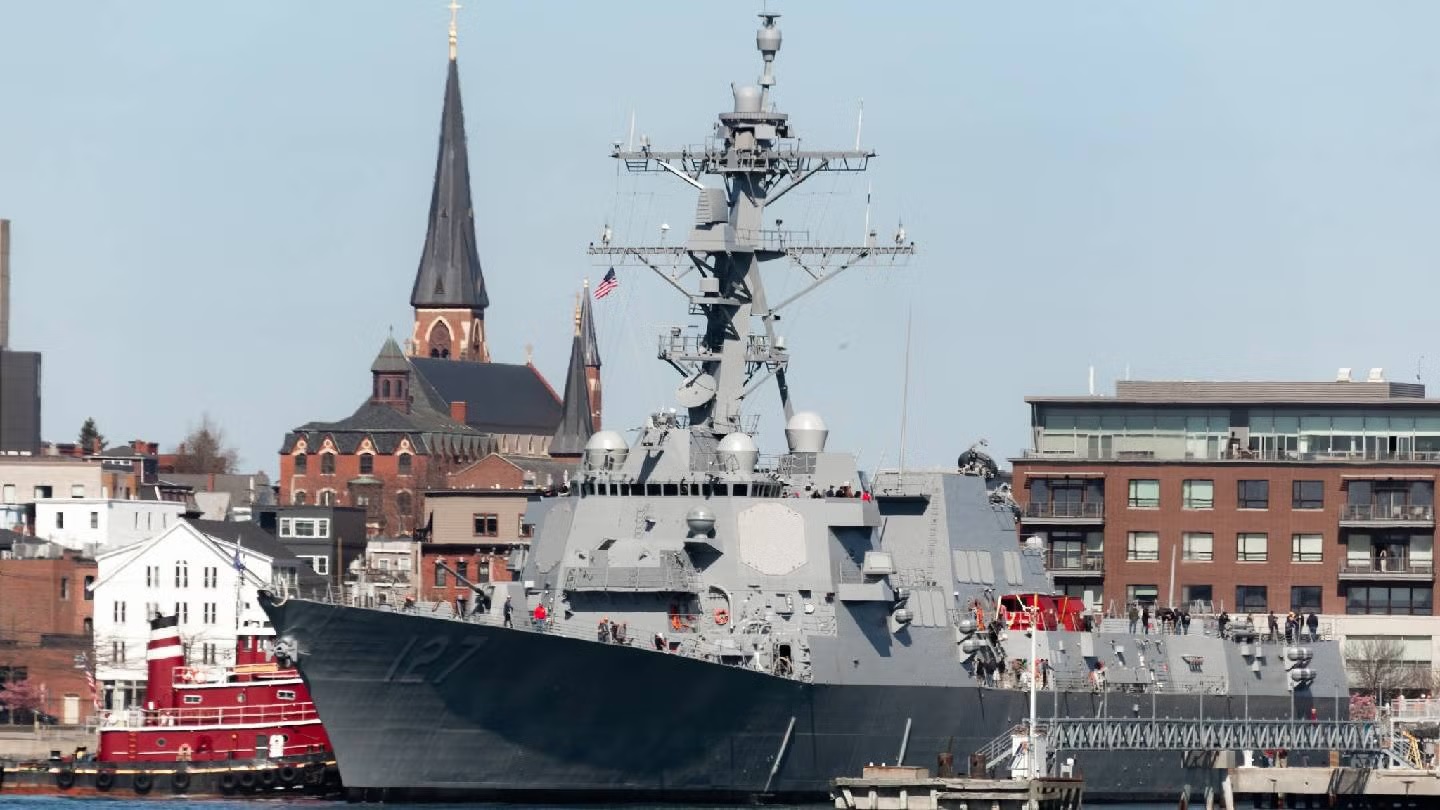
Washington — June 02, 2026 : The United States Navy officially accepted delivery of the guided-missile destroyer USS Patrick Gallagher (DDG 127) on May 28, 2026, more than two months ahead of schedule. Constructed by General Dynamics Bath Iron Works in Maine, the vessel becomes the 77th Arleigh Burke-class destroyer and the final ship built under the Flight IIA configuration.
The delivery marks the formal transfer of the ship from the shipbuilder to the Navy and concludes production of the Flight IIA variant, before the Navy transitions to the newer Flight III design for future destroyers.
Construction Timeline and Program Background
Bath Iron Works received the contract to build USS Patrick Gallagher on September 28, 2017. Construction began on November 9, 2018, while the keel was laid on March 30, 2022, marking a major milestone in the ship’s assembly.
The destroyer was christened on July 27, 2024, in a ceremony attended by the family of its namesake. Patrick Gallagher’s sisters served as ship sponsors and officially christened the vessel in his honor.
USS Patrick Gallagher is the final Flight IIA destroyer in the long-running Arleigh Burke-class program, one of the U.S. Navy’s primary multi-mission surface combatant programs. Future destroyers will be built under the Flight III configuration, which introduces upgraded systems and enhanced operational capabilities.
Accelerated Sea Trials Enabled Early Delivery
The ship departed Bath Iron Works on April 27, 2026, to begin builder’s sea trials, which assessed propulsion systems, maneuverability, combat systems, electrical performance, and overall ship readiness.
According to Navy officials, the early handover was enabled through an optimized sea trial process that reduced the time between testing phases. During a streamlined testing period, USS Patrick Gallagher completed evaluations of hull, mechanical, electrical, and combat systems in sequence.
The destroyer also conducted a scheduled stop in Portland, Maine, to facilitate crew rotations during testing.
Officials stated that the vessel demonstrated an outstanding material condition during trials, enabling acceptance ahead of schedule while maintaining required performance and safety standards.
Capt. Jay Young, program manager for the DDG-51 destroyer program, credited coordination between the Navy and Bath Iron Works for supporting the ship’s accelerated delivery timeline.
Additional Time for Crew Training and Readiness
Because the destroyer was delivered ahead of schedule, the Navy will gain additional time to prepare the ship for operational deployment.
The extended preparation period will support crew familiarization, operational training, certification, systems testing, and integration activities before the vessel enters active service.
Officials noted that the additional preparation time will contribute to fleet readiness before the destroyer joins front-line operations.
Named After a Decorated Vietnam War Marine
USS Patrick Gallagher is named after United States Marine Corps Corporal Patrick Gallagher, an Irish-born Marine who later served during the Vietnam War.
Gallagher received the Navy Cross for exceptional heroism after saving fellow Marines during combat by jumping on an enemy grenade and throwing it into a nearby river, preventing casualties among his unit.
He was later killed in action approximately one year after the incident for which he received the award.
The destroyer’s christening ceremony in July 2024 formally recognized his service and sacrifice, with his sisters serving as ship sponsors.
Ship Specifications and Combat Capabilities
USS Patrick Gallagher is a Flight IIA Arleigh Burke-class guided-missile destroyer designed for missions including air and missile defense, anti-submarine warfare, surface strike operations, maritime security, and fleet escort duties.
The vessel measures 509.5 feet (155.3 meters) in length and has a full-load displacement of 9,200–9,500 tons.
Power is provided by four General Electric LM2500 gas turbines, producing more than 100,000 shaft horsepower and enabling speeds exceeding 30 knots.
The destroyer is equipped with a 96-cell Mk 41 Vertical Launch System (VLS) capable of launching Tomahawk cruise missiles, Standard Missile interceptors, and other missile systems. Additional armament includes a 5-inch Mk 45 naval gun, torpedoes, close-in defensive systems, and facilities for two MH-60R Seahawk helicopters through an onboard hangar and flight deck.
The ship operates with a crew of approximately 329 personnel.
Flight IIA destroyers also incorporate helicopter facilities, upgraded computing systems, radar improvements, and the Aegis combat system, designed to improve detection, targeting, and response times against modern air and missile threats.
Fleet Role and Transition to Flight III Destroyers
USS Patrick Gallagher will be homeported in Norfolk, Virginia, where it will join the Navy’s destroyer fleet.
The ship enters service as the Navy continues transitioning toward the Flight III configuration, which includes the AN/SPY-6 radar and additional combat system upgrades aimed at improving detection, tracking, and missile defense performance.
The early delivery of USS Patrick Gallagher reflects continued efforts to improve production efficiency and fleet readiness during the transition from Flight IIA to Flight III destroyers.
——— End of Article ———