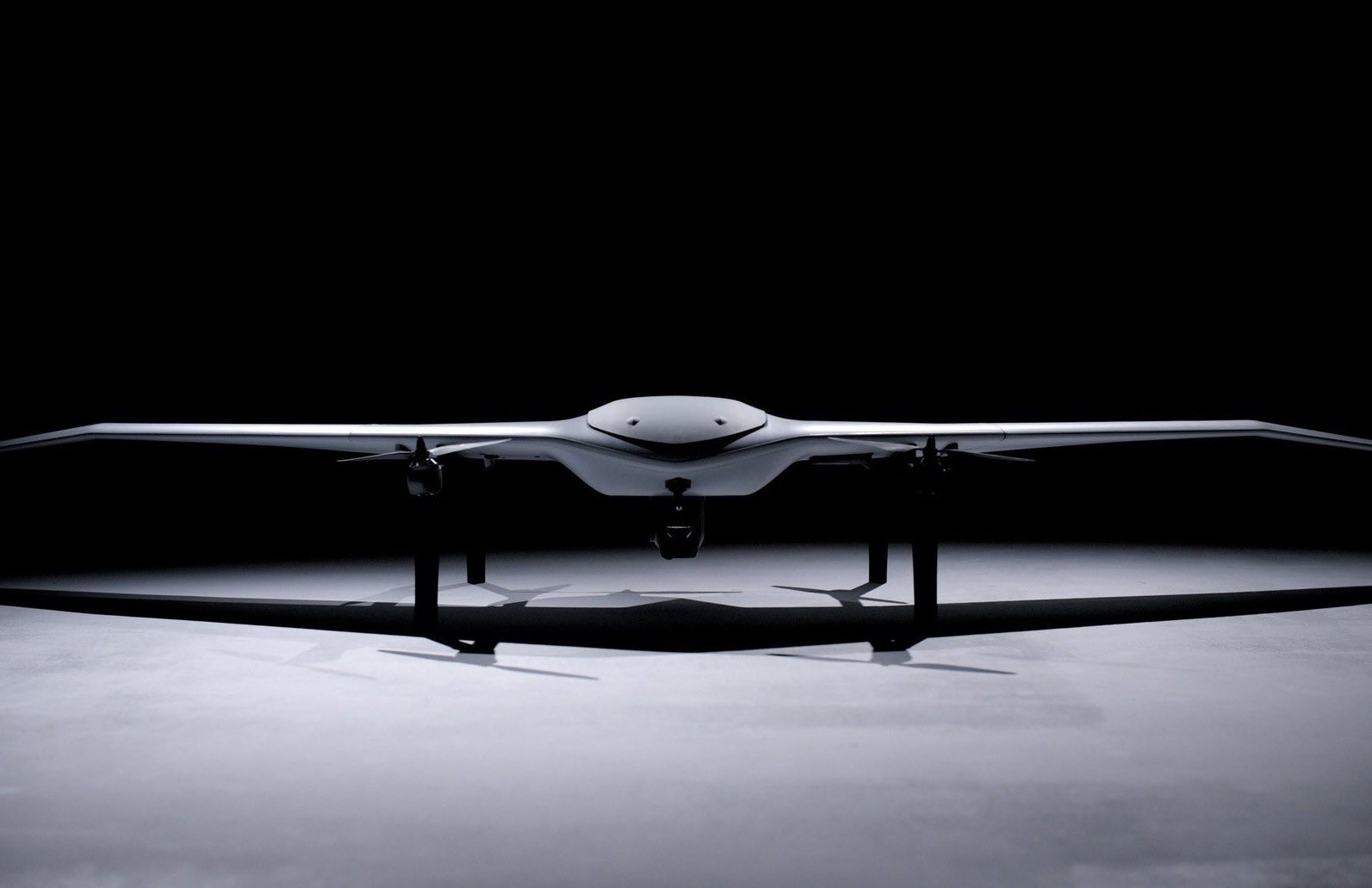
AMSTERDAM — Dutch unmanned systems manufacturer DeltaQuad has launched the Evo-LE, a fully electric fixed-wing vertical takeoff and landing (VTOL) unmanned aerial vehicle designed for long-endurance intelligence, surveillance and reconnaissance missions.
The company announced the UAV around September 22, 2026, targeting defense, security and industrial applications.
Designed for Long-Endurance Missions
The Evo-LE is designed for intelligence, surveillance, target acquisition and reconnaissance (ISTAR), border surveillance, remote-area monitoring, search and rescue, and communications relay missions.
The UAV has an endurance of up to eight hours and a maximum flight range of 480 kilometers (298 miles), depending on payload configuration, flight profile and operating conditions. Its secure radio communications range is up to 120 kilometers (75 miles).
The aircraft has a maximum takeoff weight of 13 kilograms (29 pounds) and can carry payloads weighing up to 1.5 kilograms (3.3 pounds).
Redesigned for Higher Endurance
DeltaQuad says the eight-hour endurance is not simply the result of using a larger battery. The Evo-LE features higher energy-density batteries, a dual-battery configuration, a redesigned electrical architecture and an upgraded VTOL propulsion system.
Mark van Schie, DeltaQuad’s Head of Product, said:
“Achieving this level of endurance required changes across the entire platform, rather than simply increasing battery capacity.”
Reinforced Airframe
The Evo-LE uses the reinforced DeltaQuad Block 3 airframe, constructed from composite materials. It includes dust and rain protection and a heated pitot tube designed to prevent ice buildup.
Updated landing gear struts are designed to detach during a hard landing to help protect the main fuselage. An automatic landing gear system also provides sensors with an unobstructed field of view during flight.
Its VTOL capability allows the UAV to operate from confined or remote locations without a runway. The longer endurance can reduce the need for frequent system rotations during extended missions.
Navigation and Communications
For operations in electronic warfare environments, the Evo-LE can be equipped with a 4/8-array CRPA anti-jamming system for satellite navigation. An optional visual navigation system is also available for areas where GPS is heavily disrupted or denied.
Secure communications options include mesh and phased-array broadband radios with AES-256 encryption. The aircraft uses Auterion Tactical Stack avionics, supporting autonomous navigation and a ruggedized ground-control setup.
Surveillance Payloads
The Evo-LE can carry surveillance payloads such as the NextVision Raptor, which provides stabilized RGB and thermal imaging for long-range tracking and target acquisition.
The UAV is part of the DeltaQuad Evo family and shares the Block 3 airframe with the standard Evo. While the standard Evo prioritizes payload flexibility with a payload capacity of up to 3 kilograms, the Evo-LE uses dual batteries as standard and is optimized for endurance.
DeltaQuad describes the Evo-LE as offering the longest endurance of any fully electric fixed-wing VTOL platform in the sub-15-kilogram class. The system is available to order.
——— End of Article ———