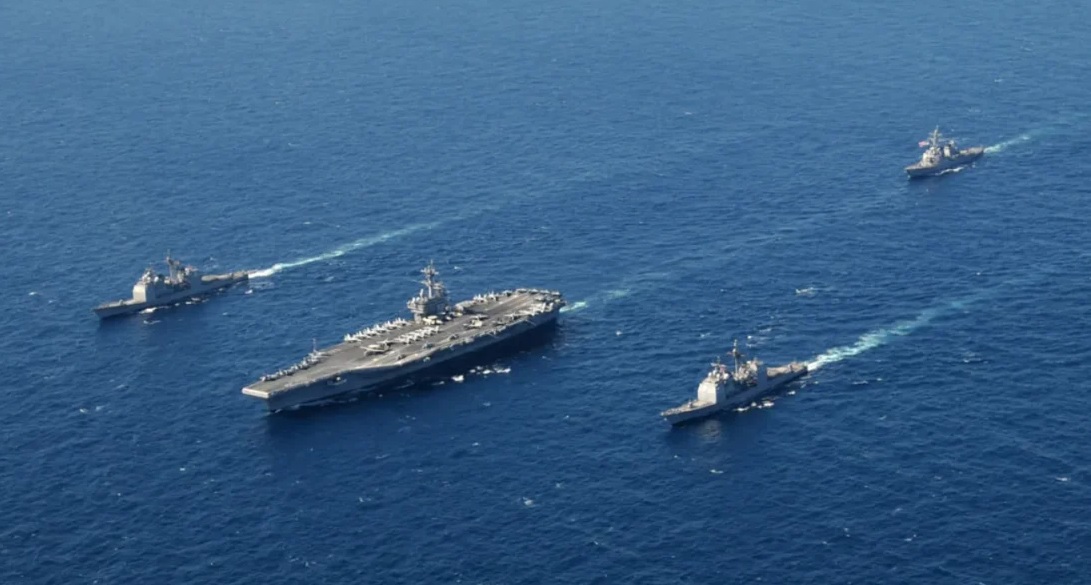
WASHINGTON — March 7, 2026 : The United States Navy is preparing to deploy the USS George H.W. Bush (CVN-77) Carrier Strike Group to the Middle East, a move that could increase the number of American carrier strike groups operating in the region to three. The deployment, first reported on March 6, 2026, would expand U.S. naval aviation capacity for sustained air operations, maritime security missions, and deterrence activities near Iran while supporting the protection of commercial shipping routes across key maritime corridors.
The carrier recently completed its final pre-deployment workups off the coast of Cape Hatteras, North Carolina, marking the conclusion of training and readiness certification required before overseas deployment. Following these exercises, the strike group is expected to cross the Atlantic Ocean and operate in the eastern Mediterranean. From this location, U.S. naval forces would be positioned to reinforce maritime security operations across the Mediterranean Sea, the Red Sea, and the approaches to the Persian Gulf.
Expanding Carrier Presence in the Region
If the deployment proceeds as planned, the United States would operate three carrier strike groups simultaneously in waters surrounding the Middle East. The USS Gerald R. Ford (CVN-78) recently transited the Suez Canal and is currently operating in the Red Sea, while the USS Abraham Lincoln (CVN-72) is deployed in the Arabian Sea.
The addition of the USS George H.W. Bush would extend U.S. carrier coverage across multiple maritime theaters, allowing aircraft and escort ships to operate across the eastern Mediterranean, the Red Sea, and waters near the Persian Gulf. Such a posture increases the ability of naval commanders to conduct sustained operations, maintain maritime security patrols, and respond rapidly to emerging threats across the region.
Carrier strike groups serve as mobile air bases capable of conducting high-tempo operations without relying on regional land bases. This operational flexibility is considered particularly important during periods of instability affecting maritime chokepoints and regional shipping lanes.
Carrier Capabilities and Aircraft Complement
The USS George H.W. Bush is the tenth and final aircraft carrier built under the U.S. Navy’s Nimitz-class program. The nuclear-powered vessel displaces more than 100,000 tons and is powered by two nuclear reactors that enable long-duration operations without refueling. Its design supports sustained aviation operations far from U.S. territory and allows the carrier to launch and recover aircraft continuously during extended missions.
Embarked aboard the ship is Carrier Air Wing Seven, which provides the carrier’s primary aviation capability. The air wing typically includes a mix of tactical aircraft and support platforms designed to perform multiple mission profiles.
These aircraft include the F/A-18E/F Super Hornet for strike and air superiority missions, the EA-18G Growler for electronic attack and suppression of enemy air defenses, the E-2D Advanced Hawkeye for command, control, and surveillance, and the MH-60 Seahawk for anti-submarine warfare, maritime surveillance, logistics, and search-and-rescue operations.
Together, these aircraft provide capabilities including precision strike operations, intelligence and surveillance missions, airborne command and control, electronic warfare, and anti-submarine operations. A carrier air wing can generate dozens of combat sorties per day depending on operational requirements.
Composition of the Carrier Strike Group
The aircraft carrier operates as the centerpiece of a broader carrier strike group formation. In addition to the carrier and its embarked air wing, the group typically includes several guided-missile destroyers from the Arleigh Burke-class destroyer and, in many deployments, a cruiser from the Ticonderoga-class cruiser.
These escort ships are equipped with the Aegis Combat System, which integrates radar, command systems, and interceptors to provide air and missile defense for the strike group and surrounding naval forces.
Warships in the formation carry vertical launch systems capable of firing long-range weapons including the Tomahawk cruise missile for land-attack missions and interceptors from the Standard Missile family used for air defense and ballistic missile defense operations. These ships also deploy anti-submarine warfare sensors, torpedoes, and helicopters to detect and track hostile submarines.
In high-intensity scenarios, a carrier strike group can conduct coordinated long-range strikes against military infrastructure, missile launch facilities, naval bases, or armed groups operating near strategic maritime corridors.
Maritime Security Concerns in the Region
The planned deployment takes place amid increasing instability affecting several key maritime chokepoints in the Middle East. In the Red Sea, forces in Yemen have launched drones and missiles targeting international shipping and vessels linked to Israel, leading several global shipping companies to divert routes away from the region.
U.S. naval vessels deployed in the Red Sea have conducted multiple interception operations to counter incoming missiles and drones while also participating in retaliatory strikes against launch sites.
At the same time, tensions have affected the Strait of Hormuz, one of the most important energy transit routes in the world. Approximately 20 percent of global oil shipments move through the strait each year, making it a critical corridor for international energy markets.
Recent security concerns have led to a reduction in maritime transit through the waterway, contributing to disruptions in global energy supply chains and shipping patterns.
U.S. Measures to Protect Shipping
In response to the disruption of maritime traffic, the United States government has introduced a financial support mechanism designed to reduce risk for commercial shipping companies operating in the region. The program includes approximately $1 billion in reinsurance coverage aimed at offsetting increased insurance costs associated with operating near active conflict zones.
U.S. Energy Secretary Chris Wright indicated that the U.S. Navy may also begin escorting commercial vessels through the Strait of Hormuz once operational conditions permit. Such escort missions would resemble naval operations conducted during the Tanker War, when U.S. naval forces escorted oil tankers to ensure safe passage through the Gulf.
Strategic Impact of the Deployment
The addition of the USS George H.W. Bush Carrier Strike Group would increase the U.S. military’s ability to sustain continuous air operations across multiple areas of the Middle East. Carrier-based aircraft can rapidly shift between mission sets, including maritime patrol, convoy escort, air defense, and precision strike operations.
Operating multiple carrier strike groups across different maritime zones also provides operational redundancy and allows commanders to distribute forces across strategic waterways while maintaining rapid response capability.
With carrier groups positioned in the Mediterranean, the Red Sea, and waters near the Persian Gulf, the United States would maintain a continuous naval aviation presence across several critical shipping routes and regional security zones. The USS George H.W. Bush and its accompanying strike group have completed composite training unit exercises and are certified for overseas deployment, allowing the Navy to initiate the mission when operational orders are issued.
——— End of Article ———