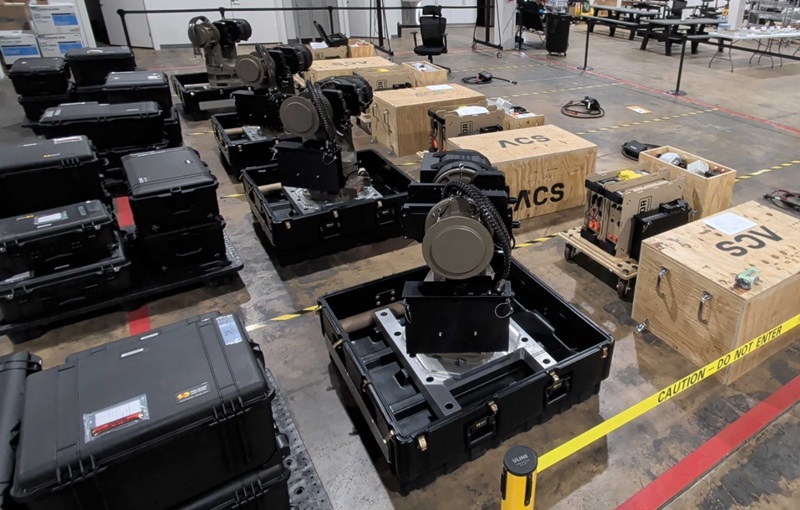
WASHINGTON, D.C., — April 3, 2026 : The U.S. Navy has awarded Northrop Grumman a $334.4 million sole-source contract modification for the production of up to nine additional Surface Electronic Warfare Improvement Program (SEWIP) Block 3 electronic attack systems, marking a continued expansion of the Navy’s next-generation electronic warfare capabilities across its surface fleet.
The modification increases the total number of SEWIP Block 3 systems under contract to a maximum of 24 units. If all contract options are exercised, the cumulative value of the award could reach $783 million. The contract action, announced on March 30, 2026, also includes the first SEWIP Block 3 shipset designated for installation on a nuclear-powered aircraft carrier (CVN), representing a significant step in extending advanced electronic attack capabilities beyond destroyer platforms.
Program Overview and System Evolution
SEWIP Block 3 is the latest upgrade to the Navy’s AN/SLQ-32(V) electronic warfare suite. The system integrates a non-kinetic electronic attack subsystem with the AN/SLQ-32(V)6 configuration developed under SEWIP Block 2, forming the AN/SLQ-32(V)7 system.
The AN/SLQ-32(V)7 provides wideband onboard electronic attack capability designed to counter anti-ship missiles and disrupt targeting systems operating across air, sea, and land domains. The system focuses on electronic warfare techniques such as jamming, deception, and emitter management, reducing reliance on kinetic interceptors and improving the cost-efficiency of fleet defense.
The architecture incorporates Active Electronically Scanned Arrays (AESA) enabled by Gallium Nitride (GaN) transmit and receive modules. These technologies were matured through earlier research and risk-reduction efforts conducted under the Office of Naval Research’s Integrated Topside program.
Platform Integration and Configuration Variants
The physical integration of SEWIP Block 3 varies depending on the host platform due to size, weight, power, and cooling (SWaP-C) constraints.
Destroyer Integration — Hemisphere Configuration
Initial deployments are being carried out under the DDG MOD 2.0 modernization program for DDG-51 Flight IIA guided-missile destroyers. These ships utilize a “Hemisphere” configuration, where antennas and associated electronic systems are grouped into large enclosures mounted on the port and starboard sides of the main deckhouse.
On these platforms, SEWIP Block 3 integrates with the Aegis Baseline 10.M combat system. The USS Pinckney (DDG-91) is the first destroyer to receive the AN/SLQ-32(V)7 system. Installed in 2023, the system is currently operational, with the vessel deployed to the Middle East in support of ongoing missions.
Aircraft Carrier Integration — Quadrant Configuration
The current contract modification initiates the adaptation of SEWIP Block 3 for aircraft carrier platforms. Due to the distinct structural layout of carriers, the system will employ a “Quadrant” configuration, redistributing hardware modules around the ship’s superstructure.
Unlike destroyers, carrier-based systems will integrate with the Ship Self-Defense System (SSDS) MK 2 Baseline 12. U.S. Navy budget documents for fiscal years 2025 and 2026 indicate that the USS Harry S. Truman (CVN 75) is scheduled to receive the first carrier installation of SEWIP Block 3.
The installation is expected to coincide with the carrier’s planned Refueling and Complex Overhaul (RCOH) at Newport News Shipbuilding, beginning in mid-2026, aligning system integration with major lifecycle maintenance.
Scaled Onboard Electronic Attack (SOEA) Development
In parallel with full-scale SEWIP Block 3 deployment, the Navy is advancing the Scaled Onboard Electronic Attack (SOEA) program to equip smaller surface combatants that cannot support the full system’s SWaP-C requirements.
SOEA is being developed under a Middle Tier of Acquisition framework and is designed to integrate with the existing AN/SLQ-32(V)6 architecture while delivering a reduced-size electronic attack capability.
In 2025, the Navy awarded two Phase 1 rapid prototyping contracts to Northrop Grumman and Lockheed Martin.
Northrop Grumman’s approach leverages the core GaN and AESA technologies from SEWIP Block 3, scaled down for smaller platforms. Lockheed Martin’s solution builds on its prior SEWIP Block 2 work and incorporates technology derived from the canceled AN/ALQ-248 Advanced Offboard Electronic Warfare (AOEW) pod program.
The Phase 1 effort focuses on validating performance, architecture, and system functionality, with prototype systems planned for at-sea demonstrations.
Program Management and Production Outlook
The SEWIP Block 3 program is managed by the Navy’s Program Executive Office Integrated Warfare Systems. Production and integration activities under the March 2026 contract modification are ongoing, supporting continued fielding of advanced electronic warfare systems across the surface fleet.
The expansion of SEWIP Block 3, alongside the parallel SOEA effort, reflects a broader Navy strategy to enhance non-kinetic defensive capabilities and improve survivability against increasingly complex missile and targeting threats.
——— End of Article ———