HOLLYWOOD, Maryland — April 16, 2026 : The U.S. Navy has awarded Platform Systems Inc., operating as Platform Aerospace, a $12,893,010 contract modification to continue support for the Vanilla long-endurance unmanned aircraft system (UAS) through August 2026. The funding is drawn from the Navy’s fiscal 2026 research, development, test, and evaluation accounts and will sustain operational availability of the system as testing and potential operational use continue.
The work will be carried out at Platform Aerospace’s facility in Hollywood, Maryland. The company, a service-disabled veteran-owned small business, develops and supports the Vanilla UAS, a Group 3 ultra-long-endurance unmanned platform designed for persistent operations measured in days rather than hours.
Contract Scope and Program Continuity
The contract modification includes the provision of Vanilla UAS hardware, spare parts, engineering services, and logistics support. It also covers continued integration and sustainment of mission payloads, indicating an ongoing transition from demonstration-focused activities toward sustained operational readiness and repeated deployment cycles.
Engineering and logistics support elements are structured to maintain system availability for extended testing, demonstrations, and mission integration efforts. The award supports continued evaluation of the platform across a range of naval and joint operational scenarios, including maritime surveillance, reconnaissance, communications relay, and persistent overwatch missions.
Aircraft Design and Technical Specifications
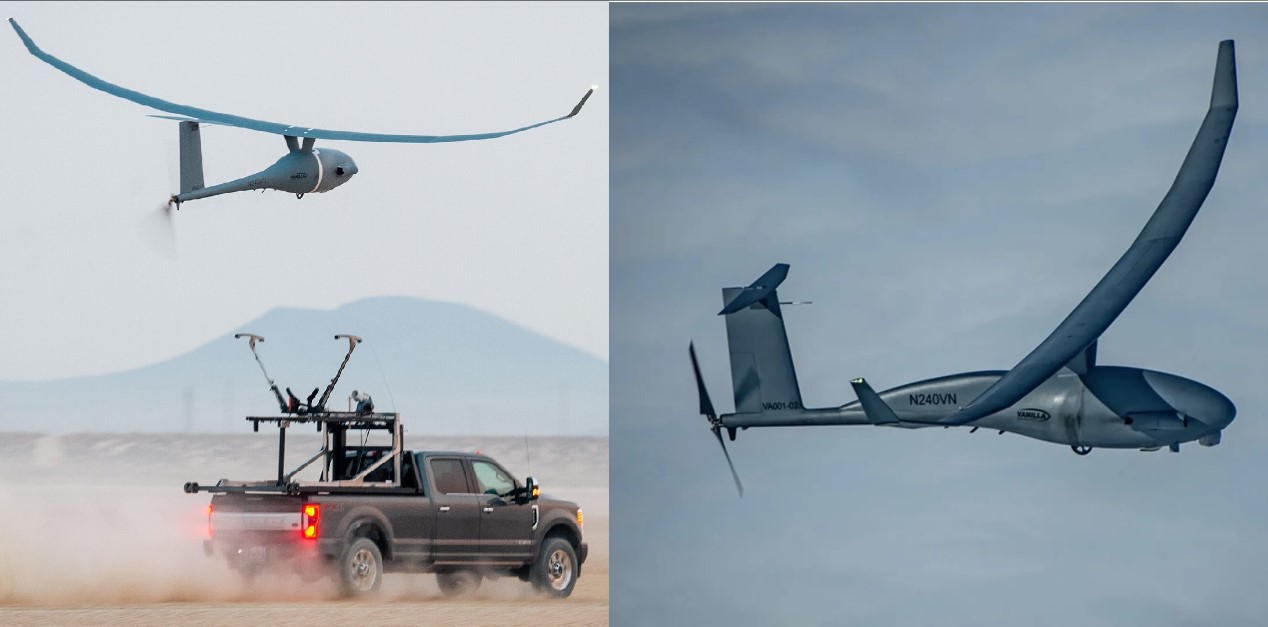
The Vanilla UAS features a modular airframe with a wingspan of 36 feet and is designed for flexible payload integration. It can carry a maximum payload of 150 pounds (68 kilograms) distributed across seven installation points, while providing up to 500 watts of onboard power to mission systems.
Performance characteristics include a dash speed of 70 knots and a loiter speed between 45 and 55 knots. The aircraft operates at a service ceiling of 15,000 feet and can achieve a range exceeding 13,000 to 15,000 nautical miles depending on payload configuration. Endurance exceeds eight days with lighter payloads and is approximately four days at maximum payload capacity.
The platform is land-launched using a truck-based mechanism and does not require a runway for takeoff. It is capable of beyond-visual-line-of-sight (BVLOS) operations, enabling long-duration missions over extended distances without direct operator visibility.
Endurance Record and Flight History
The Vanilla UAS holds the world record for unrefueled endurance in its class using an internal combustion engine. In October 2021, the aircraft completed a continuous flight lasting 8 days, 50 minutes, and 47 seconds at Edwards Air Force Base, California, covering approximately 12,200 miles. Earlier testing demonstrated endurance of 121 hours in 2017, reflecting the platform’s progressive development in long-duration flight capability.
Payload Integration and Mission Capability
The system is designed to integrate more than 40 different payload types, supporting a wide range of mission profiles. These include multi-spectral and electro-optical/infrared imaging sensors for intelligence, surveillance, and reconnaissance (ISR); signals intelligence (SIGINT) systems; and electronic warfare (EW) payloads.
Vanilla can also function as a communications relay platform, carrying equipment such as Link-16 and satellite communications systems to maintain connectivity in environments where ground infrastructure is limited or degraded. Additional payload options include synthetic aperture radar and environmental sensing systems.
The aircraft supports air-launched effects (ALE) configurations for both kinetic and non-kinetic payloads and has been tested with swarms of micro-drones. Its architecture allows multiple mission sets to be conducted during a single extended-duration flight.
Operational Testing and Deployment Experience
The Vanilla UAS has participated in U.S. Navy and joint exercises, including operations conducted at Andersen Air Force Base, Guam. Testing has included applications related to anti-submarine warfare and other maritime mission sets.
Platform Aerospace has operated the system in diverse environmental conditions, including desert, tropical, and Arctic regions. The aircraft has flown missions for NASA in Greenland and conducted Arctic operations extending more than 1,000 miles into polar ice cap areas. These deployments have demonstrated system reliability in extreme climates and long-range mission profiles.
The platform incorporates flight management systems and autonomy features designed to support continuous operations over extended durations with reduced operator workload.
Program Background and Development Framework
The Vanilla program originated from efforts to develop ultra-long-endurance unmanned aircraft capabilities, initially under Vanilla Aircraft and later expanded through acquisition and development by Platform Aerospace. The program has received support through multiple Small Business Innovation Research (SBIR) contracts from the Office of Naval Research, Naval Air Systems Command, the Air Force Research Laboratory, and other organizations.
A Phase III SBIR contract awarded in 2022 established a five-year framework for continued advancement, supporting system maturation, payload integration, and expanded operational testing.
Strategic Context
The Navy’s latest contract modification reflects continued investment in long-endurance unmanned systems designed for persistent coverage in maritime and expeditionary environments where frequent recovery and relaunch are impractical. By combining extended endurance, modular payload capability, and relatively low operating costs, the Vanilla UAS is positioned as an attritable yet reusable platform suitable for distributed operations.
The contract ensures that the system remains available for ongoing testing and mission integration activities through August 2026, supporting the Navy’s broader efforts to expand the role of unmanned systems in sustained surveillance, reconnaissance, and communications support missions.
——— End of Article ———