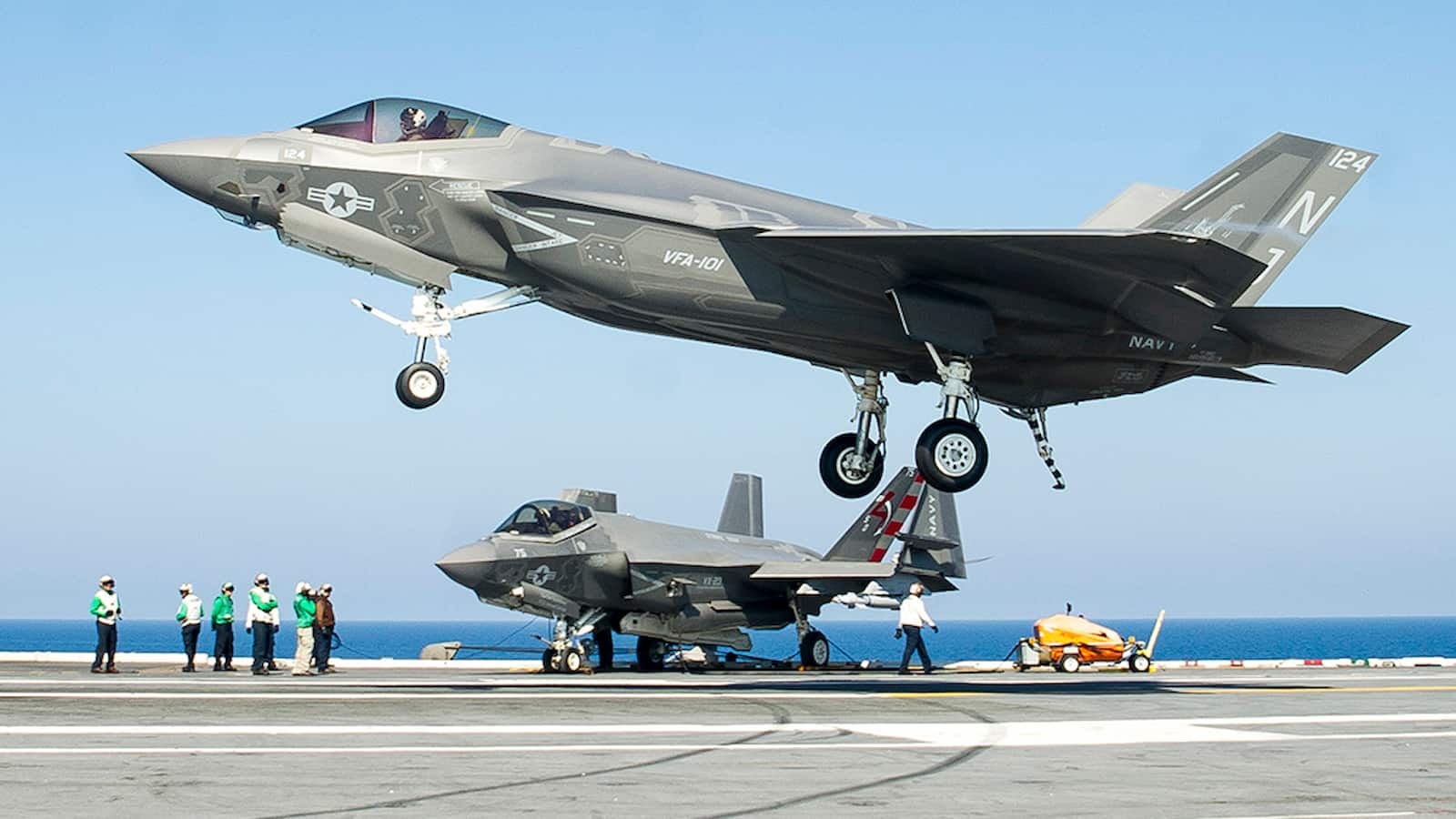
FORT WORTH, Texas, — June 10, 2026 : The U.S. Navy has awarded Lockheed Martin a $153.9 million contract modification to begin procuring long-lead materials, parts, and components for 11 F-35 Lightning II stealth fighter aircraft intended for a foreign government under the U.S. Foreign Military Sales (FMS) program.
The Pentagon has not publicly identified the customer, but the contract adds another international order to the F-35 program, which continues to attract demand from allied and partner nations seeking advanced fifth-generation combat aircraft capabilities.
The fixed-price incentive contract modification was awarded to Lockheed Martin Aeronautics and will fund the early procurement of critical components required before full-scale aircraft production begins. According to the U.S. Navy’s Naval Air Systems Command (NAVAIR), work under the contract is expected to be completed by December 2030.
Long-Lead Procurement Supports Production Schedule
Long-lead procurement is a standard practice in major defense acquisition programs, particularly for complex platforms such as the F-35. Certain components—including advanced avionics, radar systems, engine parts, electronic warfare equipment, and specialized composite structures—require extended manufacturing timelines and must be ordered years before final assembly.
By securing these materials in advance, manufacturers can reduce production bottlenecks, maintain assembly schedules, and support timely aircraft deliveries. The latest contract modification ensures that critical components will be available when production of the 11 aircraft enters later manufacturing stages.
Although the completion date applies to component procurement and production activities, final aircraft deliveries generally occur after these phases are completed.
Aircraft Being Acquired Through Foreign Military Sales Program
The procurement is being conducted through the U.S. government's Foreign Military Sales (FMS) framework, under which the U.S. government acts as an intermediary between foreign customers and American defense contractors.
Under this arrangement, the Naval Air Systems Command, headquartered at Patuxent River, Maryland, manages the acquisition process, contractual oversight, export compliance requirements, and security procedures associated with the transfer of advanced military technology.
The Navy stated that the entire $153.9 million obligation is funded by the purchasing government through FMS funds and does not involve U.S. defense budget appropriations.
As is standard for the F-35 program, the contract was not competitively awarded. Lockheed Martin remains the sole manufacturer of the F-35 airframe and the prime contractor responsible for final aircraft production and integration.
Global Supply Chain Supports F-35 Production
The contract highlights the multinational industrial structure that underpins F-35 production. Manufacturing responsibilities are distributed among several partner nations and major aerospace suppliers, supporting both production capacity and long-term international participation in the program.
The work distribution for this contract includes:
-
59% – Fort Worth, Texas: Lockheed Martin’s primary final assembly and checkout facility.
-
14% – El Segundo, California: Manufacturing activities associated with Northrop Grumman’s center fuselage production.
-
9% – Warton, United Kingdom: BAE Systems’ facility responsible for aft fuselage structures and other major airframe sections.
-
4% – Cameri, Italy: Leonardo’s production and assembly facility supporting European F-35 operators.
-
14% – Other locations: Including Orlando, Florida; Nashua, New Hampshire; Baltimore, Maryland; San Diego, California; and several international supplier facilities.
The distributed production model has become a defining feature of the F-35 program, involving hundreds of suppliers across multiple countries.
F-35 Variants and Capabilities
The F-35 Lightning II is produced in three variants designed to meet different operational requirements while sharing a common suite of sensors, mission systems, and stealth technologies.
The F-35A is the conventional takeoff and landing version operated primarily by air forces. The F-35B features short takeoff and vertical landing (STOVL) capability through its Rolls-Royce LiftSystem powered by the Pratt & Whitney F135 engine, enabling operations from amphibious assault ships and austere airfields. The F-35C is the carrier-based variant developed for aircraft carrier operations, featuring larger wings, strengthened landing gear, and enhanced range.
All variants are equipped with advanced systems including the AN/APG-81 Active Electronically Scanned Array (AESA) radar, AN/AAQ-40 Electro-Optical Targeting System (EOTS), and AN/ASQ-239 electronic warfare suite. These systems provide sensor fusion capabilities that allow pilots to detect, track, and engage threats across air, land, and maritime domains.
International Demand Remains Strong
The F-35 remains one of the most widely adopted fifth-generation fighter programs globally. More than 1,300 aircraft have been delivered to operators worldwide, and the program is expected to exceed 3,400 aircraft across current and future customers.
The aircraft's appeal extends beyond its low-observable design. Operators gain access to advanced networking capabilities through Link 16 and the Multifunction Advanced Data Link (MADL), enabling secure real-time information sharing between F-35s and other compatible military platforms.
These capabilities allow pilots to receive and distribute targeting and situational awareness data across a broader network of aircraft, ships, ground forces, and command centers while maintaining a reduced electronic signature.
The latest contract modification represents another step in sustaining the F-35 production pipeline as international customers continue to expand their fighter modernization programs. Additional details regarding the identity of the purchasing nation and the specific aircraft variant involved are expected to emerge as the acquisition progresses through future production phases.
——— End of Article ———