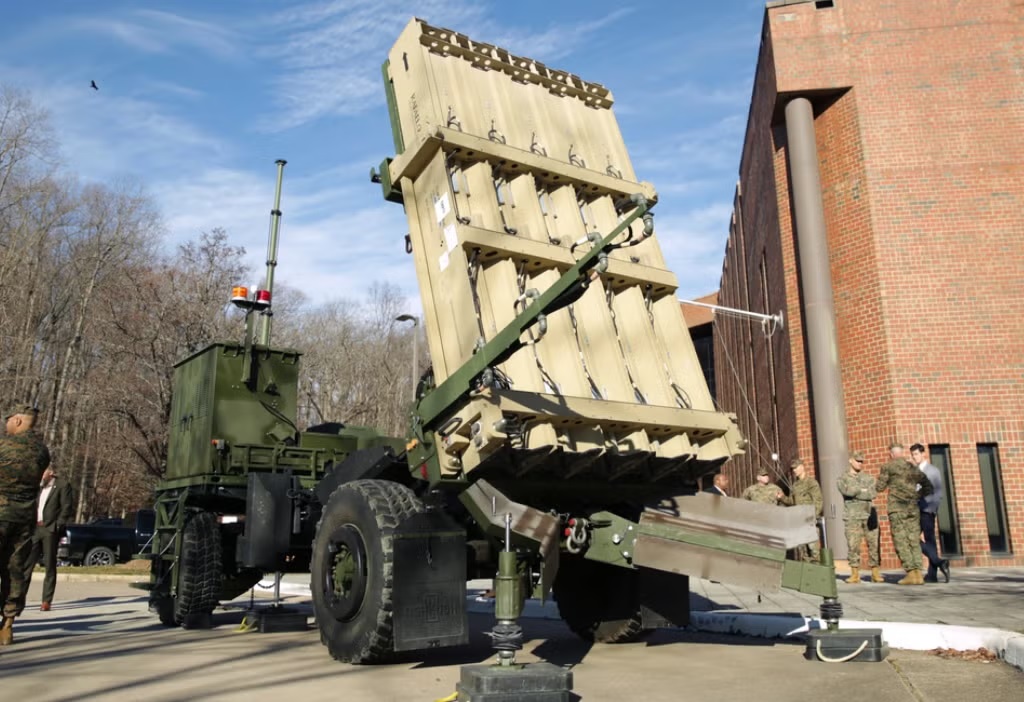
GUAM, June 28, 2026 — The U.S. Marine Corps has confirmed the first public deployment of its Medium-Range Intercept Capability (MRIC) air defense system in the Pacific during the ongoing Valiant Shield 2026 military exercise. Marines from the III Marine Expeditionary Force (III MEF) conducted calibration, evaluation, and operational drills with the system at the Mason Live Fire Training Range Complex on Guam between June 24 and June 26.
The deployment marks a key step in the Marine Corps' effort to modernize its organic air defense capability for operations in the Indo-Pacific. Valiant Shield 2026, held from June 22 to July 1, is a biennial U.S.-led exercise involving U.S. military services and allied forces across Guam, the Northern Mariana Islands, Japan, and surrounding waters. The exercise focuses on improving joint interoperability and multi-domain operational readiness.
Filling a Long-Standing Capability Gap
The MRIC restores a medium-range air defense capability the Marine Corps has lacked since retiring its MIM-23 Hawk surface-to-air missile batteries in 1997. Since then, Marines have depended on the U.S. Army's Patriot and THAAD systems for theater-level air defense.
Designed to engage aerial threats at ranges between approximately 4 and 70 kilometers (2.5 to 43 miles), the MRIC provides Marine Littoral Regiments with an organic capability to defend against drones, cruise missiles, precision-guided rockets, and fixed-wing aircraft while operating in dispersed expeditionary environments.
System Features
The MRIC integrates Israeli-developed Iron Dome technology with U.S. Marine Corps command-and-control systems. The trailer-mounted launcher carries up to 20 SkyHunter interceptor missiles, the U.S.-built version of Israel's Tamir interceptor.
The SkyHunter features an active radar seeker, a two-way data link for mid-course guidance updates, and a fragmentation warhead with a proximity fuze. The system works with the AN/TPS-80 Ground/Air Task-Oriented Radar (G/ATOR), which provides 360-degree target detection and tracking, while the Common Aviation Command and Control System manages target prioritization and engagement.
This integrated architecture enables the system to detect, track, and engage multiple aerial threats simultaneously.
Operational Evaluation on Guam
The deployment follows the delivery of the first batch of Tamir interceptors from Israel in May 2026, supporting the Marine Corps' first operational MRIC platoon.
During the exercise, Marines evaluated radar performance, communications, and engagement procedures under operational conditions. On June 26, engagement control operator Lance Cpl. Billyson Garcia-Almanzar and aviation radar technician Lance Cpl. Caden Hart assessed radar tracking functions. Air defense systems technicians Cpl. Miles Taylor and Lance Cpl. Chris Dorr monitored system diagnostics using specialized SLK devices, while transmissions system operator Lance Cpl. Delano Tracey managed communications through an AN/PRC-117 tactical radio network.
The drills expanded on earlier live-fire testing conducted at White Sands Missile Range in New Mexico by evaluating the system in a joint exercise environment.
Production and Future Fielding
Raytheon received a $380 million full-rate production contract for MRIC hardware in late 2025, increasing the total program value to approximately $412 million. SkyHunter interceptors are produced by Raytheon and Rafael Advanced Defense Systems through their R2S joint venture in East Camden, Arkansas.
The Marine Corps plans to field the MRIC to all three Low Altitude Air Defense Battalions between 2026 and 2028. The Guam deployment demonstrates that the first operational platoon is prepared to support joint and expeditionary operations while providing mobile medium-range air defense for forward-deployed Marine forces.
——— End of Article ———