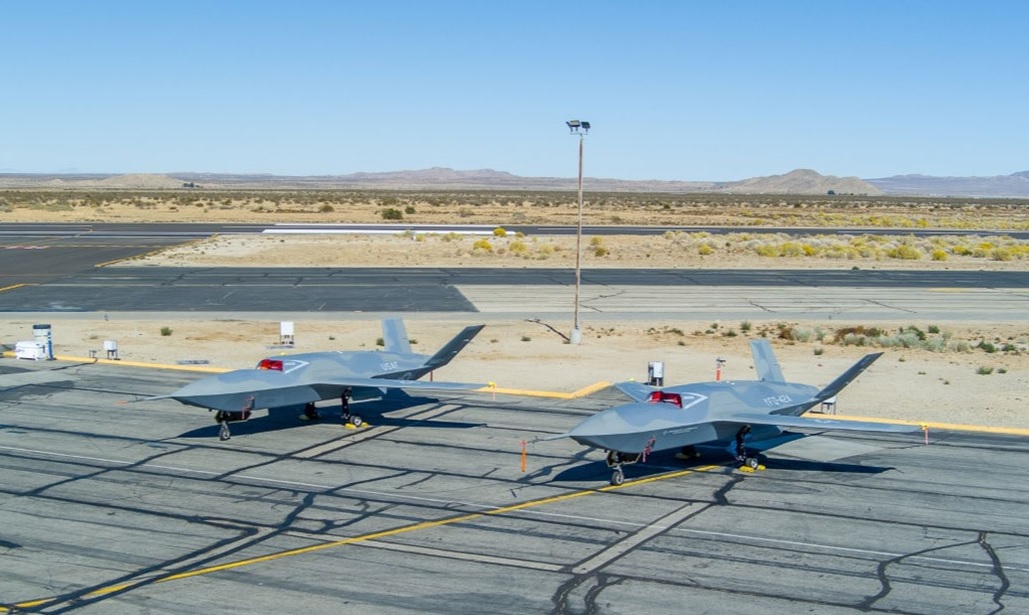
SAN DIEGO : General Atomics Aeronautical Systems, Inc. (GA-ASI) announced Tuesday that the U.S. Marine Corps (USMC) has selected its YFQ-42A Collaborative Combat Aircraft (CCA) to participate in testing under the Marine Air-Ground Task Force Uncrewed Expeditionary Tactical Aircraft (MUX TACAIR) program.
The selection designates the YFQ-42A as a flight test surrogate intended to validate how autonomous, uncrewed “loyal wingman” aircraft integrate with crewed fighter platforms within the Marine Air-Ground Task Force (MAGTF). The effort forms part of the Marine Corps’ 2026 Aviation Plan, which emphasizes manned-unmanned teaming (MUM-T) to extend the operational reach and effectiveness of its F-35 Lightning II fleet.
Program Scope and Objectives
Under a competitive contract award, GA-ASI will modify the YFQ-42A to carry a government-furnished mission systems kit. The kit is described as a software-defined, sensor-integrated suite capable of delivering both kinetic and non-kinetic effects. Testing will focus on evaluating the aircraft’s autonomous control systems, often referred to as its “digital brain,” and its ability to securely communicate and coordinate with Marine Corps aviation and ground assets in contested operational environments.
The Marine Corps intends to use the YFQ-42A surrogate to validate key operational requirements. These include assessing the rapid development and refinement of autonomous behaviors tailored for expeditionary missions, evaluating tactical integration within the MAGTF construct, and collecting flight data to inform requirements for future MUX TACAIR increments. Those increments are projected to enter service in phases between 2030 and 2040.
As part of the evaluation, the aircraft will demonstrate how an uncrewed platform can function alongside crewed fighters in distributed operations, supporting sensing, strike, and electronic warfare roles while remaining interoperable within existing command-and-control networks.
Platform Development and Technical Lineage
The YFQ-42A is a purpose-built combat drone derived from the XQ-67A Off-Board Sensing Station, originally developed for the Air Force Research Laboratory. The XQ-67A served to validate a “genus/species” design approach, using a common baseline airframe to produce multiple mission-specific variants. The YFQ-42A builds on that concept but has been optimized for a tactical fighter support role.
The aircraft completed its maiden flight in August 2025. According to GA-ASI, the YFQ-42A incorporates enhanced speed and maneuverability compared to earlier demonstrators, along with a reduced radar cross-section suited for operations in contested airspace.
The platform is designed with an internal weapons bay capable of carrying two AIM-120 AMRAAM air-to-air missiles, with additional provision for external stores depending on mission requirements. Its modular architecture supports rapid integration of different payloads and mission systems.
Manufacturing leverages model-based digital engineering, enabling scalable production. GA-ASI has indicated that this approach aligns with broader U.S. Air Force demand signals for several hundred Collaborative Combat Aircraft units under parallel CCA initiatives.
Autonomy Architecture and Industry Experience
The YFQ-42A integrates an autonomy architecture developed across GA-ASI’s unmanned aircraft portfolio, including the MQ-9A Reaper, MQ-1C Gray Eagle, and the jet-powered MQ-20 Avenger. The MQ-20 Avenger has been used as a testbed for autonomous flight profiling and artificial intelligence training, forming part of the flight control and mission autonomy core adapted for the YFQ-42A.
GA-ASI states that the aircraft’s “flight core” architecture enables rapid mission reconfiguration and integration of new capabilities. The modular design is intended to support varying operational needs across different branches of the U.S. military while maintaining a common baseline platform.
Mike Atwood, Vice President of Advanced Programs at GA-ASI, said the YFQ-42A combines the company’s autonomy framework with its integration experience to deliver an affordable CCA solution. He noted that mission sets can be exchanged with minimal redesign, supporting adaptability across service requirements.
Competitive Context and Future Development
The Marine Corps is also evaluating alternative concepts under the MUX TACAIR program, including a team led by Northrop Grumman and Kratos centered on the XQ-58A Valkyrie. The comparative testing process will inform the Marine Corps’ long-term approach to fielding attritable, autonomous-heavy aviation capabilities.
Data gathered from the YFQ-42A flight test campaign will contribute to refining technical and operational requirements for subsequent MUX TACAIR increments. These future increments are expected to expand the role of uncrewed aircraft in supporting Marine Corps expeditionary operations, particularly in distributed maritime and forward-deployed environments.
The selection of the YFQ-42A for evaluation marks a formal step in the Marine Corps’ ongoing integration of autonomous systems into its aviation framework, with testing outcomes expected to inform future procurement and force structure decisions.
——— End of Article ———