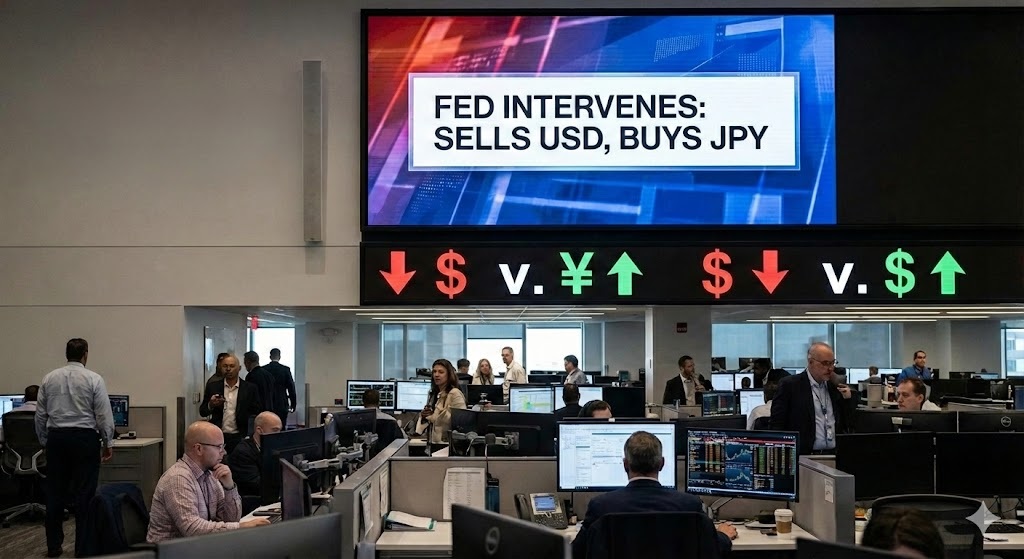
WASHINGTON / TOKYO : For the first time in more than a decade, global financial markets are bracing for the possibility of coordinated U.S.–Japan currency intervention, amid mounting stress in Japan’s bond market and persistent weakness in the yen that policymakers fear could spill over into broader global instability.
Market speculation has intensified after signs that the Federal Reserve Bank of New York has conducted so-called “rate checks” — a technical but significant step that historically precedes direct foreign-exchange intervention. While U.S. officials have not confirmed any plans, traders and analysts widely interpret the move as a signal that Washington may be preparing to sell U.S. dollars and buy Japanese yen, an action that would mark the first such operation by the Federal Reserve this century.
If confirmed, the move would represent a dramatic shift in U.S. policy, reviving a tool that has largely been dormant since the late 1990s and underscoring the seriousness with which authorities are now viewing Japan’s currency turmoil.
A Yen Under Siege
Japan’s currency has been under sustained pressure for years, driven by wide interest-rate differentials, structural capital outflows and a long period of ultra-loose monetary policy. That strain has intensified recently as Japanese government bond yields surged to multi-decade highs, reflecting both global rate pressures and growing unease over Japan’s debt dynamics.
The Bank of Japan, after decades of stimulus, has moved cautiously toward a more hawkish stance, but markets have remained unconvinced that incremental tightening alone can stabilize the yen. The result has been a rare and troubling divergence: yields rising sharply while the currency continues to weaken — a combination many analysts describe as a sign of market dysfunction rather than healthy repricing.
Japanese authorities have already intervened directly several times. Tokyo spent tens of billions of dollars defending the yen in 2022 and again in 2024, including a high-profile operation in July 2024. Each effort produced only temporary relief, with the currency resuming its slide once official support faded.
History suggests why. When Japan acts alone, intervention has repeatedly failed to deliver lasting results. When Washington joins, outcomes have been very different.
Lessons From 1985 and 1998
The most famous example remains the 1985 Plaza Accord, when the United States, Japan and other major economies agreed to jointly weaken the dollar. Over the following two years, the dollar fell by nearly 50 percent against major currencies, reshaping global trade flows and igniting powerful rallies in commodities and non-U.S. asset markets.
A similar dynamic played out during the 1998 Asian Financial Crisis. Japan’s unilateral attempts to stabilize the yen proved ineffective, but once the U.S. Treasury and Federal Reserve coordinated with Tokyo, the currency steadied and market volatility eased.
Those episodes now loom large in investors’ thinking. The growing belief is that only coordinated action can arrest the yen’s decline — and that Washington may finally be preparing to step in.
How Intervention Would Work
In practical terms, a joint intervention would involve the Federal Reserve creating dollars, selling them on foreign-exchange markets and using the proceeds to purchase yen, in coordination with Japanese authorities. The immediate effect would be downward pressure on the U.S. dollar and support for the yen.
Such an operation would also inject liquidity into global markets. Historically, periods of intentional dollar weakness have coincided with strong performance in risk assets, including equities, commodities and emerging-market currencies.
From a U.S. perspective, a softer dollar carries additional advantages. It makes American exports more competitive, supports manufacturing, and — critically — reduces the real burden of servicing the federal government’s massive debt stock by inflating it away over time.
Winners, Losers and Market Tensions
Asset holders have traditionally benefited when the dollar weakens. Stocks and metals often surge in such environments, and past coordinated interventions have coincided with broad rallies across global markets.
However, the current setup is unusually complex. U.S. equities and gold are already trading near or at all-time highs, leaving less room for immediate upside and raising concerns about overcrowded positioning.
Nowhere is the tension more evident than in crypto markets. Bitcoin has historically shown a strong inverse relationship with the U.S. dollar and a strong positive relationship with the Japanese yen. That correlation has recently approached record levels, making digital assets especially sensitive to sharp currency moves.
There is also a critical risk factor: the yen carry trade. Hundreds of billions of dollars remain tied up in strategies that borrow cheap yen to invest in higher-yielding assets, including stocks and cryptocurrencies. When the yen strengthens abruptly, those positions can unwind violently.
That risk was on full display in August 2024, when a relatively small Bank of Japan rate hike sent the yen sharply higher. Bitcoin plunged from around $64,000 to $49,000 in less than a week, and the broader crypto market shed an estimated $600 billion in value.
The implication is stark. A stronger yen could trigger short-term pain for crypto and other risk assets, even if dollar weakness ultimately supports them over the longer term.
Why 2026 Could Be a Turning Point
Despite recent volatility, some analysts argue that crypto remains one of the few major asset classes that has not fully repriced for years of currency debasement. Bitcoin, in particular, remains well below projections many investors had for its 2025 cycle peak.
If coordinated U.S.–Japan intervention does occur and leads to sustained dollar weakness, capital may rotate toward assets perceived as undervalued relative to the new macro environment. Historically, crypto has performed strongly in such conditions once initial dislocations fade.
For now, officials on both sides of the Pacific remain publicly cautious, and no formal announcement has been made. But the signals emerging from New York and Tokyo suggest that policymakers are preparing for contingencies once thought unthinkable.
If the Federal Reserve re-enters the foreign-exchange arena alongside Japan, it would mark a watershed moment — not just for the yen, but for global markets navigating what could become one of the most consequential macro setups of 2026.
——— End of Article ———