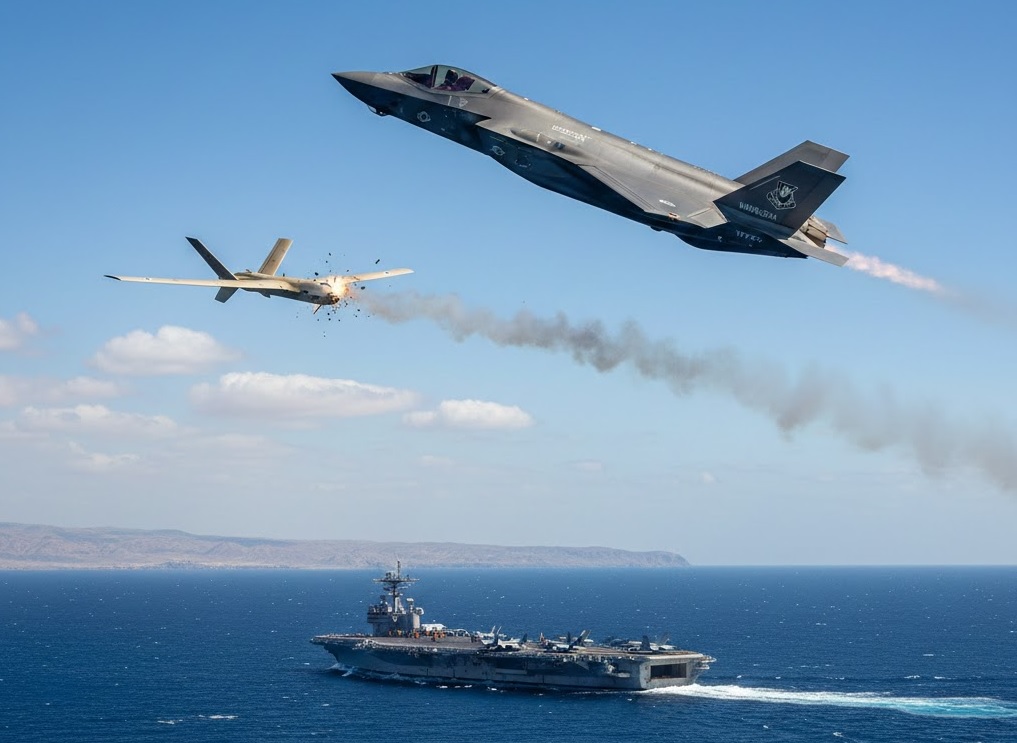
WASHINGTON / ARABIAN SEA : According to Reuters , U.S. military forces destroyed an Iranian unmanned aerial vehicle on February 3 after it approached a U.S. Navy aircraft carrier in what officials described as an unsafe and unprofessional manner, marking a rare direct kinetic encounter between U.S. and Iranian forces at sea.
According to U.S. Central Command (CENTCOM), an Iranian Shahed-139 drone was shot down while the aircraft carrier USS Abraham Lincoln was transiting the Arabian Sea in international waters.
Incident and Military Response
CENTCOM said the drone repeatedly closed in on the carrier strike group despite multiple attempts to reduce tensions. Captain Tim Hawkins, a CENTCOM spokesperson, stated that U.S. forces issued radio warnings and employed standard de-escalatory measures, but the drone continued its approach toward the carrier.
A carrier-based F-35C Lightning II was launched and engaged the aircraft. The drone was destroyed in what CENTCOM described as an act of self-defense, undertaken to ensure the safety of the carrier and the thousands of sailors aboard. No U.S. personnel were injured, and no American equipment was damaged during the engagement.
Location and Operational Context
At the time of the incident, the USS Abraham Lincoln and its escorting vessels were operating in the Arabian Sea, well outside Iran’s territorial waters. U.S. officials emphasized that the carrier strike group was conducting routine operations consistent with international law.
The Abraham Lincoln is the central element of a U.S. Navy carrier strike group deployed to the region to support maritime security and freedom of navigation. The strike group includes multiple guided-missile destroyers tasked with air defense, anti-submarine warfare, and surface operations. U.S. officials reiterated that the carrier remains fully mission-capable and continues its deployment.
The Drone Involved
The aircraft involved was identified by U.S. officials as a Shahed-139, a medium-altitude, long-endurance (MALE) unmanned aerial vehicle operated by Iran. Unlike one-way attack drones, the Shahed-139 is a reusable platform designed for reconnaissance and potential strike missions. It is equipped with electro-optical and infrared sensors that allow for persistent surveillance and real-time data transmission.
Military analysts note that the use of a higher-value reconnaissance drone suggests an effort to closely observe U.S. naval movements and assess response procedures, rather than a routine patrol by a lower-cost system.
Iranian Response
Iranian state-affiliated media outlets acknowledged the loss of contact with a drone operating over international waters. They characterized the mission as a surveillance flight and said the aircraft had completed its task before communications were interrupted. Iranian authorities did not immediately comment on whether the drone was armed or clarify its intended proximity to the U.S. carrier.
Wider Regional Activity
The shootdown occurred amid a broader period of friction in regional waterways. U.S. officials said the drone encounter followed other recent interactions involving Iranian forces and commercial shipping near the Strait of Hormuz, a critical maritime corridor for global energy supplies. The U.S. Navy has increased patrols and escorts in the area in response to these developments.
Despite the incident, U.S. officials stressed that the United States remains committed to preventing escalation while maintaining the right to defend its forces. CENTCOM said it would continue to operate wherever international law allows and would respond appropriately to actions that threaten U.S. personnel or assets.
The February 3 encounter represents the first confirmed shootdown involving U.S. and Iranian forces since mid-2025, underscoring the persistent volatility of the maritime security environment in and around the Arabian Sea.
——— End of Article ———