WASHINGTON — March 13, 2026 : The United States Air Force has sharply increased the operational tempo of its E-3 Sentry airborne early warning and control (AWACS) aircraft across the Middle East as U.S. and allied forces attempt to compensate for the loss of multiple ground-based early warning radar systems destroyed during ongoing hostilities with Iran.
According to defense officials and regional flight tracking data, E-3 aircraft are now flying frequent surveillance missions over Jordan, northern Saudi Arabia, southern Iraq, and portions of the eastern Mediterranean. The aircraft are being used to provide persistent detection and tracking of Iranian drones and ballistic missiles targeting sites in Israel and Jordan after significant portions of the regional radar network were damaged in Iranian strikes.
The expanded airborne surveillance activity follows a series of attacks on U.S. military installations after the United States and Israel launched coordinated strikes against Iranian military infrastructure on February 28, 2026.
Loss of Ground-Based Radar Infrastructure
Since the beginning of the conflict, Iranian forces have targeted numerous U.S. and allied military sites across the region. According to available assessments, approximately 17 U.S. military facilities have been attacked by Iranian missiles or drones.
Several high-value radar installations were destroyed or severely damaged during these strikes, resulting in the loss of an estimated $2.7 billion in radar systems.
Among the most significant confirmed losses were:
• AN/FPS-132 early warning radar located at Al Udeid Air Base in Qatar, valued at approximately $1.1 billion. The radar was the only system of its type deployed outside the United States and served as a critical sensor for ballistic missile detection.
• AN/TPY-2 missile tracking radars associated with Terminal High Altitude Area Defense (THAAD) batteries deployed in Jordan and the United Arab Emirates.
Commercial satellite imagery from Planet Labs and independent analysts shows damage to radar installations at several locations, including strikes recorded between March 1 and March 3 at Muwaffaq Salti Air Base in Jordan, where a THAAD radar was positioned.
The loss of these sensors has significantly reduced the ground-based early warning coverage used to detect incoming missiles and drones across the region.
Shift Toward Airborne Surveillance
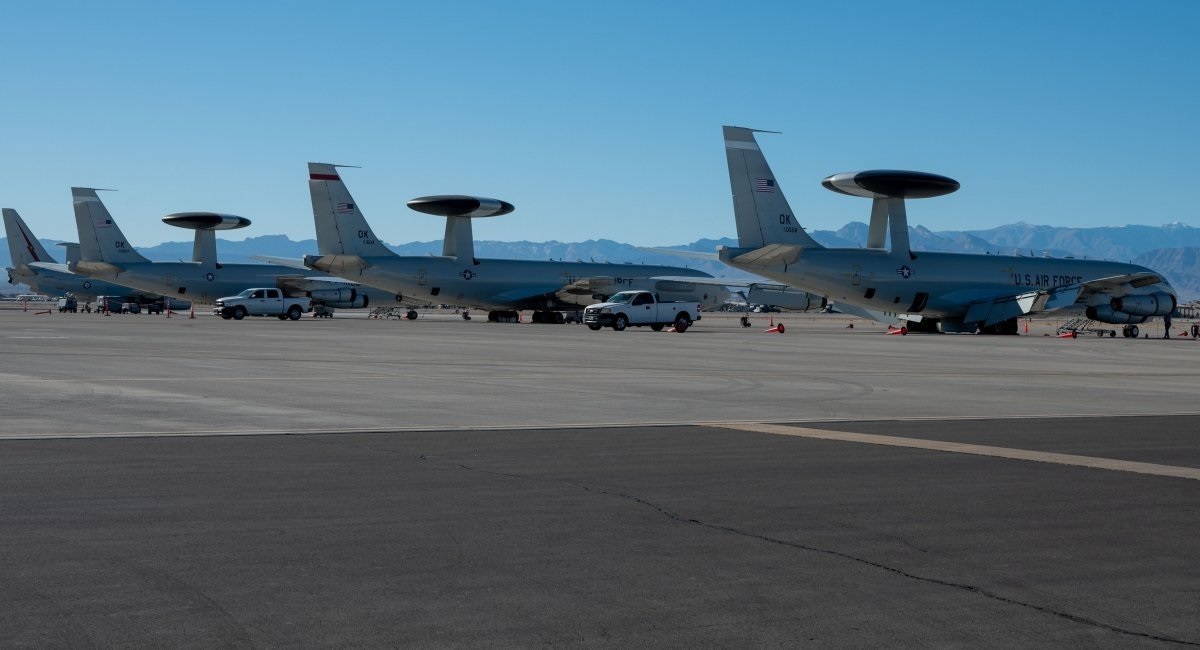
To maintain situational awareness and missile detection capabilities, the U.S. Air Force has relied increasingly on its fleet of E-3 Sentry AWACS aircraft, which provide long-range airborne radar coverage and command-and-control capabilities.
Prior to the start of hostilities, the United States deployed a large portion of its available E-3 fleet to operational theaters in Europe and the Middle East. Approximately six of the Air Force’s remaining 16 operational E-3 aircraft — around 37.5 percent of the fleet — were forward deployed ahead of the February 28 strikes.
Operating primarily from regional bases, the aircraft provide wide-area radar surveillance and transmit targeting and tracking information to U.S. and allied air defense systems through secure tactical data links.
The aircraft carry the AN/APY-1 and AN/APY-2 airborne radars, which are among the largest radar systems installed on aircraft and are capable of tracking hundreds of aerial targets simultaneously.
Operational Demands and Limitations
Maintaining continuous radar coverage using airborne platforms requires sustained aerial refueling operations. E-3 aircraft typically require refueling every four to six hours during long surveillance missions.
The shift from ground-based radar networks to airborne detection platforms has placed additional logistical demands on tanker aircraft and maintenance crews supporting AWACS operations.
The E-3 Sentry platform itself is also facing growing operational limitations. The aircraft’s radar and avionics systems were originally developed during the 1970s, and the platform was not designed specifically for ballistic missile defense missions.
Defense analysts note that the sensors are less effective against certain modern threats, including low-observable drones such as Iran’s Shahed-series systems, and that the aircraft could face challenges in environments with heavy electronic warfare activity.
Fleet availability has also declined after decades of service. The U.S. Air Force currently operates a significantly smaller number of E-3 aircraft than it did during Operation Desert Storm in 1991, when AWACS aircraft maintained continuous surveillance over Iraq and the Persian Gulf.
Replacement Program and Budget Debate
The aging AWACS fleet was expected to be replaced by the E-7 Wedgetail, a modern airborne early warning aircraft based on the Boeing 737 platform and equipped with an advanced multi-role electronically scanned array radar.
However, the U.S. Department of Defense proposed canceling procurement of the E-7 in the fiscal year 2026 budget due to rising program costs and schedule delays.
Members of the U.S. Congress have continued to support the program and have allocated funding to keep the project moving forward, citing the increasing capability gap created by the aging E-3 fleet.
Allied Support and Regional Radar Data
Allied nations are also contributing to airborne surveillance and missile detection operations.
On March 11, 2026, the Royal Australian Air Force deployed an E-7A Wedgetail aircraft from No. 2 Squadron at RAAF Base Williamtown to the Gulf region for an initial four-week deployment supporting regional air defense missions. The aircraft is expected to operate from bases such as Al Minhad Air Base in the United Arab Emirates.
Australia has additionally committed to supplying replacement AIM-120 air-to-air missiles to replenish stocks held by the UAE.
Regional partners are also providing radar tracking data to support the U.S.-led air defense network.
Turkey’s AN/TPY-2 ballistic missile tracking radar located at Kurecik Radar Station, operational since 2012, continues to supply early warning information to NATO and Israeli missile defense systems against potential threats originating from Iran or Syria.
Reports indicate that tracking data from Turkey’s S-400 long-range air defense system may also contribute to regional missile detection networks, although official confirmation of this cooperation has not been publicly provided.
Continuing Missile Threats
The aerial threat environment over Israel and neighboring states remains complex as Iranian ballistic missiles and drones continue to target regional military sites.
Recent footage recorded by an Israeli fighter pilot showed submunitions descending from an Iranian ballistic missile over Israeli territory. Such payloads release multiple smaller bomblets, creating additional challenges for missile interception systems.
Defense officials say the combination of degraded ground-based radar coverage, increased reliance on airborne surveillance platforms, and the growing diversity of Iranian strike systems has placed additional pressure on regional air defense networks.
U.S. Central Command has not publicly disclosed the exact sortie rate of AWACS flights or provided a detailed assessment of the impact of radar losses on overall missile defense coverage in the region.
However, the intensified deployment of E-3 aircraft across the Middle East indicates that airborne early warning platforms are currently playing a central role in maintaining situational awareness while replacement ground-based radar systems are redeployed to the theater.
——— End of Article ———