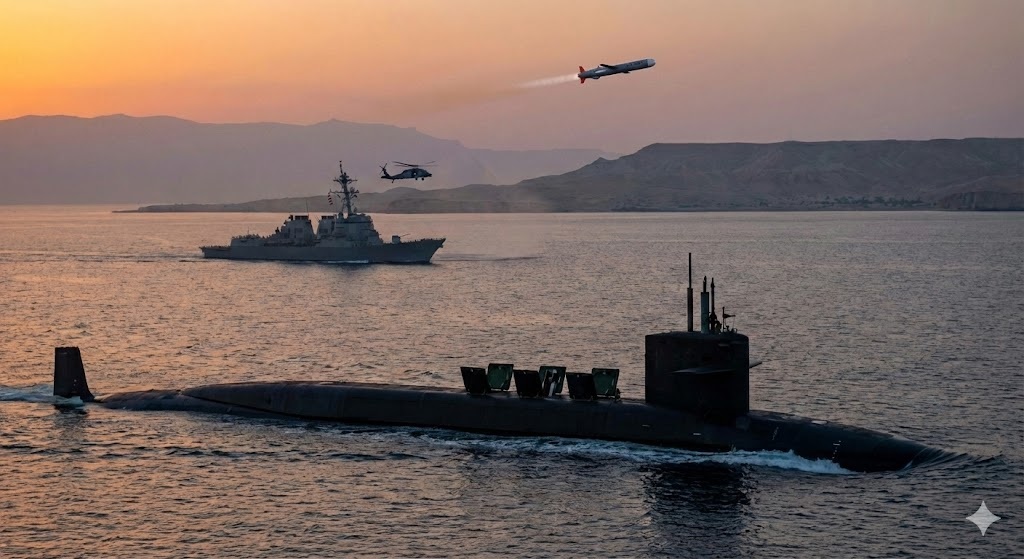
Washington / Gulf Region : In a significant escalation of American military posture in the Middle East, the United States has deployed an additional Tomahawk-armed Ohio-class guided-missile submarine to the Gulf region, a move underscoring rising tensions with Iran and Tehran’s enhanced ballistic and cruise missile capabilities.
According to U.S. defense and regional sources, the submarine, believed to be a converted Ohio-class SSGN capable of carrying up to 154 Tomahawk cruise missiles, has entered the broader Persian Gulf / Arabian Sea theatre as part of a wider reinforcement of U.S. naval and air power in response to Iran’s latest missile developments and growing regional assertiveness.
Strategic Deployment Amid Escalating Tensions
The deployment reinforces what U.S. officials describe as a robust deterrent posture, focused on limiting Iran’s ability to escalate conflict through missile strikes or anti-ship attacks. The exact identity of the submarine has not been officially disclosed, but U.S. naval assets in the region of this class include vessels such as the USS Ohio, USS Michigan, and USS Georgia, all of which have previously been part of strategic deterrence missions.
Each Ohio-class SSGN, following conversion from ballistic missile submarines, can carry up to 154 Tomahawk land-attack cruise missiles, giving the U.S. Navy a potent long-range precision-strike capability from concealed undersea launch platforms.
U.S. Central Command (CENTCOM) and Navy representatives have not publicly confirmed specifics of the submarine’s location or armament, consistent with longstanding operational security protocols governing submarine movements. However, regional analysts say the deployment sends an explicit strategic signal to Tehran and Iran-aligned militant groups that the United States retains unrivaled offshore strike capability.
Backdrop of Missile Capability Claims
Iranian leadership has, in recent months, publicly touted advancements in ballistic and cruise missile technology, asserting improvements in range, accuracy, and survivability. Iranian officials say the upgrades are intended to strengthen the country’s defensive posture against external threats, particularly from the United States and its regional allies.
These claims have coincided with heightened regional instability, including periodic exchanges of missile and drone fire involving Iran-backed proxy forces operating in Iraq, Syria, and Yemen.
The U.S. Navy’s decision to station additional long-range strike assets in the region forms part of a broader American military buildup, which has included aircraft carrier strike groups, guided-missile destroyers, and advanced air and missile defense systems. Pentagon officials maintain that the objective remains deterrence, aimed at preventing actions that could spiral into open regional conflict.
Historical Context and Recent Operations
Ohio-class guided-missile submarines have played critical roles in U.S. military operations in the Middle East over the past decade. In June 2025, at least one Ohio-class SSGN launched more than two dozen Tomahawk missiles as part of Operation Midnight Hammer, a large-scale combined strike operation targeting Iranian nuclear infrastructure, conducted alongside B-2 stealth bomber raids.
The rare public acknowledgment of submarine participation in such operations highlights the strategic value of undersea warfare platforms in projecting American power with stealth, survivability, and precision. Historically, the U.S. military has occasionally released imagery or confirmations of guided-missile submarine transits through strategic chokepoints such as the Suez Canal to reinforce deterrence messaging.
Implications for Regional Security
Defense analysts say the deployment of a Tomahawk-armed submarine is aimed not only at Iran’s missile programs but also at Iran-aligned militia networks that have periodically targeted U.S. military bases, naval assets, and personnel across the region.
By positioning such a platform within strike range of critical coastal and inland infrastructure, Washington seeks to raise the cost of aggression for Tehran and its regional partners.
Yet the expanded military posture also carries strategic risks. Critics warn that heavy force signaling could further inflame tensions already elevated by past military exchanges, sanctions pressure, and ongoing geopolitical competition across the Gulf, Levant, and Red Sea corridors.
As the Ohio-class submarine continues operations in the Persian Gulf and adjacent waters, U.S. military planners will closely monitor Iranian reactions. Any direct confrontation involving U.S., Iranian, or proxy forces could test the limits of deterrence strategy and shape the security landscape of the Middle East throughout 2026 and beyond.
——— End of Article ———