WASHINGTON — June 08, 2026 : The U.S. House Armed Services Committee has included a provision in the Fiscal Year 2027 National Defense Authorization Act (NDAA) requiring the U.S. Navy to provide a detailed briefing on its efforts to develop at-sea reloading capabilities for Vertical Launching System (VLS) cells aboard warships.
The move reflects growing congressional interest in improving the Navy’s ability to sustain combat operations during prolonged deployments, particularly in the Indo-Pacific region where access to major naval facilities could be limited during a conflict.
Congress Seeks Details on Navy Rearming Plans
In its markup of the FY2027 NDAA, the House Armed Services Committee emphasized the importance of developing expeditionary rearming solutions that would allow surface combatants to replenish missile inventories without returning to port.
According to the draft legislation, lawmakers noted that uncertainty regarding future at-sea rearming capabilities highlights the need to identify and advance practical near-term solutions that can be implemented using existing platforms and infrastructure.
The committee has requested a comprehensive briefing covering:
- Operational requirements for at-sea missile reloading.
- Technical and logistical challenges.
- Near-term technology options and associated risks.
- Investments needed to accelerate deployment of the capability.
The briefing is intended to help Congress evaluate the Navy’s progress and determine what additional resources may be required to advance the program.
Operational Need for At-Sea Rearming
The initiative addresses a long-standing challenge for U.S. Navy surface combatants. Guided-missile destroyers and cruisers equipped with the MK 41 Vertical Launching System typically carry between 96 and 112 missile cells. Once those missiles are expended, the ships must return to specialized port facilities for reloading.
In a potential conflict in the Western Pacific, where U.S. naval bases and logistics hubs are widely dispersed, the time required to travel to and from port could significantly reduce fleet availability and combat effectiveness.
An operational at-sea rearming capability would allow warships to replenish missile inventories closer to the operational area, enabling them to remain on station longer and continue missions with fewer interruptions.
Renewed Focus on a Cold War-Era Concept
Although the concept of reloading VLS cells at sea was originally explored during the final years of the Cold War, interest in the capability has increased in recent years as the Navy seeks to improve logistics and sustainment in contested environments.
Former Secretary of the Navy Carlos Del Toro identified at-sea VLS reloading as one of the service’s key modernization priorities, leading to renewed testing and development efforts.
At the same time, the Johns Hopkins Applied Physics Laboratory has worked with Naval Sea Systems Command to modernize and redesign earlier concepts developed during the 1990s, adapting them for current operational requirements.
TRAM Demonstration Achieved Major Milestone in 2024
A significant step forward occurred in July 2024 when the Naval Surface Warfare Center, Port Hueneme Division, successfully conducted a land-based demonstration of the Transferrable Reload At-sea Method (TRAM).
The system was later tested at sea on October 11, 2024, off the coast of San Diego.
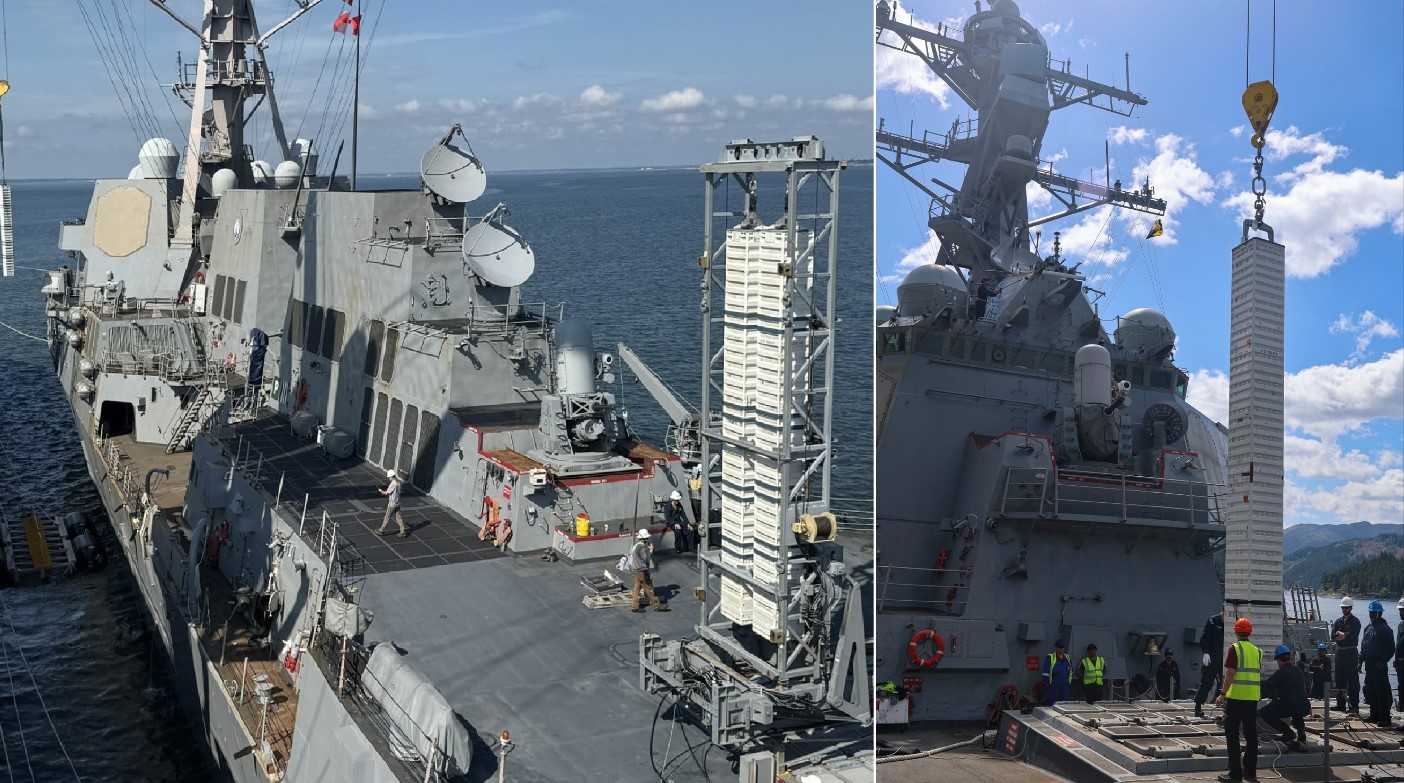
During the demonstration, the Ticonderoga-class cruiser USS Chosin (CG 65) was fitted with the TRAM system, while the dry cargo and ammunition ship USNS Washington Chambers (T-AKE 11) transferred a missile canister to the cruiser using cables stretched between the vessels.
Sailors aboard USS Chosin then used the hydraulically powered TRAM mechanism to raise the canister into a vertical position and lower it into an empty MK 41 VLS cell.
The successful demonstration marked one of the Navy’s most important achievements in advancing practical at-sea missile reloading.
Large Scale Exercise 2025 Expanded Testing
The Navy continued testing the concept during Large Scale Exercise 2025, its annual global exercise focused on evaluating command-and-control systems, logistics operations, and emerging capabilities.
During the exercise, a crane-equipped support vessel successfully conducted the simultaneous reloading of both forward and aft VLS magazines on an Arleigh Burke-class destroyer while the ships were moored at sea.
The event demonstrated the potential for expeditionary logistics teams to rapidly replenish missile inventories outside traditional port facilities and provided valuable operational data for future development.
Future Testing Planned for Additional Weapon Systems
Recent budget documents released in May 2026 indicate that the Navy intends to expand testing beyond VLS-equipped surface combatants.
Future trials are expected to examine at-sea reloading methods for attack submarine torpedoes, anti-ship missiles, and other munitions using expeditionary support docks and related logistics infrastructure.
These efforts are part of a broader initiative aimed at improving the Navy’s ability to sustain combat operations in contested maritime environments where access to fixed facilities may be restricted.
Timeline of Key VLS Rearming Developments
| Year | Milestone | Description |
|---|---|---|
| July 2024 | Land-Based TRAM Demonstration | Successful testing of the TRAM prototype at Naval Surface Warfare Center, Port Hueneme Division. |
| October 2024 | At-Sea TRAM Demonstration | USS Chosin and USNS Washington Chambers successfully demonstrated the transfer and loading of a VLS missile canister at sea. |
| 2025 | Large Scale Exercise 2025 | Simultaneous reloading of both VLS magazines on a destroyer from a crane-equipped vessel while moored. |
| May 2026 | Budgetary Commitments | Navy outlined plans to test expeditionary support docks for reloading VLS cells, torpedoes, and other munitions. |
| FY2027 | NDAA House Markup | House Armed Services Committee directed the Navy to provide a detailed briefing on progress, challenges, and investment requirements. |
Congressional Oversight Continues
The House Armed Services Committee approved its FY2027 NDAA markup in early June 2026, advancing the legislation for further consideration.
By requiring a detailed briefing on at-sea VLS rearming efforts, lawmakers aim to assess the Navy’s progress in developing a capability that could significantly enhance fleet endurance and operational flexibility during future maritime conflicts. The briefing will also help Congress evaluate funding requirements and determine the next steps needed to transition the capability from testing to operational use.
——— End of Article ———