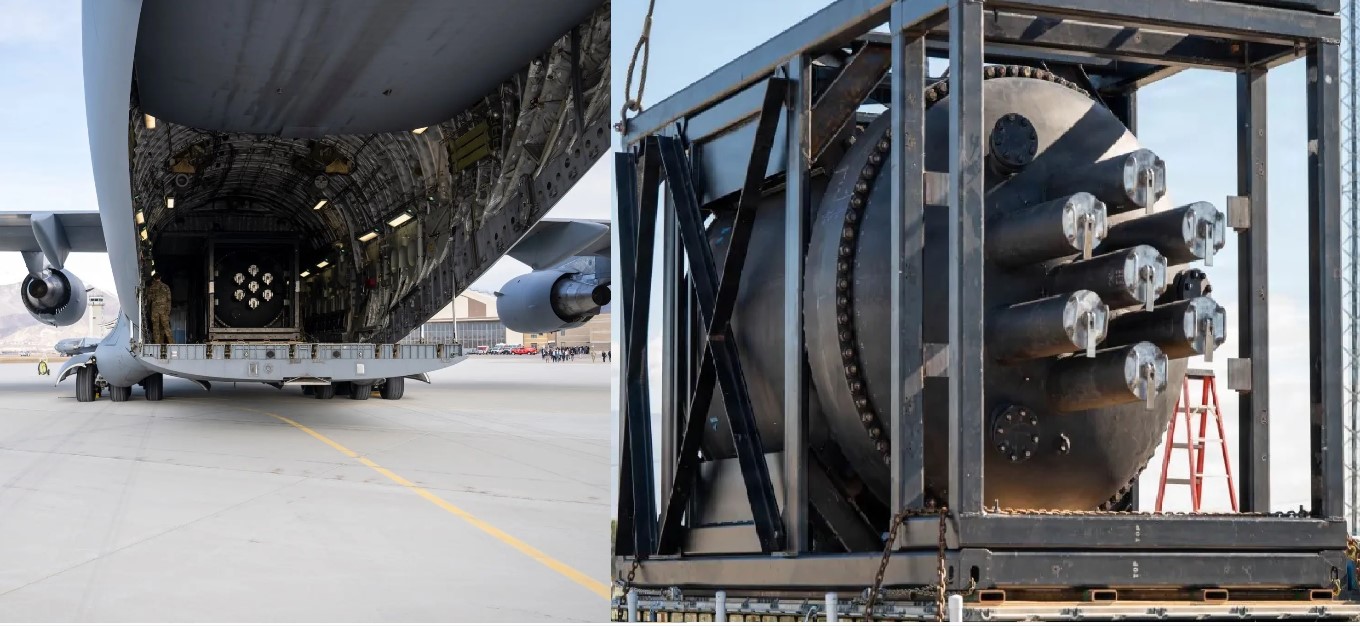
WASHINGTON, D.C., : The United States has completed the first air transport of a modular nuclear microreactor system, marking a logistical milestone in the federal government’s effort to develop deployable nuclear power for defense and civilian use. The operation was carried out jointly by the U.S. Department of Energy (DOE) and the U.S. Department of Defense (DoD) on Sunday, February 15.
A Boeing C-17 Globemaster III heavy transport aircraft moved the unfueled reactor system from March Air Reserve Base in Southern California to Hill Air Force Base in Utah. The flight represented the first transfer of an eight-module system, which is scheduled to be delivered in full through a total of three C-17 sorties.
Operation Windlord Logistics
The mission, designated “Operation Windlord,” was conducted to demonstrate the logistical feasibility of transporting modular nuclear systems by strategic airlift. The reactor components were shipped without nuclear fuel to comply with safety and transport regulations.
The U.S. Air Force currently maintains a fleet of more than 200 C-17 Globemaster III aircraft, supported by 52 modernized Lockheed Martin C-5M Super Galaxy transport aircraft. Defense officials stated that the operation validates the military’s ability to rapidly relocate compact nuclear energy systems to domestic or overseas installations.
Energy Secretary Chris Wright and Undersecretary of Defense for Acquisition and Sustainment Michael Duffey were present during the initial flight to oversee the transfer process.
The Ward250 Microreactor System
The transported reactor unit, known as the Ward250, was manufactured by Valar Atomics, a California-based company. It is classified as a Generation IV nuclear microreactor and has been designed with dimensional and structural specifications that allow for modular transport.
The Ward250 operates using High-Temperature Gas Reactor (HTGR) technology. It employs helium coolant and graphite moderators. The reactor is designed to use TRISO (tristructural isotropic) coated fuel particles, a fuel form engineered to retain fission products within multiple protective layers. The nuclear fuel will be transported separately from the Nevada National Security Site.
According to current operational data, the Ward250 is expected to achieve an initial thermal output of 100 kilowatts, with mechanical capability for output scaling over time. The modular configuration allows the system to be transported in segments and assembled at the deployment site.
Policy Framework and Executive Order 14301
The deployment effort is linked to Executive Order 14301, issued by President Donald Trump, which directs federal agencies to accelerate domestic nuclear deployment to support energy self-sufficiency for military installations, heavy industry, and emergency operations.
The initiative aims to provide independent and reliable electricity generation at U.S. military bases, including forward operating bases and remote facilities. By deploying microreactors directly to installations, the Department of Defense seeks to reduce dependence on local civilian grids and third-party contractors for energy supply.
Officials state that modular reactors are intended to enhance energy resilience, particularly in contingency scenarios where conventional power infrastructure may be disrupted.
Testing and Certification Timeline
Following arrival at Hill Air Force Base, the Ward250 system is scheduled for ground transport to the Utah San Rafael Energy Lab (USREL) experimental site in Orangeville, Utah. At the facility, the Department of Energy will conduct continued testing, validation, and certification procedures.
The Department of Energy has established a regulatory milestone targeting July 4, 2026, for the reactor to achieve criticality — the operational state in which a sustained nuclear chain reaction is established. The date coincides with the 250th anniversary of the United States.
Regulatory and Economic Considerations
The reactor components transported during Operation Windlord did not contain nuclear fuel, consistent with federal safety standards for air shipment. Fuel handling, licensing, and storage remain subject to regulatory review and coordination between federal and state authorities.
Independent nuclear policy analysts have noted that the cost per kilowatt of microreactor systems remains higher than that of conventional commercial nuclear power plants. Oversight organizations, including the Union of Concerned Scientists, have indicated that long-term radioactive waste management frameworks continue to be under negotiation with host states such as Utah.
Federal agencies have stated that ongoing testing and evaluation at the Utah facility will address technical performance, safety validation, and certification requirements before operational deployment decisions are finalized.
The February 15 airlift marks the first completed strategic relocation of a modular nuclear microreactor system by the United States government and forms part of a broader federal program focused on deployable nuclear energy infrastructure.
——— End of Article ———