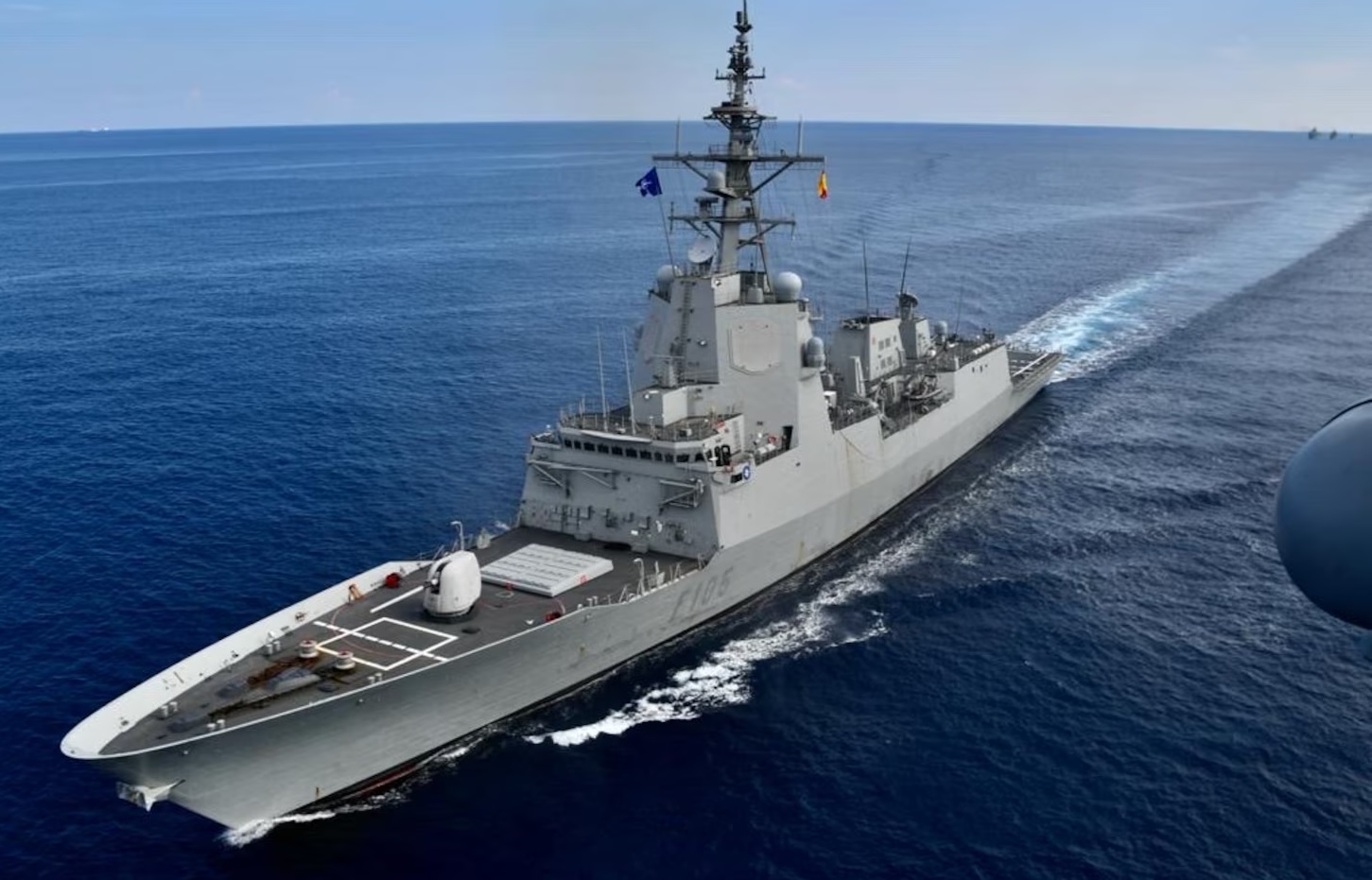
Washington / Madrid : The United States has approved a $1.7 billion Foreign Military Sale (FMS) to Spain to support the modernization of the Spanish Navy’s five F-100 Álvaro de Bazán-class frigates, authorizing a comprehensive upgrade of the ships’ Aegis combat system hardware, software, sensors, and launch systems. The decision is intended to preserve Spain’s fleet air-defense capability, ensure continued interoperability with NATO forces, and extend the operational service life of the class to approximately 2045.
The approved sale covers upgrades across all five ships, which form the backbone of Spain’s current high-end surface combatant force. The modernization focuses on combat-system renewal rather than structural redesign, allowing the frigates to remain operationally relevant while Spain transitions toward the introduction of the newer F-110 frigate class. Spanish defense planning identifies the mid-life upgrade (MLU) as a critical measure to avoid capability gaps during this transition period.
Ship Characteristics and Operational Role
The F-100 Álvaro de Bazán-class frigates were constructed by Navantia at the Ría de Ferrol shipyard and entered Spanish Navy service between 2002 and 2012. The first four ships displace approximately 5,800 tonnes at standard load, while the fifth unit displaces around 6,400 tonnes. All five vessels share an overall length of 146.7 meters and a beam of 18.6 meters.
Propulsion is provided by a combined diesel or gas (CODOG) arrangement, integrating two General Electric LM2500 gas turbines with diesel engines driving two propellers. This configuration allows a maximum speed of roughly 28 knots and a range of about 4,500 to 5,000 nautical miles at cruising speed. Crew complements typically range from 200 to 216 personnel, depending on configuration and mission requirements. The ships were designed for sustained blue-water operations and routine integration into multinational naval task groups.
Within Spain’s future naval force structure, the F-100 class is expected to operate alongside the F-110 frigates, sharing escort and fleet-defense missions while relying on different generations of combat systems. The mid-life upgrade is designed to maintain parity with allied fleets and ensure that the F-100s remain effective contributors to NATO maritime operations.
Mid-Life Upgrade Program and Industrial Framework
In parallel with the U.S. FMS authorization, Spain has outlined a long-term mid-life upgrade (MLU) program for the F-100 class with an estimated total value of €3.2 billion over approximately 120 months from execution. The work is centered at Navantia’s Ría de Ferrol shipyard and is structured as a phased industrial effort extending over roughly a decade.
Spanish planning documents estimate an average annual economic impact of about €215 million and approximately 3,500 jobs, including direct, indirect, and induced employment. The program is linked to Spain’s Industrial and Technological Plan for Security and Defense, approved in April, and combines military sustainment objectives with broader industrial, technological, and environmental considerations. Environmental compliance and efficiency improvements are included among the stated goals of the upgrade.
The primary objective of the MLU is to eliminate identified obsolescence across combat systems, sensors, and support equipment while increasing commonality among onboard systems. The program aims to extend the operational life of all five ships to around 2045 without requiring fundamental changes to hull or propulsion architecture.
Design Foundations and Upgrade Capacity
The Álvaro de Bazán-class was engineered in the 1990s to integrate the Aegis combat system within a frigate-sized hull, making it the first European surface combatant class designed from the outset around Aegis requirements. The ships feature a steel hull and superstructure configured to support the fixed AN/SPY-1 phased-array radar panels, with sufficient power generation, cooling capacity, and stability margins.
Machinery is mounted on resilient foundations to reduce acoustic signatures, supporting anti-submarine warfare (ASW) operations. Hull and superstructure shaping incorporates measures to reduce radar cross-section compared with earlier Spanish escorts. Internal layouts were designed with space, weight, and power margins to accommodate future upgrades, enabling successive combat-system modernizations without major structural modifications.
Combat System and Weapons Integration
The F-100 frigates were designed as multi-mission escorts with primary roles in fleet air defense, surface warfare, and anti-submarine operations, with a strong emphasis on interoperability with allied navies. The core of their combat capability is a 48-cell Mk 41 Vertical Launching System (VLS), supporting SM-2 and RIM-162 Evolved Sea Sparrow Missile (ESSM) interceptors for area and point air defense.
A 127 mm Mk 45 naval gun provides surface engagement and naval gunfire support, integrated with ship fire-control systems. Anti-ship warfare is handled through dedicated missile launchers, while two Mk 32 torpedo tubes support lightweight torpedoes for ASW missions. Each ship operates an embarked SH-60 Seahawk helicopter, extending sensor reach and undersea warfare capability. Defensive systems include electronic warfare equipment, decoy launchers, and a towed torpedo countermeasure system.
Under the approved FMS package, modernization elements include five shipsets of the Mk 41 Baseline VIII VLS, five shipsets of next-generation surface search radar, and ultra-high-frequency satellite communications radio terminal systems to support long-range connectivity. Navigation and timing resilience are enhanced through the inclusion of GPS Miniature Precision Lightweight Receiver Engines (M-Code).
Additional components include AN/SRQ-4 Ku-band hardware and materials to support upgrading the NIXIE SLQ-25A torpedo countermeasure to the SLQ-25E standard. The scope also covers Mk 331 torpedo setting panels and Mk 32 surface vessel torpedo tube upgrades to maintain torpedo employment and control functions. U.S. Government support for the Mk 45 Mod 2 and Mod 2B gun weapon system is included to ensure continued integration with the modernized combat system.
Aegis Combat System Background
The Aegis combat system was developed in the United States beginning in the late 1960s in response to the growing threat posed by high-speed anti-ship missiles and massed air attacks against surface fleets. The program followed the cancellation of earlier naval air-defense concepts and emphasized the integration of radar detection, tracking, command-and-control, and weapon guidance into a single architecture.
Development centered on fixed phased-array radar technology, advanced computing, and automated threat evaluation, enabling continuous surveillance without mechanical antenna rotation. The first operational Aegis installations entered service in the early 1980s aboard U.S. Navy cruisers, later expanding to destroyers and export customers. Over successive software and hardware baselines, the system evolved beyond area air defense to include surface warfare coordination and ballistic missile defense roles.
Aegis integrates sensors, weapons, and command functions through centralized computers and automated decision logic. Core elements include the AN/SPY-1 multifunction phased-array radar, the Mk 99 fire-control system, command-and-decision computers, weapon control components, and interfaces with the Mk 41 VLS. The radar conducts simultaneous search, track, and missile guidance functions, while digital processors manage data fusion and threat evaluation. Missile engagements rely on continuous data exchange between radar arrays, fire-control illuminators such as the AN/SPG-62, and interceptors from the Standard Missile family, enabling multiple concurrent engagements.
Global Aegis Fleet Context
The Aegis combat system is installed on a wide range of surface combatants operated by the U.S. Navy and allied navies. U.S. platforms include Ticonderoga-class cruisers and Arleigh Burke-class destroyers, while allied operators include Japan, Spain, Norway, South Korea, Australia, and Canada. Variants of the system have also been adapted for land-based missile defense roles using similar radar, command, and launcher components.
Although ship sizes and missions vary, all Aegis-equipped platforms share common combat-system principles, software lineage, and missile interfaces. Data links such as Link-11 and Link-16 support interoperability among Aegis ships and other allied units. As of the mid-2020s, more than one hundred Aegis-equipped ships are active worldwide, with additional vessels planned or under construction.
The U.S. approval of the $1.7 billion Foreign Military Sale enables Spain to align its F-100 mid-life upgrade with the broader Aegis user community, ensuring technical compatibility, sustained air-defense capability, and continued relevance of the Álvaro de Bazán-class frigates through the mid-21st century.
——— End of Article ———