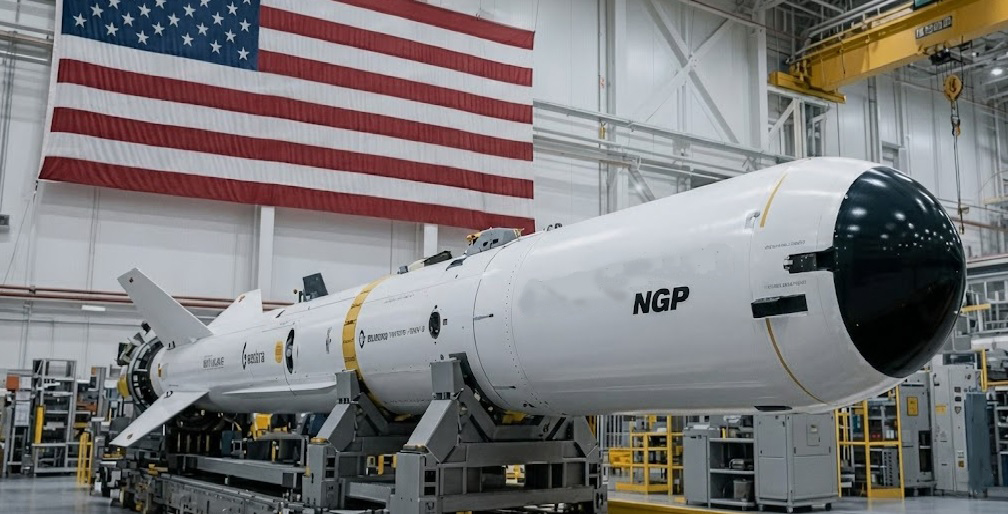
WASHINGTON : The U.S. Air Force is moving forward with development of the Next Generation Penetrator (NGP), a new hard-target defeat weapon intended to replace the GBU-57 Massive Ordnance Penetrator (MOP). The decision follows operational use of the 30,000-pound GBU-57 earlier this year and reflects updated requirements tied to future bomber platforms and evolving electronic warfare conditions.
The program is being managed by the Air Force Life Cycle Management Center (AFLCMC), which has awarded a two-year contract to Applied Research Associates (ARA), headquartered in New Mexico, to lead overall system design, prototyping and testing. Boeing, the original manufacturer of the GBU-57, is partnering on development of the tail kit assembly and will support integration of the complete munition configuration.
Operational Context and Program Acceleration
The Department of Defense began examining concepts for a successor to the GBU-57 more than a decade ago. However, the requirement gained urgency following “Operation Midnight Hammer” (June 2025), during which U.S. Air Force B-2 Spirit bombers conducted strikes against deeply buried Iranian nuclear facilities at Fordow and Natanz.
During that operation, 14 GBU-57 Massive Ordnance Penetrators were employed against hardened underground targets. Post-strike assessments identified operational constraints associated with the weapon’s size and platform compatibility. The GBU-57, weighing approximately 30,000 pounds, can only be carried by the B-2 Spirit and is limited to two weapons per sortie.
In cases involving heavily reinforced structures, multiple munitions were required to be delivered sequentially into the same impact point to achieve the intended structural damage. The NGP program is structured to address these constraints by reducing weapon weight, improving precision, and expanding compatibility with future bomber platforms.
Weight Reduction and Platform Integration
Procurement documentation specifies that the NGP warhead must weigh 22,000 pounds or less, representing a reduction of roughly one-third compared to the GBU-57. The size and weight limits are aligned with integration requirements for the B-21 Raider stealth bomber, which is expected to carry one NGP per mission under current planning assumptions.
The reduced form factor is also intended to allow potential integration with additional platforms as future force structure evolves. While the GBU-57 is exclusive to the B-2 fleet, the NGP is being designed with broader compatibility considerations, subject to certification and testing.
Guidance and Accuracy in Contested Environments
The NGP will incorporate advanced guidance and navigation systems designed to operate effectively in GPS-degraded or denied environments. The requirement reflects operational lessons from recent conflicts involving electronic interference and satellite navigation disruption.
The Air Force has specified a terminal Circular Error Probable (CEP) of 2.2 meters (7.2 feet) or less, ensuring high accuracy even under contested conditions. The guidance architecture is expected to reduce reliance on standard GPS signals, though specific subsystem configurations have not been publicly disclosed.
Smart Fuzing and Penetration Enhancements
A key feature of the NGP will be the integration of “void-counting” smart fuzes. These embedded sensors are designed to detect internal cavities or hollow spaces within rock, reinforced concrete, or underground structures. By measuring density changes during penetration, the fuze system can determine the optimal detonation depth to maximize internal structural damage.
The munition is required to deliver a combination of blast, fragmentation, and specialized penetration effects. The design objective is to enhance effectiveness against Hard and Deeply Buried Targets (HDBT), including facilities protected by reinforced concrete, steel structures, and natural rock overburden.
Propulsion and Stand-Off Capability
Unlike the unpowered GBU-57, which relies on gravity and release altitude to generate kinetic energy, contracting documents indicate that the NGP may incorporate a rocket motor or booster.
If implemented, this propulsion system would provide stand-off strike capability, enabling bomber aircraft to release the weapon from greater distances outside advanced air defense coverage. Increased impact velocity from a booster could also improve penetration depth prior to detonation.
Development Timeline and Budget
For fiscal year 2026, the Air Force has requested $73.7 million to support research and development activities for the NGP program. Funding will cover ground-based sub-scale testing, full-scale static testing, engineering refinement, and prototype validation.
Under the current contract, Applied Research Associates (ARA) and Boeing are tasked with delivering approximately 10 sub-scale prototypes and three to five full-scale test articles within an 18- to 24-month timeframe.
The Air Force plans to conclude the prototype demonstration phase by the end of fiscal year 2027. If program milestones are achieved, the Next Generation Penetrator is expected to transition into production and ultimately replace the concluding GBU-57 production line, maintaining U.S. capability to engage hardened and deeply buried targets while aligning with next-generation bomber requirements.
——— End of Article ———