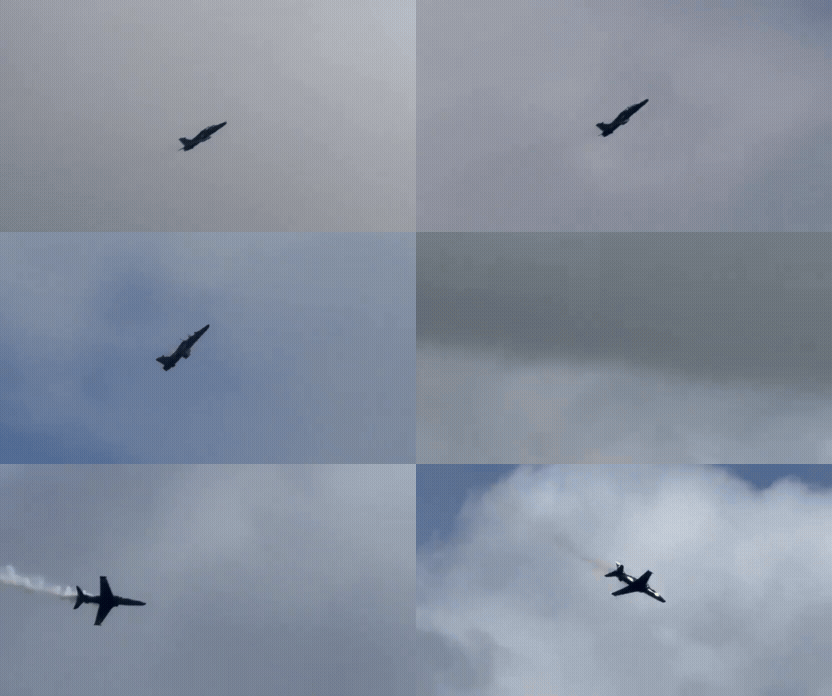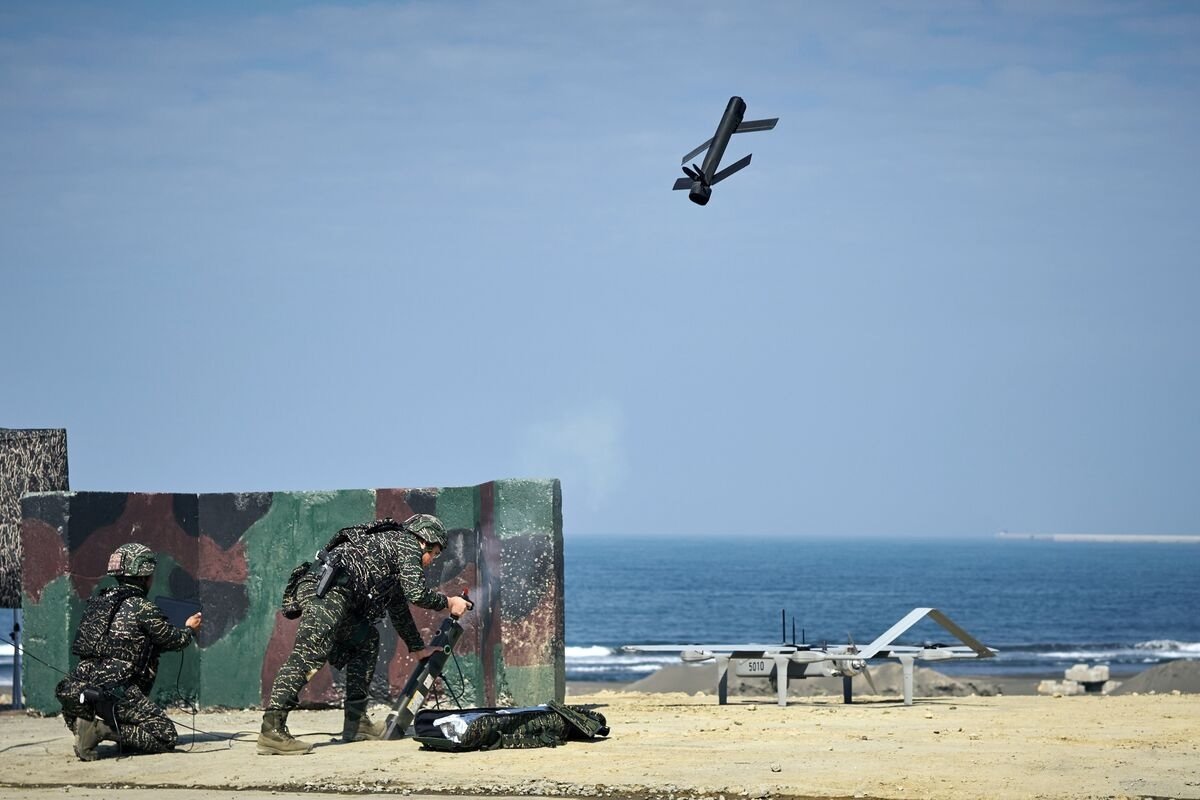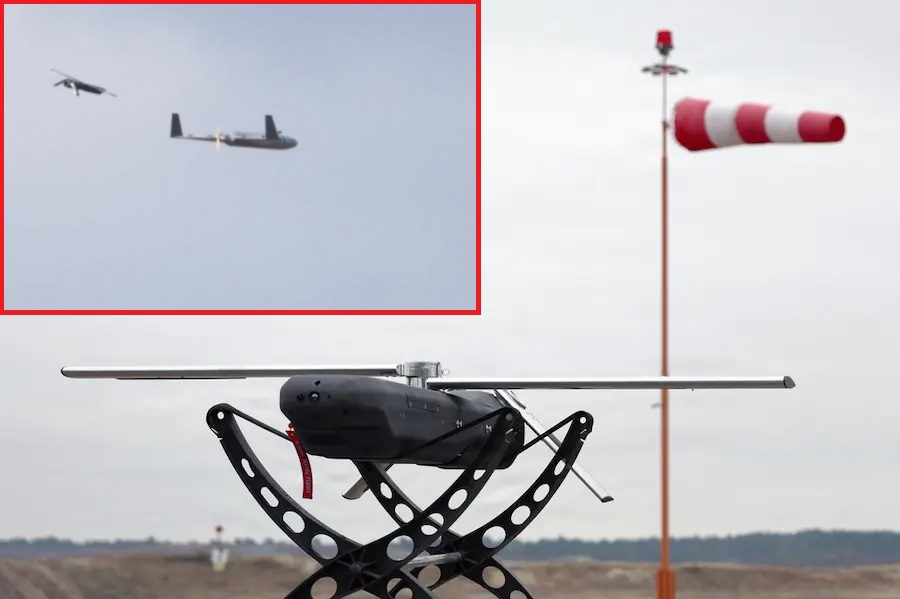
SEMBACH, Germany — June 01, 2026 : The U.S. Army’s 52nd Air Defense Artillery Brigade (52d ADA BDE) has conducted developmental testing of the Skyhammer interceptor during the Project Bullfrog exercise series in Europe, evaluating the system’s role in strengthening layered air and missile defense against drones and low-speed cruise missile threats.
The testing forms part of the brigade’s broader effort to identify cost-effective air defense capabilities for forward-deployed forces across the European and African theaters. Brigade personnel worked alongside engineers and operational planners to assess Skyhammer’s flight control, performance, and integration potential within existing air defense networks.
Developed by UK-based Cambridge Aerospace, Skyhammer is designed as a lower-cost interceptor intended to address growing operational concerns over the use of expensive missile systems against low-cost aerial threats such as one-way attack drones. Modern air defense systems often rely on high-value interceptors to destroy targets that are significantly cheaper to produce, creating operational and budgetary challenges.
Founded in late 2024 by aerospace specialist Steven Barrett and former UK Defence Secretary Grant Shapps, Cambridge Aerospace developed Skyhammer to support layered air defense at lower cost. The jet-powered, tube-launched interceptor weighs approximately 18 kilograms, has a range exceeding 30 kilometers, and can reach speeds of around 700 kilometers per hour, or approximately Mach 0.58.
During Project Bullfrog, soldiers and technical teams evaluated how Skyhammer could improve defensive depth, increase magazine capacity, and expand engagement options against aerial threats within an integrated defense architecture.
The testing is linked to the Eastern Flank Deterrence Initiative (EFDI), a NATO-supported operational concept led by U.S. Army Europe and Africa (USAREUR-AF) and NATO Allied Land Command. The initiative focuses on the use of unmanned and minimally manned systems supported by integrated mission command networks that process live operational data to improve battlefield decision-making and force coordination.
Capt. Kurt Blumeyer, Weapons Evaluation Test Cell Officer for the 52nd Air Defense Artillery Brigade, said the testing enabled soldiers and developers to assess operational requirements and evaluate emerging technologies against identified defense gaps.
“The threat is adapting quickly, and our formations must move with the same urgency,” Blumeyer said. “These tests allowed Soldiers and developers to work side by side, identify operational requirements, and evaluate whether emerging technology can help close real gaps in the current defense design.”
Cambridge Aerospace officials said the exercise provided operational feedback to support refinement of the interceptor for military use.
Chris Sylvan, Chief Commercial Officer and co-founder of Cambridge Aerospace, said feedback from brigade personnel contributed to understanding how the system could be adapted to operational requirements.
“This partnership with the 52nd Air Defense Artillery Brigade allowed us to put Skyhammer in front of Soldiers who understand the threat and the mission,” Sylvan said. “Their feedback was direct, operationally grounded, and invaluable as we continue refining the system for real-world use.”
Alongside Skyhammer, the brigade is also working with Cambridge Aerospace on Starhammer, a higher-speed interceptor intended for counter-cruise missile operations. Starhammer is described as a solid-rocket-powered interceptor capable of speeds up to Mach 2 with a range of approximately 10 kilometers.
Maj. Cody Davis, Operations Officer for the 52nd ADA Brigade, said the Army is seeking to expand magazine depth for both counter-drone and counter-cruise missile operations while reducing overall costs.
“Along with increasing magazine depth amongst c-UAS capabilities, we are looking to do the same in the counter cruise missile space, at a low cost, to augment our exquisite interceptors,” Davis said. “Currently, we are planning to integrate Starhammer into existing joint-force and European multinational exercises.”
Brigade officials emphasized that the developmental testing does not represent a procurement or fielding decision. Following the recent tests, the U.S. Army’s Global Tactical Edge Acquisition Directorate (G-TEAD) is expected to invite Cambridge Aerospace to participate in a formal operational assessment scheduled for this summer.
The assessment will evaluate Skyhammer under operational conditions relevant to current and future ground-based air defense requirements and provide additional data on potential integration and future employment.
Through Project Bullfrog, the 52nd Air Defense Artillery Brigade continues to evaluate emerging technologies intended to strengthen air defense capabilities and improve protection of critical assets across Europe and Africa.
——— End of Article ———