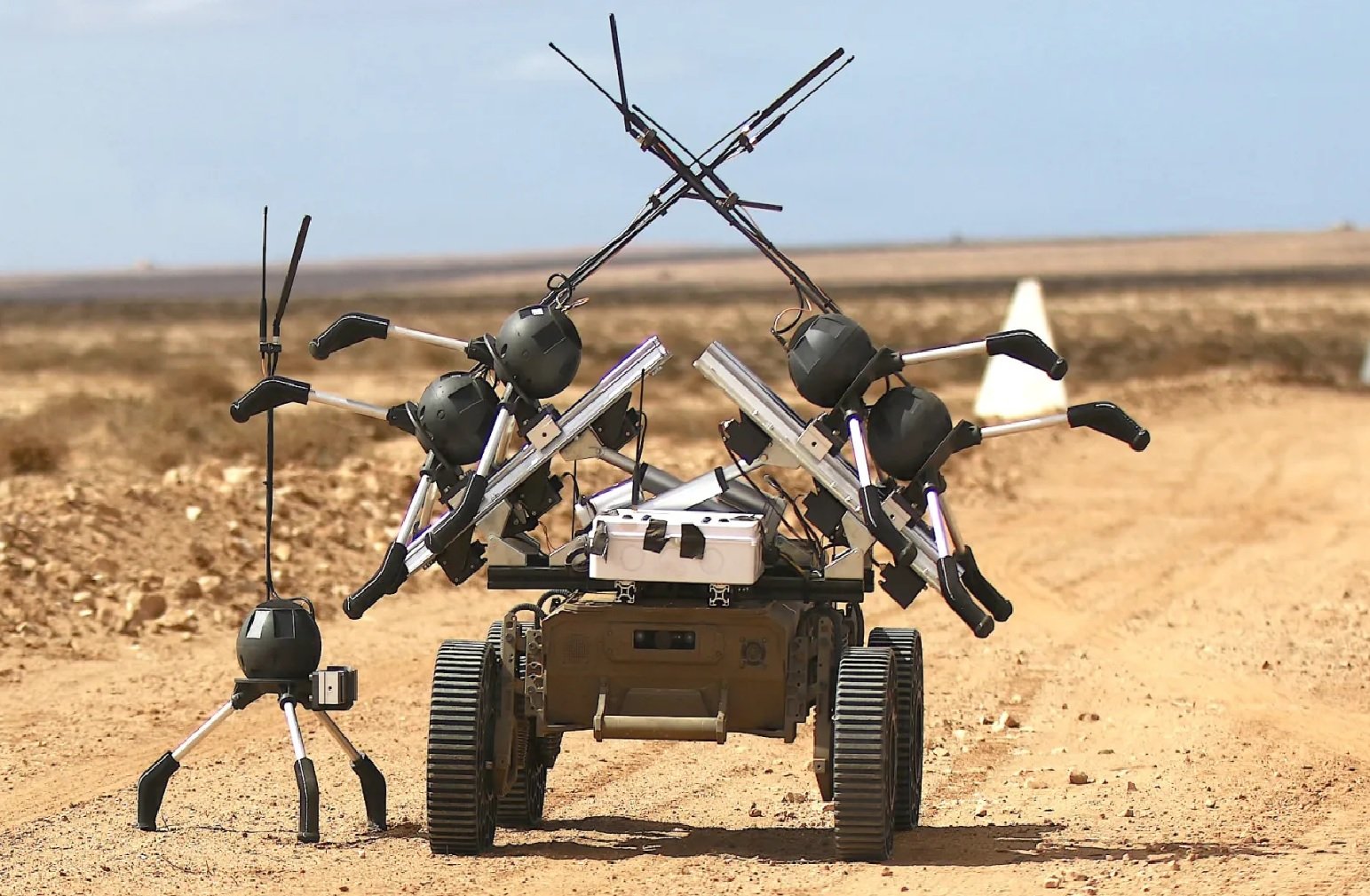
Tan-Tan, Morocco – The U.S. Army has tested the FireAnt, a compact four-wheeled uncrewed ground vehicle (UGV), to deploy ground sensors for detecting hostile drones during a joint military exercise with Moroccan forces.
The trials took place from October 3 to 14, 2026, at the Multidomain Training Area in Tan-Tan under the NANO ACE II programme. The Army released details on November 19, following preliminary evaluations in Yuma, Arizona, completed in September. More than 10 U.S. defense companies participated alongside American and Moroccan soldiers.
Developed by Swarmbotics AI, FireAnt is a modular 4×4 robotic vehicle designed for electronic warfare, reconnaissance and one-way attack missions. It can also operate in semi-autonomous groups using the company's ANTSNet control software.
During the Morocco trials, FireAnt carried six deployable ground sensors, mounted on two angled side rails. Three sensors were fitted on each side and released onto the ground as the vehicle moved into position. Each sensor landed upright on three short legs. The Army has not disclosed their exact detection range or technical specifications.
The Army has also tested other sensor configurations, including Maple Seeds radiofrequency sensors developed by MaXentric Technologies and the FireFLY passive acoustic system supplied by Invariant Corporation and Hyperion Technology Group.
Testing Autonomous Counter-Drone Systems
NANO ACE II evaluated whether robotic vehicles could navigate rough terrain while operating under electronic warfare jamming. The exercise also included Group 1 uncrewed aircraft as targets. On October 9, an autonomous counter-drone system was used to defeat a drone.
The trials were conducted under the Army's Operation Jailbreak, which aims to connect different vehicles, sensors and software through a shared network. The objective is to improve threat detection and provide soldiers with a clearer picture of battlefield activity.
Using small robots to deploy sensors reduces the need for soldiers to enter exposed forward positions. Multiple vehicles can distribute sensors across wider areas, while passive systems can detect threats without continuously transmitting signals. Connected sensors can also provide early warnings and help cue longer-range radars and counter-drone weapons.
Morocco Supports U.S. Army Technology Development
The Multidomain Training Area offers open electromagnetic spectrum, relatively uncongested airspace and rugged terrain for testing military technologies. The exercise involved the Army Test and Evaluation Command (ATEC), U.S. Army Central, U.S. Africa Command (AFRICOM), Southern European Task Force-Africa (SETAF-AF) and other Army organizations.
Col. Woodrow D. Miner of SETAF-AF said the trials allow military units and industry to test systems in contested environments. Maj. Kyle Rau of ATEC highlighted their potential to reduce soldiers' workload and keep them away from dangerous areas.
The testing site is part of the planned Africa Multidomain Training and Experimentation Center (AMTEC). It is expected to support the African Lion 2027 exercise as a proof of concept, ahead of the full Tan-Tan training center's planned completion around 2030.
The Army has used unattended ground sensors for decades, including during Operation Igloo White in Vietnam. It has also explored deploying sensors using aerial drones and high-altitude balloons.
However, connecting different platforms and processing large volumes of sensor data remain major challenges. The Army is looking at artificial intelligence and machine learning to help filter information and provide actionable intelligence.
The growing use of drones and robotic systems in Ukraine and other conflicts has increased military interest in smaller ground robots. The NANO ACE II trials will help the Army assess how FireAnt and similar platforms can support counter-drone operations and battlefield surveillance.
——— End of Article ———