The U.S. Army has received the first prototype of the M1E3 Abrams main battle tank from General Dynamics Land Systems (GDLS), a milestone that signals a fundamental redesign of the Abrams platform after more than four decades of incremental upgrades. The prototype was delivered to the Army in mid-December 2025, according to defense and congressional reporting, and will now enter a phase of intensive testing and soldier evaluation.
The M1E3 program represents the Army’s most ambitious effort in years to rethink the balance between firepower, protection, mobility, and sustainment. Rather than continuing with ever-heavier upgrades to the existing M1A2 Abrams series, the Army has opted for a clean-sheet approach focused on weight reduction, digital architecture, and adaptability to rapidly evolving battlefield threats.
A Program Born From A Strategic Reset
The origins of the M1E3 Abrams trace back to September 2023, when the U.S. Army formally ended development of the M1A2 SEPv4 and announced it would pursue a new variant designed from the outset to be lighter and more modular. That decision reflected lessons drawn from recent conflicts, where loitering munitions, drones, and advanced anti-tank weapons have challenged traditional armor concepts and placed a premium on mobility, active protection, and electronic integration.
In May 2024, General Dynamics Land Systems was tasked with advancing the design using digital engineering tools and mature technologies. The company drew heavily on concepts demonstrated earlier in its AbramsX technology demonstrator, accelerating development and allowing the Army to move from requirements to a physical prototype in roughly two years—an unusually compressed timeline for a major armored vehicle program.
Key Features Of The M1E3 Prototype
The first M1E3 prototype reflects this shift in philosophy. The Army has indicated the design targets a combat weight of about 60 tons, significantly lighter than the heaviest Abrams variants, improving strategic mobility and tactical mobility. A hybrid-electric propulsion system is central to the concept, promising reduced fuel consumption, extended operational range, and quieter operation, including the ability to power onboard systems without running the main engine.
One of the most consequential changes is the adoption of an unmanned turret paired with an autoloader. This configuration reduces crew size and alters internal layout, allowing more efficient use of space while supporting a higher sustained rate of fire. The tank retains a 120mm main gun, with provisions for future upgrades as new ammunition and gun technologies mature.
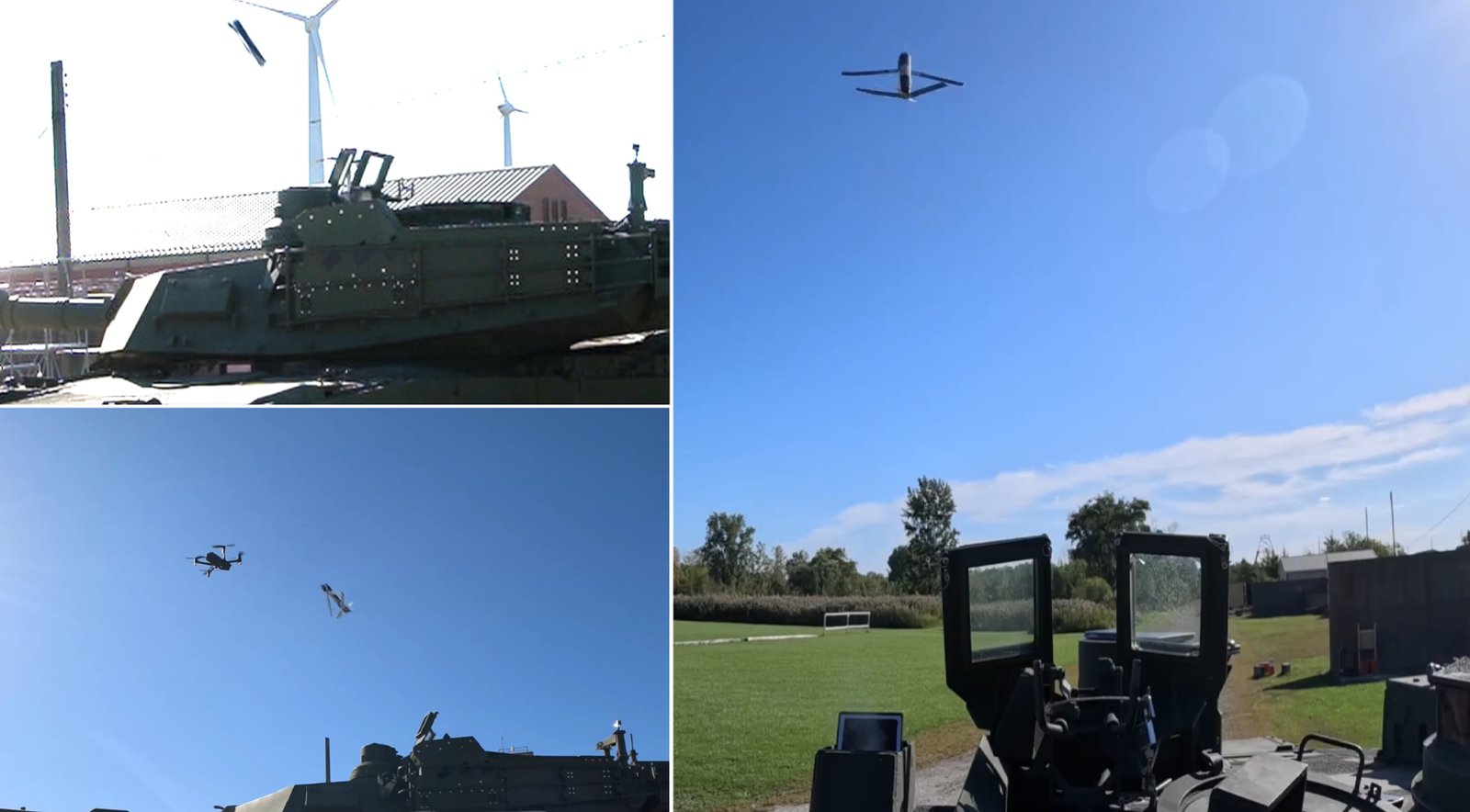
Survivability is addressed through a layered approach. The M1E3 integrates an Active Protection System (APS) designed to intercept incoming missiles, rocket-propelled grenades, and other threats, including those launched by small aerial platforms. Modular armor packages can be tailored to specific missions, while additional survivability measures focus on countering loitering munitions and reducing visual, thermal, and acoustic signatures.
At the heart of the vehicle is a Modular Open Systems Architecture (MOSA), enabling rapid insertion of new hardware and software throughout the tank’s service life. Advanced sensors and artificial-intelligence-enabled processing are intended to improve target detection, identification, and engagement speed, while simplifying future upgrades and reducing dependence on lengthy redesign cycles.
Testing And Development Ahead
With the first prototype now in Army hands, the program moves into a critical evaluation phase. Additional M1E3 prototypes are expected to be delivered in 2026, allowing soldiers to assess the vehicle in realistic training environments. Feedback from crews will shape decisions on ergonomics, automation levels, sustainment concepts, and the maturity of systems such as the autoloader and active protection suite.
Army officials have emphasized that the M1E3 will be developed iteratively. Some capabilities may be fielded in stages, reflecting both technical risk and the desire to move useful improvements into service as quickly as possible. While earlier projections placed initial operational capability closer to the end of the decade, the accelerated pace of development has raised the possibility of earlier fielding, depending on test results and funding decisions.
Implications For The Abrams Fleet
The arrival of the M1E3 prototype underscores a broader transformation in how the U.S. Army approaches heavy armor. By prioritizing reduced logistical demands, lower fuel consumption, and easier upgrades, the service aims to make armored formations more deployable and sustainable in future conflicts. At the same time, the shift toward active protection systems and digital technologies introduces new challenges in maintenance, training, and electronic resilience.
For now, existing Abrams variants will remain in service, and production of upgraded models is expected to continue in parallel. The M1E3 Abrams is not an immediate replacement for the current fleet but a foundation for the next generation of U.S. main battle tanks.
As testing begins, the first M1E3 Abrams prototype stands as a tangible marker of the U.S. Army’s modernization strategy, reflecting a decisive shift toward mobility, adaptability, and technological resilience on a battlefield increasingly shaped by precision weapons, autonomy, and rapid technological change.
——— End of Article ———