ADELPHI, Maryland — June 09, 2026 : The U.S. Army has successfully demonstrated a new quantum sensor capable of measuring the full three-dimensional direction of radio-frequency (RF) signals, a development that could enhance battlefield awareness, electronic warfare, and signal detection capabilities.
Developed by scientists at the U.S. Army Combat Capabilities Development Command (DEVCOM) Army Research Laboratory (ARL), the system is the first quantum sensor capable of determining not only the strength of an electromagnetic signal but also its complete 3D orientation and direction of travel. The achievement was detailed in a paper published in Physical Review Applied.
Designed for Complex Electromagnetic Environments
Modern military operations rely heavily on radio-frequency signals generated by drones, communication networks, radar systems, electronic warfare equipment, and autonomous platforms. At the same time, military forces face increasing challenges from electronic jamming, spectrum congestion, and GPS disruption.
According to Army researchers, the new sensor can determine the direction of incoming radio signals with an accuracy of approximately two degrees, allowing military forces to more precisely locate signal sources.
The capability could help troops identify hostile drone operators, enemy communication nodes, and electronic warfare systems operating on the battlefield.
How the Quantum Sensor Works
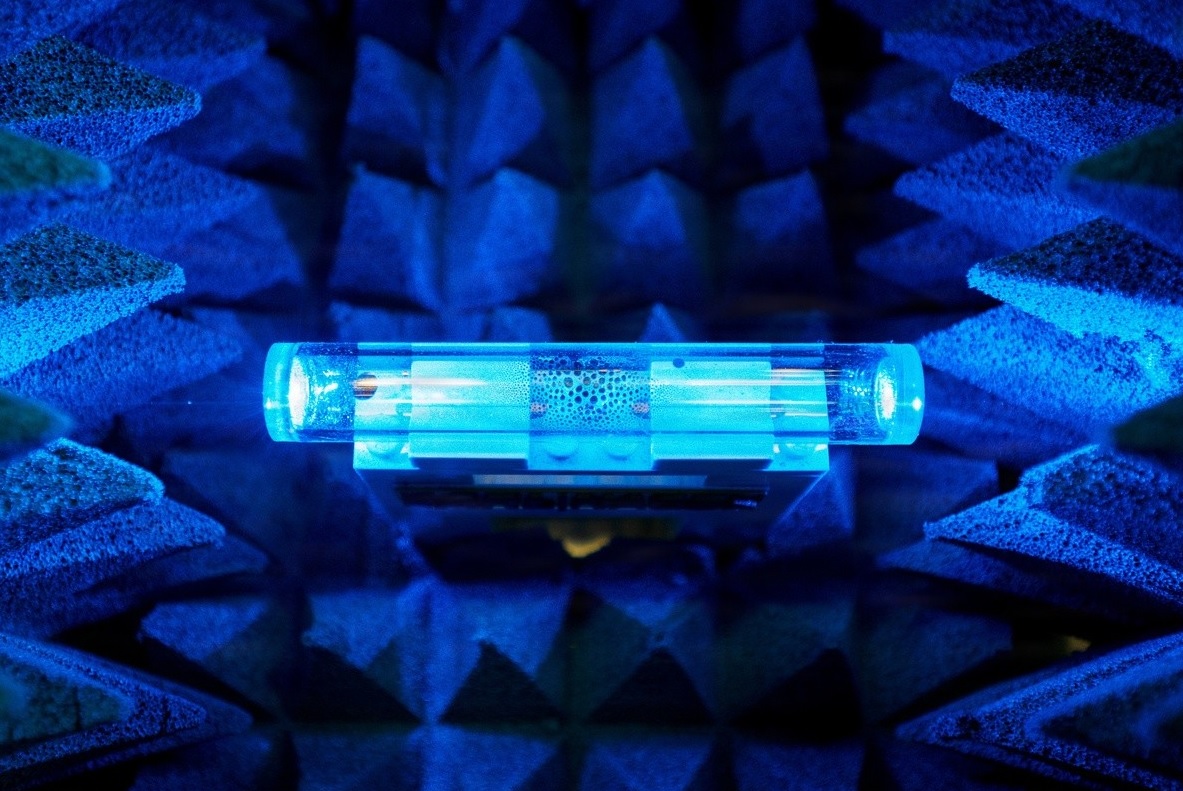
The sensor uses a small glass vapor cell containing rubidium atoms. Researchers use laser beams to excite the atoms into highly sensitive Rydberg states, making them extremely responsive to electric fields.
When a radio-frequency signal passes through the cell, it interacts with the atoms. By analyzing the atoms' response, researchers can determine not only the presence and strength of the signal but also its precise three-dimensional direction and movement.
Compact Design with Wide Frequency Coverage
Unlike conventional antennas that are often designed for specific frequency ranges, the Army's quantum sensor is only a few centimeters in size and can operate across an extremely broad spectrum.
Researchers say the system can detect frequencies ranging from direct current (DC) to terahertz bands using a single sensing package, reducing the need for multiple antennas and receivers.
“Our work in quantum science is about giving our Soldiers new ways to sense and understand the world around them,” said David Meyer, a research physicist at ARL. “This research opens the door to detecting and pinpointing signals over a broad frequency range in a single sensing package, even in the most challenging environments.”
Potential for GPS-Denied Operations
One of the key advantages of the technology is its ability to function in GPS-denied environments. Because the sensor operates independently of satellite navigation systems, it could strengthen Position, Navigation and Timing (PNT) capabilities during operations where GPS signals are jammed or unavailable.
The technology could provide commanders with additional situational awareness in contested electromagnetic environments.
Future Military Applications
Army researchers believe the sensor could support a range of missions, including electronic warfare, intelligence gathering, communications monitoring, drone detection, and spectrum management.
“The modern battlefield is an extremely complicated radio frequency environment,” Meyer said. “With the proliferation of autonomous systems, there can be hundreds of distinct signal sources. Having a single sensor platform that covers the entire radio-frequency spectrum and can measure the 3D direction of those fields represents a potentially transformative capability.”
The Army Research Laboratory, which has invested in quantum science since the early 1990s and became one of the Army's Quantum Information Science Research Centers in 2023, will now focus on transitioning the technology from laboratory testing to field-deployable military systems.
The successful demonstration marks an important step in the Army's efforts to develop advanced quantum sensing technologies for future battlefield operations.
——— End of Article ———