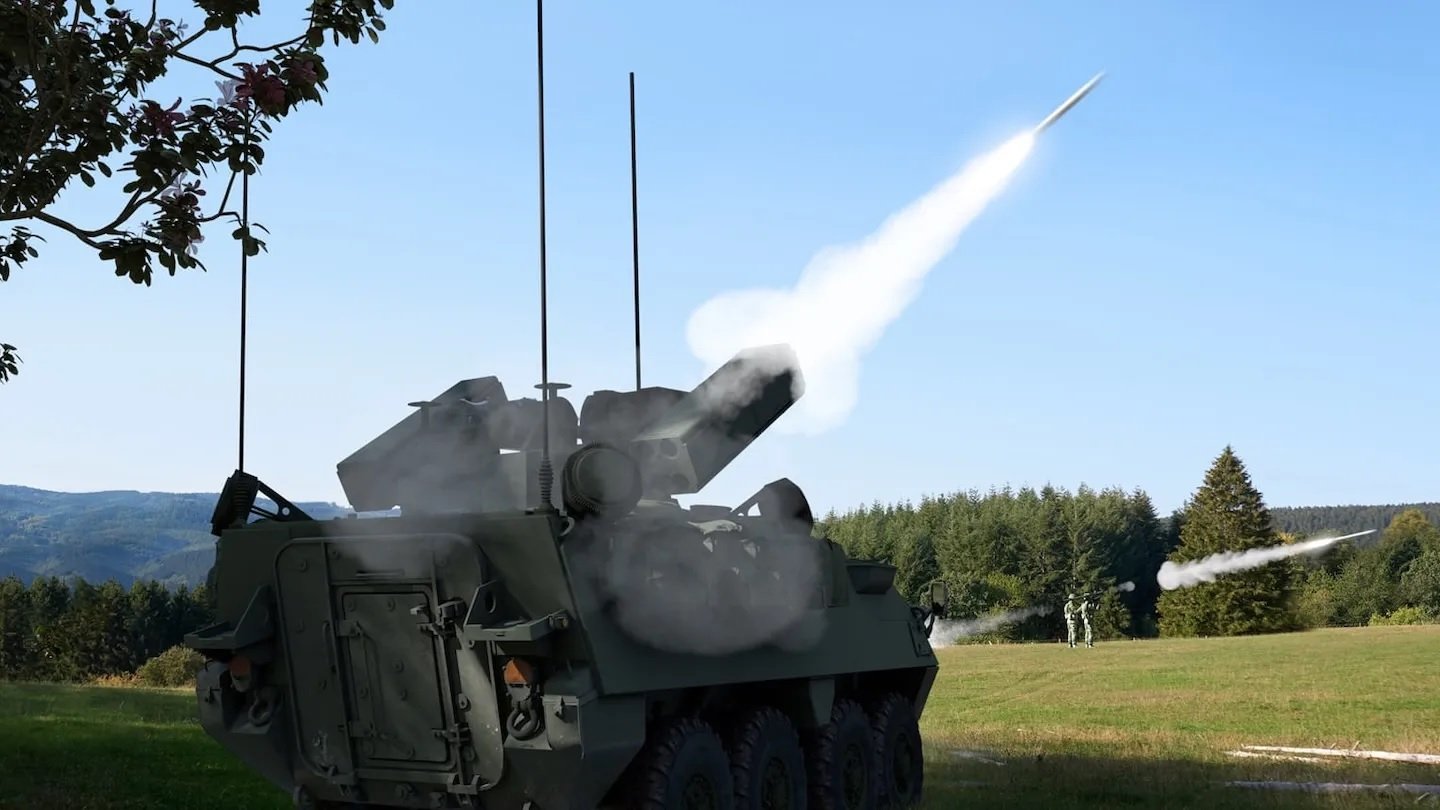
Washington —The US Army is seeking a third defence contractor to compete in the Next Generation Short Range Interceptor (NGSRI) programme, which aims to replace the ageing FIM-92 Stinger man-portable air defence system (MANPADS).
The Army issued solicitation MOSAIC-26-04 on November 20, 2026. Existing competitors Lockheed Martin and Raytheon are already developing prototypes. The Army plans live-fire demonstrations in May and June 2027, followed by prototype development agreements in September 2027.
Interested companies must submit questions by November 30 and solution briefs by December 20, 2026. Participants must be US companies or foreign firms partnered with US businesses holding SECRET-level security clearance.
NGSRI Missile Requirements
The replacement must feature a day-and-night fire-and-forget guidance system capable of engaging helicopters, fixed-wing aircraft and drones.
Its requirements include:
-
Group 2 UAS: 9.5–25 kg takeoff weight.
-
Group 3 UAS: 25–600 kg takeoff weight.
-
Compatibility with existing FIM-92 Stinger gripstocks.
-
Integration with the Army's SGT STOUT system (formerly M-SHORAD), mounted on Stryker vehicles, and the Marine Corps' MADIS air defence system.
Live-Fire Tests and Production Targets
The Army has established three pass/fail firing tests:
-
Hit a Hot Plate-type thermal target suspended at least 25 metres above ground at 6 km.
-
Intercept a Group 3 drone approaching head-on at 5–8 km.
-
Intercept a Group 3 drone crossing at a 90-degree angle at 5–8 km.
For comparison, the existing Stinger has an engagement range of approximately 4.8 km from the SGT STOUT platform.
Competitors must deliver at least 50 developmental missiles and six launchers within three months of the trials. They must also demonstrate the ability to begin low-rate production by the fourth quarter of FY2028.
The Army expects production estimates for at least 11,000 missiles and 2,200 launchers over 10 years, with target prices below $200,000 per missile and per launcher. Successful target interception will be the primary selection criterion, followed by delivery schedules, production readiness and cost.
Lockheed Martin and Raytheon Testing Progress
Lockheed Martin conducted the first flight test of its QuadStar NGSRI missile on January 13, 2026, at White Sands Missile Range, New Mexico. It completed a seeker-characterisation test in May and demonstrated an automated final assembly line at its Grand Prairie, Texas, facility in April.
The company claims its missile can more than double the Stinger's range, probability of kill and resistance to countermeasures in certain scenarios. It also uses artificial intelligence (AI) and machine learning (ML) for target recognition and guidance in electronic warfare environments.
Raytheon, an RTX business and the original Stinger manufacturer, completed a ballistic test on February 2, 2026, demonstrating shoulder-launched firing and drone tracking.
On July 15, Raytheon reported multiple guided NGSRI missile launches at Dugway Proving Ground, Utah, achieving direct hits on representative aerial targets. The company claims its missile offers greater speed and range than the Stinger.
NGSRI Programme Funding
The Army's FY2027 budget request includes $215 million for NGSRI development, within a broader $460.9 million request for manoeuvre short-range air defence, compared with $296 million requested for the broader programme in FY2026.
The addition of a third competitor would provide the Army with another missile option and increase competition before selecting a replacement for the Stinger.
Main Source : Defenceblog
——— End of Article ———